+852 46135220

pH
Quick Summary (For Environmental and Industrial Applications)
pH is a fundamental water quality parameter used to characterize the acidity or alkalinity of aqueous systems and plays a critical role in environmental monitoring, wastewater treatment, industrial process control, and regulatory compliance. The glass electrode potentiometric method is widely recommended as the standard approach for both laboratory and field pH measurement due to its accuracy, rapid response, and minimal interference from sample color or turbidity. This method is suitable for routine monitoring and continuous measurement, but reliable results depend strongly on proper electrode condition, calibration, and temperature compensation.
pH is a core water quality parameter that characterizes the acidity or alkalinity of aqueous solutions and is the negative logarithm of hydrogen ion activity. It plays an irreplaceable role in water quality assessment, industrial process control, environmental monitoring, and wastewater discharge compliance. The glass electrode potentiometric method is different from traditional colorimetric methods, which have become the standard method for both laboratory and field pH measurements. It’s faster, more accurate and reliable, and has very few interferences by sample color or turbidity. From an engineering perspective, pH is not only a descriptive parameter but also a key control variable. In wastewater treatment plants, pH directly affects biological activity, chemical precipitation efficiency, corrosion behavior, and the toxicity of ammonia and heavy metals. As a result, pH is routinely monitored both online and in laboratory settings.
1. Core Measurement Principle: Potentiometry and the Nernst Equation
1.1 Physicochemical Definition of pH
pH=−lgaH+
where aH+ is the activity of hydrogen ions rather than their concentration. In dilute solutions, activity is approximately equal to concentration. The typical pH range is 0–14, and at 25 °C, pH 7 represents neutrality.
1.2 Principle of Electrode-Based pH Measurement — Formation of an Electrochemical Cell
The pH electrode method is a form of potentiometric analysis. It determines pH by measuring the electromotive force (EMF) of an electrochemical cell composed of:
l Indicator electrode: a glass electrode sensitive to hydrogen ions
l Reference electrode: an electrode providing a stable and constant potential
In practice, these components are usually integrated into a combined pH electrode.
1.3 Nernst Equation and Temperature Effects
The overall EMF (E) of the cell is governed by the Nernst equation. For hydrogen ions, the Nernst equation is expressed as:
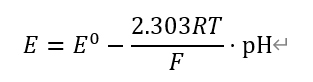
Where:
l E: measured electromotive force
l E⁰: standard potential, related to electrode properties, internal solution, and reference potential
l R: gas constant (8.314 J·mol⁻¹·K⁻¹)
l T: absolute temperature (K)
l F: Faraday constant (96485 C·mol⁻¹)
l 2.303RT/F is known as the Nernst slope (S), which is approximately 59.16 mV/pH at 25 °C.
This equation has two critical points:
u Linearity: The EMF is linearly related to pH, with a slope of −S.
u Temperature dependence: The slope varies with temperature (approximately 0.2 mV/pH per °C). Therefore, modern pH meters must incorporate temperature compensation, either input manually or automatic calibrate by temperature compensation (ATC) probes.
Because both electrode response and solution chemistry are temperature-dependent, pH values measured without proper temperature compensation may not be comparable across different sampling conditions. For this reason, automatic temperature compensation (ATC) is generally recommended for routine and regulatory pH measurements.
1.4 Necessity of Two-Point Calibration
From the equation: E= E⁰−S⋅pH, both E⁰ and S must be known to calculate pH. A single measurement cannot determine both parameters simultaneously. And by measuring the potentials E1 and E2 of two standard buffer solutions with known pH values pH1 and pH2, the actual slope and standard potential can be calculated:
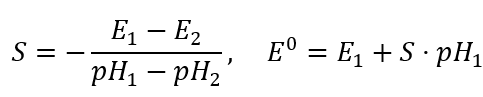
This procedure constitutes two-point calibration, after which the instrument can accurately measure unknown sample pH values. While two-point calibration is sufficient for most routine measurements, three-point calibration is recommended when measuring samples with a wide pH range or when high-accuracy results are required, such as in environmental compliance testing or research applications.
1.5 Electrode Selecting for pH Measurement
From a practical standpoint, electrode selection should match the sample matrix. General-purpose glass electrodes are suitable for most aqueous samples, while low-resistance or specialized electrodes are recommended for low-ionic-strength waters, high-alkalinity samples, or continuous monitoring applications.
1.6 Typical Application Scenarios
The glass electrode potentiometric pH method is commonly applied in:
ü Wastewater treatment process monitoring and discharge compliance
ü Surface water, groundwater, and drinking water analysis
ü Industrial process control (chemical, food, pharmaceutical industries)
ü Laboratory quality control and research applications
2. Key Factors: Structure of the Combined pH Electrode
Modern combined pH electrodes integrate the glass electrode and reference electrode into a single probe. The main components are summarized below:
Component | Function | Notes |
Glass-sensitive membrane | Made of special lithium glass; forms a hydrated silica gel layer (10⁻⁴–10⁻⁵ mm). H⁺ exchange at the interface generates the membrane potential. | Fragile; must not be scratched, impacted, or allowed to dehydrate. |
Internal reference system | Ag/AgCl electrode immersed in a constant-pH internal buffer (e.g., pH 7 phosphate buffer). | Provides a stable internal reference potential. |
Reference system | Typically an Ag/AgCl electrode in saturated KCl solution, connected to the sample via a liquid junction. | Liquid junction blockage is a common failure point. |
Electrode body and cable | Protects internal components and transmits the signal. | Must be kept dry and clean to prevent leakage currents. |
3. Standardized Operating Procedure and Technical Considerations
3.1 Instrument and Electrode Preparation
Electrode inspection and activation
l New or long-term dry-stored electrodes should be soaked in 3 mol/L KCl or pH 4.00 buffer for at least 8 hours to let the glass membrane get full hydration.
l Routine-use electrodes should be rinsed with deionized water and gently blotted dry (do not wipe).
Preparation of standard buffer solutions
l Use certified pH buffer standards within their validity period (e.g., pH 4.00 potassium hydrogen phthalate, pH 6.86/7.00 mixed phosphate, pH 9.18/9.21 sodium tetraborate).
l Prepare using freshly boiled and cooled deionized water to remove dissolved CO₂.
l Apply the bracketing principle: the sample pH should fall between the calibration buffers.
3.2 Instrument Calibration
1.Turn on the pH meter and allow 15–30 minutes for stabilization.
2. Set temperature compensation to the sample temperature (or immerse the ATC probe together with the electrode)
3. First-point calibration (offset adjustment)
ü Submerge the electrode in the first buffer (e.g., pH 6.86).
ü Record the value after the reading is stable (30–60 s).
ü Confirm or input the buffer value and complete calibration.
4.Second-point calibration (slope adjustment)
ü Wash and blot the electrode.
ü Submerge in the second buffer (e.g., pH 4.00).
ü Complete calibration after the reading is stable. Then check and verify the slope (ideal: ~100% at 25 °C; acceptable: 95–105%).
5.Calibration check: Verify with a third buffer (e.g., pH 9.18). Acceptable deviation should be ≤ ±0.1 pH (≤ ±0.02 pH for high-precision work).
3.3 Sample Measurement
l Samples should be collected in sealed containers to minimize CO₂ exchange, especially for low-buffer-capacity waters such as pure or rainwater.
l On-site measurement is strongly recommended.
l Wash the electrode with deionized water and sample before measurement.
l Submerge the electrode, stir gently, avoid air bubbles, and record the stabilized reading.
4. Method Advantages, Interferences, and Error Sources
Advantages
ü High accuracy and precision (up to 0.01 pH units)
ü Wide applicability (acidic, alkaline, colored, turbid, colloidal samples)
ü Non-destructive and suitable for continuous monitoring
ü Simple operation with modern digital instruments
Major Error Sources and Control Measures
Error Source | Mechanism | Control Measures |
Temperature | Affects slope and sample pH | Use temperature compensation |
Liquid junction potential | Large ionic differences (e.g., pure water) | Use low-resistance junctions or add KCl |
Electrode hysteresis | Slow response when switching pH ranges | Rinse thoroughly; recalibrate |
Sodium error | High Na⁺ at pH > 10 | Use low-sodium-error electrodes |
Acid error | Very strong acids (pH < 1) | Use specialized electrodes |
Glass membrane damage | Scratches, fouling | Proper cleaning or replacement |
Improper calibration | Contaminated buffers | Use fresh certified buffers |
* Is the Glass Electrode Method Recommended for pH Measurement?
For most water quality applications, the glass electrode potentiometric method is generally recommended due to its accuracy, versatility, and compatibility with both laboratory and online monitoring systems. However, for samples with extreme temperatures, strong oxidizing agents, or highly viscous matrices, specialized electrodes and additional validation are recommended to ensure measurement reliability.
5. Quality Control and Quality Assurance (QC/QA)
l Daily or batch-wise two-point calibration
l Post-calibration verification with a third buffer
l Continuous monitoring of electrode slope (95–105%)
l Parallel sample analysis (≥ 10%)
l Certified reference materials as quality control samples
l Comprehensive electrode maintenance records
6. Instruments Selecting for pH Measurement
From an instrument selection perspective, reliable pH measurement requires a stable electrochemical meter, high-input-impedance signal processing, and consistent electrode maintenance. Instruments supporting automatic temperature compensation, multi-point calibration, and electrode diagnostics are generally preferred for routine monitoring.
Conclusion
The potentiometric pH measurement method based on glass electrodes is a precise analytical technique founded on well-established electrochemical principles. Accurate pH determination depends on a deep understanding of the Nernst equation and temperature compensation, proper execution of two-point calibration, meticulous electrode maintenance, and accurate identification and reduction of interferences.
pH is not like other parameters which require chemical digestion, its measurement relies primarily on the condition of the physical sensor and strict control of measurement conditions. As a fundamental and critical water quality parameter, reliable pH measurement forms the cornerstone of water analysis, playing a decisive role in assessing chemical status, ecological health, and process control performance.
Recommend water quality testing instruments for pH:
Accurate pH determination relies primarily on the performance of the electrochemical measuring system rather than on chemical reagents. For routine water quality monitoring, a typical configuration includes an electrochemical pH meter combined with a combined glass electrode and temperature probe, offering a practical balance between accuracy, ease of use, and long-term stability.
pHS-220 Series Benchtop pH Meters
RAT Muti Series Portable Electrode Method Water Quality Analyzer