+852 46135220

Chemical Oxygen Demand (COD) is one of the most widely used parameters in water and wastewater monitoring. Because of its central role in regulatory compliance, process control, and operational optimization, thousands of laboratories worldwide perform COD analysis every day.
Photometer-based COD analysis typically using dichromate digestion followed by colorimetric endpoint measurement, which is often regarded as a “standard solution.” However, in real-world engineering applications, it performs extremely well in some scenarios, while in others it can produce unreliable results or even fail entirely. Photometer water quality analyzer for COD testing is a fixed-wavelength, endpoint colorimetric method whose accuracy is determined primarily by digestion chemistry and workflow control, not by optical complexity. Understanding when photometer-based COD is suitable and when it is not—is critical for laboratories seeking to balance data reliability, cost, and operational efficiency.
This article provides a clear explanation from an engineering and laboratory management perspective.
1. What “Photometer-based COD” Really Means
Photometer-based COD analysis refers to COD determination using the following steps:
l Standard dichromate digestion
l Fixed-wavelength photometer-based measurement of either:
ü Trivalent chromium (Cr³⁺) generated during oxidation (≈610–620 nm)
ü Remaining hexavalent chromium (Cr⁶⁺) after digestion (≈440 nm)
Key characteristics:
l Fixed wavelength endpoint measurement
l Predefined calibrated curves
l Batch digestion followed by rapid photometer-based reading
Important clarification: The photometer itself is not the core determinant of COD accuracy. COD accuracy fundamentally depends on sample preparation and digestion quality, not on optical sophistication. Therefore, photometer-based COD should be evaluated as a process-controlled analytical system rather than as an optical measurement problem.
2. Scenarios Where Photometer-based COD Performs Extremely Well
Photometer-based COD works extremely well when the wastewater matrix is stable, digestion conditions are controlled, and standardized methods are followed consistently.
2.1 Routine Municipal Wastewater Monitoring
Photometer-based COD performs best under the following conditions:
ü COD concentration within the standard method range
ü Relatively stable sample matrix
ü Chloride concentration within maskable limits (typically <2000 mg/L)
ü Daily or high-frequency testing requirements
Engineering rationale:
l COD digestion chemistry is well established
l Fixed-wavelength measurement is fully sufficient
l High repeatability supports trend analysis and process control
Typical applications:
u Influent and effluent routine monitoring
u Aeration control feedback
u Discharge compliance reporting
2.2 Standardized Regulatory Compliance Testing
For regulatory monitoring, photometer-based COD is highly effective because:
l Most national and international standards specify photometer-based endpoint determination
l Regulators assess method compliance, not instrument sophistication
l When SOPs are followed, results are legally defensible
Key requirement: Regulatory accuracy depends on method discipline, not on replacing a photometer with a spectrophotometer.
2.3 High-Throughput Laboratory Environments
Photometer-based COD excels in laboratories with:
l Large daily sample volumes
l Multiple operators and shift-based operation
l Tight turnaround time requirements
Reasons for success:
ü Built-in methods eliminate wavelength selection errors
ü Direct concentration readouts remove manual calculations
ü Batch digestion combined with rapid reading maximizes throughput
Engineering benefits:
u Reduced human error
u Improved data consistency across operators and time
2.4 Process Control and Trend Analysis
For operational decision-making, photometer-based COD is ideal when:
l Relative change matters more than absolute theoretical accuracy
l Data consistency is critical
l Rapid feedback is required
Engineering insight: In process control, repeatability and stability often deliver more value than marginal gains in theoretical precision.
Photometer-based COD delivers highly reliable results when:
· COD concentration falls within the validated method range
· Wastewater composition is relatively stable
· Chloride and known interferences are properly controlled
· Digestion temperature and time are consistent
· Results are used for routine monitoring, compliance, or trend analysis
3. Scenarios Where Photometer-based COD Starts to Fail
Photometer-based COD starts to fail when chemical interferences, digestion instability, or poor laboratory discipline dominate the uncertainty budget.
3.1 Highly Complex Industrial Wastewater
Photometer-based COD may fail when samples contain:
u Chloride concentrations >2000 mg/L
u Strong reducing agents (e.g., sulfites, sulfides)
u High color or turbidity causing optical interference
u Poorly oxidizable organics (e.g., pyridine, certain aromatic compounds)
Typical failure modes:
l Incomplete oxidation (COD biased low)
l Chloride interference (COD falsely high)
l Optical interference even after filtration (poor absorbance reading)
l Low recovery and unstable results
Mitigation may require:
ü Sample dilution
ü High-chloride reagents with enhanced masking
ü Chlorine correction methods or dedicated high-chloride COD procedures
3.2 Poor Control of Digestion Conditions
Failures are rarely caused by optics, but by pretreatment issues such as:
l Uneven digestion tube temperature (>3 °C variation)
l Insufficient digestion time
l Degraded or incorrectly dosed reagents (e.g., inaccurate dichromate concentration)
l Poor tube sealing leading to sample loss
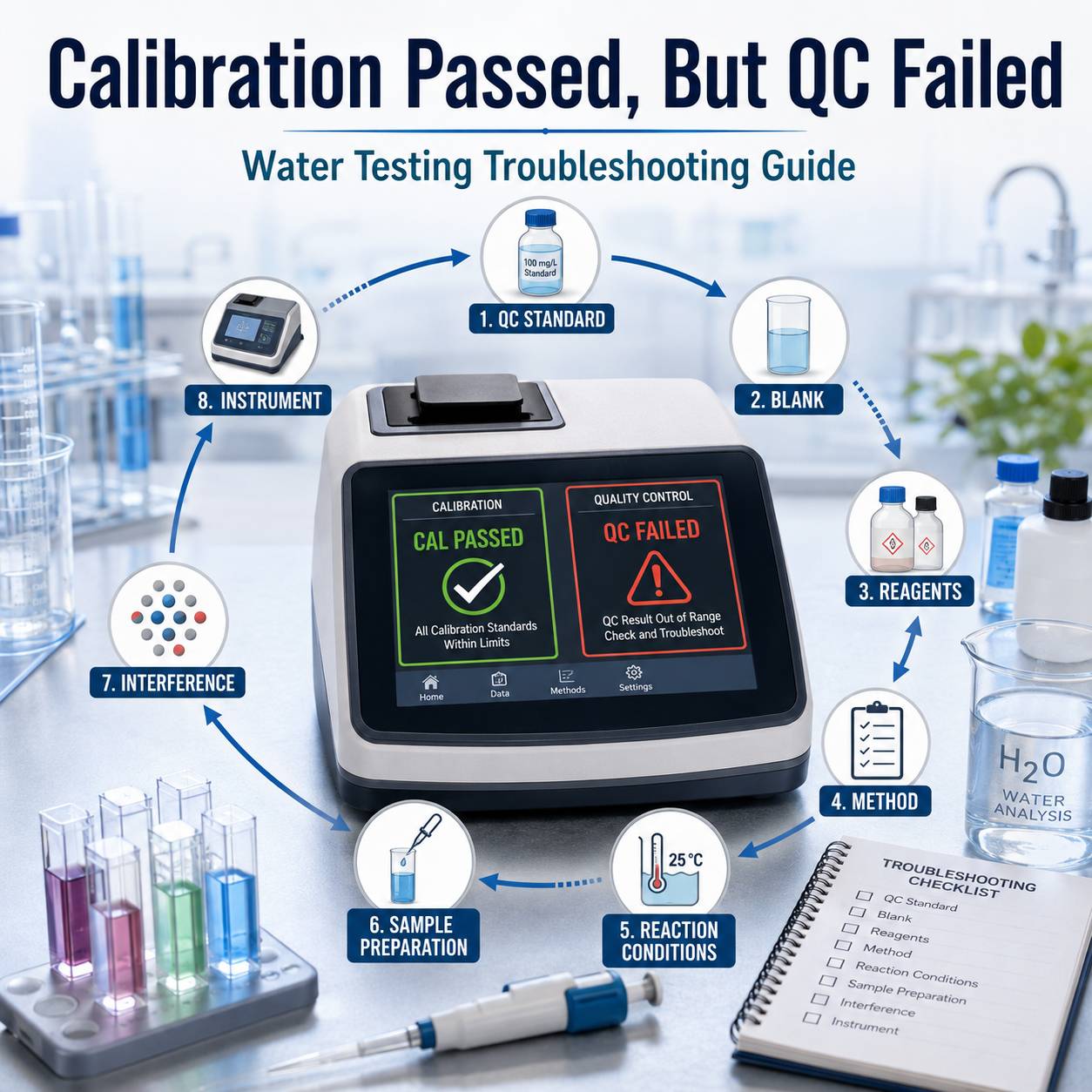
Engineering reality:
More than half of COD errors originate before the sample enters the photometer. A photometer cannot compensate for:
u Incomplete oxidation
u Sample loss during digestion
u Systematic pretreatment bias
Supporting data: Statistics from an industrial wastewater laboratory showed that approximately 65% of failed COD results were traceable to digestion issues (temperature non-uniformity, time control, poor sealing), not photometer-based measurement.
3.3 Low-Concentration or Detection-Limit Applications
Photometer-based COD may be unsuitable when:
l COD <30 mg/L
l Extremely low background levels are required (e.g., Class I surface water standards)
l High dilution factors amplify dilution error
Recommendations for low COD:
ü Use low-range COD reagents and methods
ü Consider TOC as an alternative parameter
ü Apply concentration steps or advanced laboratory methods when necessary
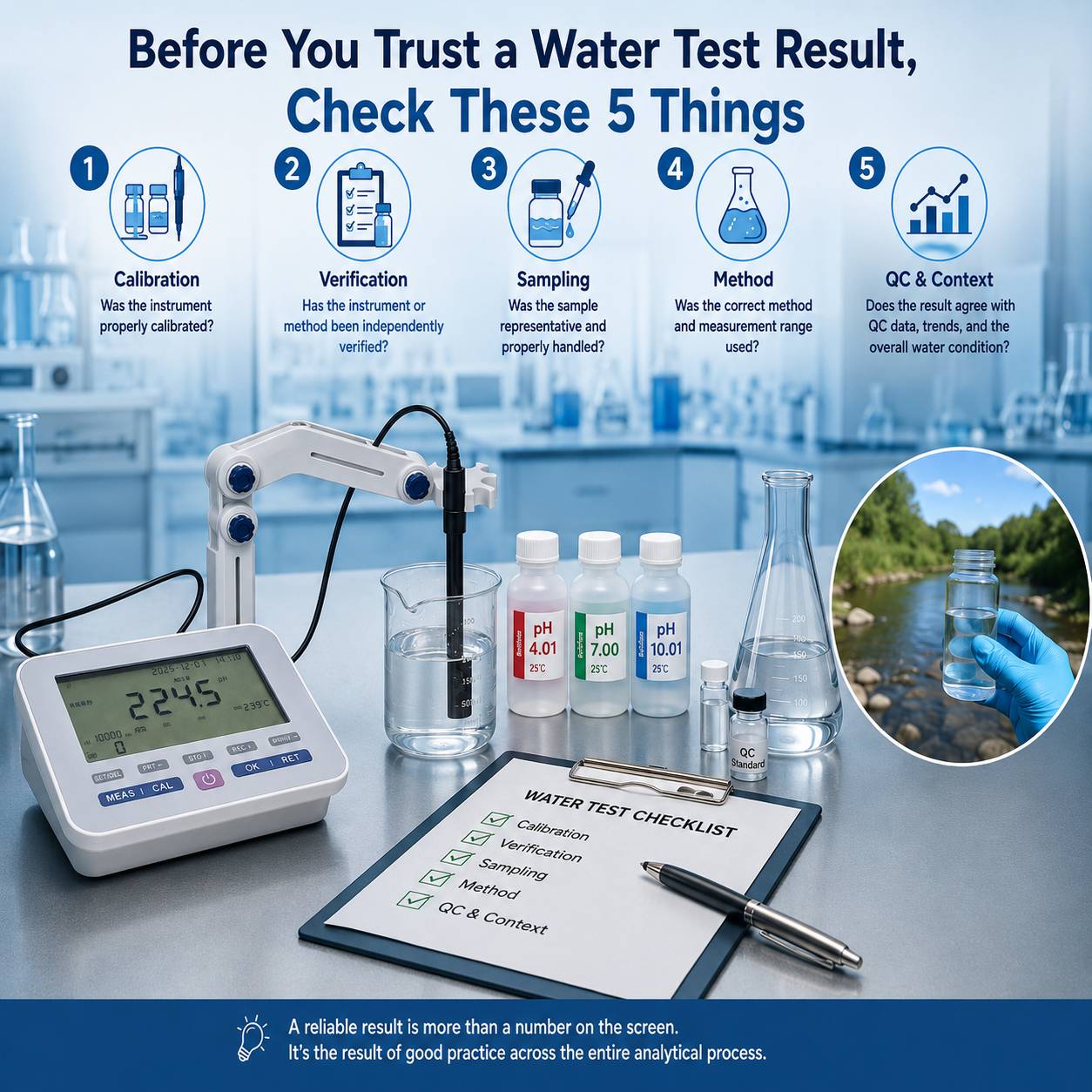
3.4 Laboratories with Weak Quality Control Systems
Photometer-based COD is particularly vulnerable in laboratories that lack:
l Strict sampling and digestion SOPs
l Routine blanks, duplicates, and spike recovery tests
l Calibration verification discipline
l Adequate staff training and accountability
Engineering conclusion:
Photometer-based COD amplifies workflow weaknesses rather than correcting them.
Photometer-based COD becomes unreliable when:
· Chloride concentration exceeds masking capacity
· Strong reducing agents or poorly oxidizable compounds are present
· Digestion temperature, time, or sealing are inconsistent
· COD levels approach the detection limit
· Quality control and operator discipline are weak
4. What Truly Determines COD Accuracy (Not the Photometer)
From an engineering perspective, COD accuracy is determined by the following hierarchy (ranked by importance):
Rank | Factor | Engineering Significance |
1 | Sample representativeness (sampling point, timing, preservation) | Primary uncertainty source |
2 | Digestion completeness and consistency (temperature, time, reagent quality) | Sets accuracy ceiling; >60% of errors originate here |
3 | Interference control (chloride masking, dilution, matrix handling) | Critical for complex samples |
4 | Quality control discipline (blanks, duplicates, standards) | Continuous accuracy verification |
5 | Reduced operator dependency (method binding, automation) | Minimizes human error |
6 | Photometer-based measurement stability | Necessary, but diminishing returns beyond standard compliance |
In routine COD analysis, improvements in sampling, digestion, and quality control yield far greater accuracy gains than upgrading photometer optics beyond standard compliance.
5. Engineering Guidance: Is Photometer-based COD Right for You?
Applicability Matrix:
Scenario | Suitability | Recommended Configuration |
Municipal wastewater, routine monitoring | ★★★★★ Highly suitable | Photometer water quality analyzer + standard digester |
Industrial wastewater, stable matrix | ★★★★☆ Suitable (with validation) | Photometer water quality analyzer + matrix-matched curves |
Industrial wastewater, complex/variable | ★★☆☆☆ Use with caution | Dilution, masking, or alternative methods |
Low COD effluent (<30 mg/L) | ★★★☆☆ Low-range applicable | Low-range COD reagents and methods + strict QC |
Research and method development | ★★★★☆ Flexible | Programmable methods, custom curves |
High-throughput, multi-operator labs | ★★★★★ Highly suitable | Photometer water quality analyzer + batch digester |
6. When to Consider Alternatives or Enhanced Controls
Additional methods or safeguards should be considered when:
l Industrial wastewater matrices are highly variable and unpredictable (such as pharmaceuticals and chemicals)
l COD data are used in legal disputes or forensic investigations (higher-precision methods)
l Results frequently fail recovery or QC acceptance criteria (pretreatment issues need to be investigated)
Conclusion
Photometer-based COD performs exceptionally well within its engineered operating envelope: standardized methods, controlled digestion conditions, and disciplined laboratory workflows.
Its failure is not due to simplicity. It fails when laboratories expect instruments to compensate for weaknesses in sampling, pretreatment, and quality control—something no photometer can do.
In routine water and wastewater testing, COD accuracy is the outcome of process control, not optical sophistication. When methods are well controlled and workflows are designed for reliability, photometer-based COD delivers stable, reliable, and highly actionable data day after day.
Choosing the right COD method is not about selecting the most advanced instrument—it is about selecting the method that best supports real operational needs. For routine monitoring, a photometer-based water quality analyzer perfectly aligned with laboratory workflows is often far more valuable than an overqualified spectrophotometer that is difficult to manage.
Within its engineered operating envelope, a multi-parameter photometer water quality analyzer for COD testing remains one of the most efficient tools for routine wastewater analysis.
Example: iWannaMP Multi-Parameter Photometer Water Quality Analyzer