+852 46135220

Adding another parameter to a routine water testing program may appear to be a simple improvement. A laboratory adds a new reagent, installs another method, updates the reporting template, and begins generating more data. From the outside, the monitoring program now looks more comprehensive.
But a longer parameter list does not automatically create a better testing program. Every additional parameter also creates new requirements:
l Sampling procedures
l Preservation conditions
l Reagents and consumables
l Calibration and quality control
l Analyst training
l Instrument maintenance
l Data interpretation
l Reporting time
l Follow-up actions
If these requirements are not clearly defined, the new parameter may increase workload without improving operational decisions.
This is why routine water testing should not begin with the question: What else can we measure?
A better question is: What additional decision will this measurement help us make?
Before adding another parameter to a routine water testing program, laboratories, water treatment plants, environmental teams, and industrial facilities should ask four practical questions. The short answer is that a parameter should only become part of routine water testing when four conditions are clear: the result supports a defined decision, a threshold or pattern triggers action, the result is available within the required decision window, and the laboratory can maintain a reliable measurement workflow. If one of these conditions is missing, the parameter may be better suited to periodic, screening, or investigative testing.
What Is Routine Water Testing Designed to Do?
Routine water testing is not intended to measure every possible chemical, physical, or biological characteristic of water. Its main purpose is to provide consistent information that supports recurring decisions. A routine water testing parameter is not simply a measurement performed frequently. It is a measurement performed at a planned frequency because its result is connected to a defined decision, an interpretation rule, a required response time, and a controlled analytical workflow. Frequency alone does not make a parameter “routine.” Decision value and workflow reliability do.
Depending on the application, those decisions may include:
l Is the treatment process operating normally?
l Is the water suitable for its intended use?
l Is a discharge approaching a regulatory limit?
l Has contamination entered the system?
l Is corrective action required?
l Should additional confirmatory testing be performed?
l Is the process improving or deteriorating over time?
Routine parameters are therefore selected because they provide useful information repeatedly, not simply because they are scientifically important. For example, pH may be measured routinely because it affects treatment chemistry, corrosion, biological activity, and chemical dosing. Turbidity may be monitored because it helps assess filtration performance and can affect disinfection efficiency. COD may be included in wastewater monitoring because it provides an operational indication of oxidizable pollution load. Conductivity may be useful because it can reveal changes in dissolved ionic content, process water quality, salinity, chemical dosing, or industrial discharge.
These parameters are valuable not only because they can be measured, but because changes in their results can trigger interpretation and action. That distinction is essential. A parameter may be environmentally important but unsuitable for daily routine control. Another parameter may be less comprehensive scientifically but highly useful for fast operational decisions. The purpose of routine testing is not maximum information volume. It is reliable decision support.
A Quick Framework for Selecting Routine Water Testing Parameters
Question | What the laboratory must define | Warning sign |
What decision will the result change? | The operational, regulatory, quality, or investigative decision | The result is reported but rarely used |
What threshold or pattern triggers action? | A limit, trend, deviation, or comparison rule | Nobody knows when follow-up is required |
How quickly is the result needed? | The decision window and required turnaround time | The result arrives after the opportunity to act |
Can the workflow support reliable measurement? | Sampling, method, range, QC, staff, and maintenance capability | The method works only under ideal conditions |
Question 1: What Decision Will This Result Change?
The first question is the most important: If this parameter changes, what decision will the laboratory, operator, engineer, or manager make differently?
A parameter should not be added merely because it appears in an instrument menu, a technical catalogue, a research paper, or another laboratory’s testing list. It should be connected to a defined operational, regulatory, investigative, or quality-related decision.
In practice, most routine water quality measurements support one or more of four decision types:
l Compliance decisions: Is the result within a regulatory or permit requirement?
l Process-control decisions: Should treatment, dosing, aeration, filtration, or another operating condition be adjusted?
l Quality-assurance decisions: Is the water, process, or product remaining within an internal specification?
l Escalation decisions: Does the result justify repeat testing, confirmatory analysis, or a wider investigation?
Defining the decision category helps determine the correct sampling point, testing frequency, method range, turnaround time, and level of quality control.
A Result Without a Decision May Become Passive Data
Many laboratories collect results that are reported, archived, and rarely used. The data may be technically correct, but its operational value is limited because nobody has defined what the result is supposed to influence. For example, a facility may add phosphate testing to its routine program. But several questions remain:
l Is phosphate used to control nutrient removal?
l Is it required for discharge compliance?
l Is it monitored to prevent scaling?
l Is it part of an investigation into eutrophication?
l Is it simply reported because it is available?
These are different purposes. Each purpose may require a different:
n Sampling location
n Testing frequency
n Analytical range
n Detection limit
n Response time
n Interpretation method
Without a clear decision objective, it is difficult to design the method correctly.
One Parameter Can Support Different Decisions
The same parameter may have very different value in different systems. Consider ammonia nitrogen. In a municipal wastewater treatment plant, ammonia may be monitored to evaluate nitrification performance. In drinking water treatment, it may be relevant to source water quality, chloramination, or contamination assessment. In aquaculture, ammonia may be linked to animal health and biological loading. In an industrial discharge, it may be measured primarily for regulatory compliance.
Although the parameter is the same, the decision context is different. That context determines how the parameter should be measured.
A Practical Decision Test
Before adding a parameter, complete this sentence:
We need to measure __________ because the result will help us decide whether to __________.
Examples: We need to measure ammonia because the result will help us decide whether nitrification is operating effectively. We need to measure conductivity because the result will help us identify changes in dissolved salts entering the process. We need to measure phosphate because the result will help us adjust nutrient removal or chemical dosing. We need to measure residual chlorine because the result will help us confirm whether the disinfection target is being maintained.
If the second part of the sentence cannot be completed clearly, the parameter may not yet be ready for routine inclusion. It may still be useful for:
l Periodic surveys
l Troubleshooting
l Research
l Source investigation
l Regulatory confirmation
l Special projects
But that is different from routine testing.
Monitoring objective | Possible parameter | Example decision supported |
Check nitrification performance | Ammonia and nitrate | Adjust aeration, sludge age, or investigate biological inhibition |
Detect changes in dissolved ionic content | Conductivity | Investigate chemical leakage, salinity change, or process contamination |
Evaluate organic loading | COD or BOD | Review treatment loading or process removal performance |
Check filtration performance | Turbidity or suspended solids | Inspect filtration, settling, or solids separation |
Control chemical conditions | pH | Adjust dosing or investigate process instability |
Monitor nutrient removal | Phosphate or total phosphorus | Review biological or chemical phosphorus removal |
Question 2: What Threshold or Pattern Will Trigger Action?
After defining the decision, the next question is: What result, trend, or change will trigger action?
A result becomes operationally useful only when the organization knows how to interpret it. This does not always mean that every parameter needs a single fixed pass-or-fail limit. In many applications, action may be triggered by:
u A regulatory limit
u An internal control limit
u A sudden increase or decrease
u A deviation from the normal operating range
u A repeated trend over several measurements
u A difference between sampling locations
u A relationship between two or more parameters
Regulatory Limits Are Only One Type of Threshold
Some parameters are included because regulations specify maximum or minimum values.
In those cases, the interpretation appears straightforward. However, even regulatory testing requires additional decisions:
l What happens when the result is close to the limit?
l Is repeat testing required?
l Is confirmatory analysis needed?
l Should a new sample be collected?
l How is measurement uncertainty considered?
l Who must be informed?
l What corrective action should follow?
A parameter should not be considered operationally complete merely because a legal limit exists. The laboratory and facility still need a response procedure.
Three Types of Action Triggers
Not every routine parameter needs the same type of threshold. Laboratories should distinguish between three common triggers:
1.Compliance limit: A legal, permit, contractual, or product-specification boundary.
2.Operational control limit: An internal range used to keep the process stable before a compliance failure occurs.
3.Investigation trigger: An unusual change, trend, or relationship that requires additional checking even when the result remains within a formal limit.
These thresholds should not be treated as interchangeable. A result may remain legally acceptable while already showing an operational deterioration that deserves attention.
Operational Thresholds May Be More Useful Than Compliance Limits
Routine process control often depends on internal operating ranges rather than regulatory limits. For example, a wastewater treatment plant may set an internal ammonia warning level well below the discharge limit. This allows operators to investigate changes before a compliance failure occurs.
Similarly, conductivity may not always have a regulatory limit in a particular application, but a sudden increase may indicate:
u Chemical leakage
u Saline intrusion
u Concentrated wastewater discharge
u Failure of a treatment stage
u Cross-contamination
u Deterioration of purified water quality
In such cases, the important trigger is not necessarily the absolute result. It may be the deviation from the normal baseline.
Trends Can Be More Important Than Individual Results
One isolated result rarely tells the whole story. A value may remain within an acceptable range while still showing a gradual deterioration. For example:
u Turbidity may increase slowly over several days.
u Conductivity may rise after each cleaning cycle.
u COD removal efficiency may decline over several weeks.
u pH may become progressively more unstable.
u Ammonia may show repeated morning peaks.
A routine program should therefore define whether it is looking for:
n Absolute limits
n Short-term changes
n Long-term trends
n Location-to-location differences
n Process efficiency
n Recurring patterns
Define the Response Before Routine Testing Begins
For each new parameter, laboratories should document:
1.The expected normal range
2.The warning condition
3.The action condition
4.The person responsible for reviewing the result
5.The required follow-up
6.The escalation procedure
A simple action framework may look like this:
Result or pattern | Interpretation | Typical next action |
Within expected operating range | No evidence of abnormal change | Continue routine monitoring |
Repeated movement toward a warning level | Possible process deterioration | Review trend and operating conditions |
Sudden isolated abnormal result | Possible process event, sampling error, or analytical error | Verify sample, instrument, method, and process conditions |
Close to a regulatory or internal limit | Higher decision risk | Repeat or confirm the measurement according to procedure |
Above an action threshold | Corrective action may be required | Escalate, investigate, and document the response |
Inconsistent with related parameters | Possible interference or incomplete interpretation | Compare with supporting parameters and review the sample matrix |
The exact response will depend on the application, but the principle remains the same: Do not add a routine parameter without defining what the organization will do with the result.
Question 3: How Quickly Is the Result Needed?
The third question is: How soon must the result be available to support the intended decision? This question affects not only the test method but also where and how the measurement should be performed.
The decision window is the maximum period within which a result can still influence the intended action. It may be a few minutes for chemical dosing, several hours for process adjustment, or several days for periodic compliance review. Turnaround time should therefore be defined from the operational decision backward—not from the analytical method forward.
A technically accurate result may still have little operational value if it arrives too late.
Different Decisions Require Different Response Times
Some results are needed within minutes. Examples may include:
n pH adjustment
n Chemical dosing
n Disinfection control
n Process troubleshooting
n Filter performance checks
n Rapid contamination screening
Other results may be acceptable within several hours or by the end of the working day. Examples may include:
l Routine COD analysis
l Nutrient monitoring
l Daily wastewater performance checks
l Batch release decisions
Some parameters may only be needed weekly, monthly, or during specific investigations. Examples may include:
l Long-term source water characterization
l Periodic compliance monitoring
l Specialized trace contaminant testing
l Emerging pollutant surveys
l Detailed confirmatory analysis
Required decision time | Typical testing strategy | Suitable purpose |
Minutes | Field meter, rapid test, or validated online monitoring | Immediate process adjustment or early warning |
Same shift | On-site laboratory method | Routine process control and troubleshooting |
Same day or next day | Laboratory analysis with controlled preparation | Daily performance review or batch decisions |
Several days | Specialized internal or external laboratory analysis | Periodic compliance, confirmation, or investigation |
Weekly or monthly | Scheduled laboratory or third-party testing | Long-term trends, characterization, and risk review |
The fastest method is not automatically the best method. The appropriate method is the one that provides sufficient reliability within the required decision window.
Fast Is Not Always Better
A rapid method can be valuable, but speed alone should not determine method selection. A faster method may involve trade-offs related to:
n Detection limit
n Selectivity
n Interference control
n Sample preparation
n Accuracy
n Precision
n Regulatory acceptance
n Operator dependency
For example, a rapid photometric method may be suitable for routine process monitoring, while a more specialized laboratory method may be required for confirmation or regulatory reporting. The correct method depends on the decision.
Laboratory, Field, and Online Testing Serve Different Roles
The required result time may also determine the measurement location.
Field testing
Field testing is useful when immediate conditions matter or when sample characteristics may change during transport. Typical applications may include:
l pH
l Dissolved oxygen
l Temperature
l Conductivity
l Residual disinfectant
l Rapid screening parameters
Laboratory testing
Laboratory testing is generally better suited to methods requiring:
l Controlled sample preparation
l Digestion
l Reagent addition
l Accurate volumetric procedures
l Interference management
l Calibration verification
l Quality control samples
Online monitoring
Online analyzers can provide continuous or high-frequency data, but they also require:
l Stable installation
l Regular maintenance
l Calibration
l Cleaning
l Reagent management
l Validation against laboratory methods
Online monitoring usually requires periodic verification or comparison with an appropriate laboratory or reference method, particularly when results are used for critical process or compliance decisions. It supports a different type of decision.
Match the Method to the Decision Window
A useful question is: When the result becomes available, will there still be time to act?
If an operational problem must be corrected within 30 minutes, a result delivered two days later cannot support real-time control. It may still be useful for reporting or investigation, but it does not serve the original decision.
Routine testing should therefore be designed backward from the required action time.
Question 4: Can the Workflow Support Reliable Routine Measurement?
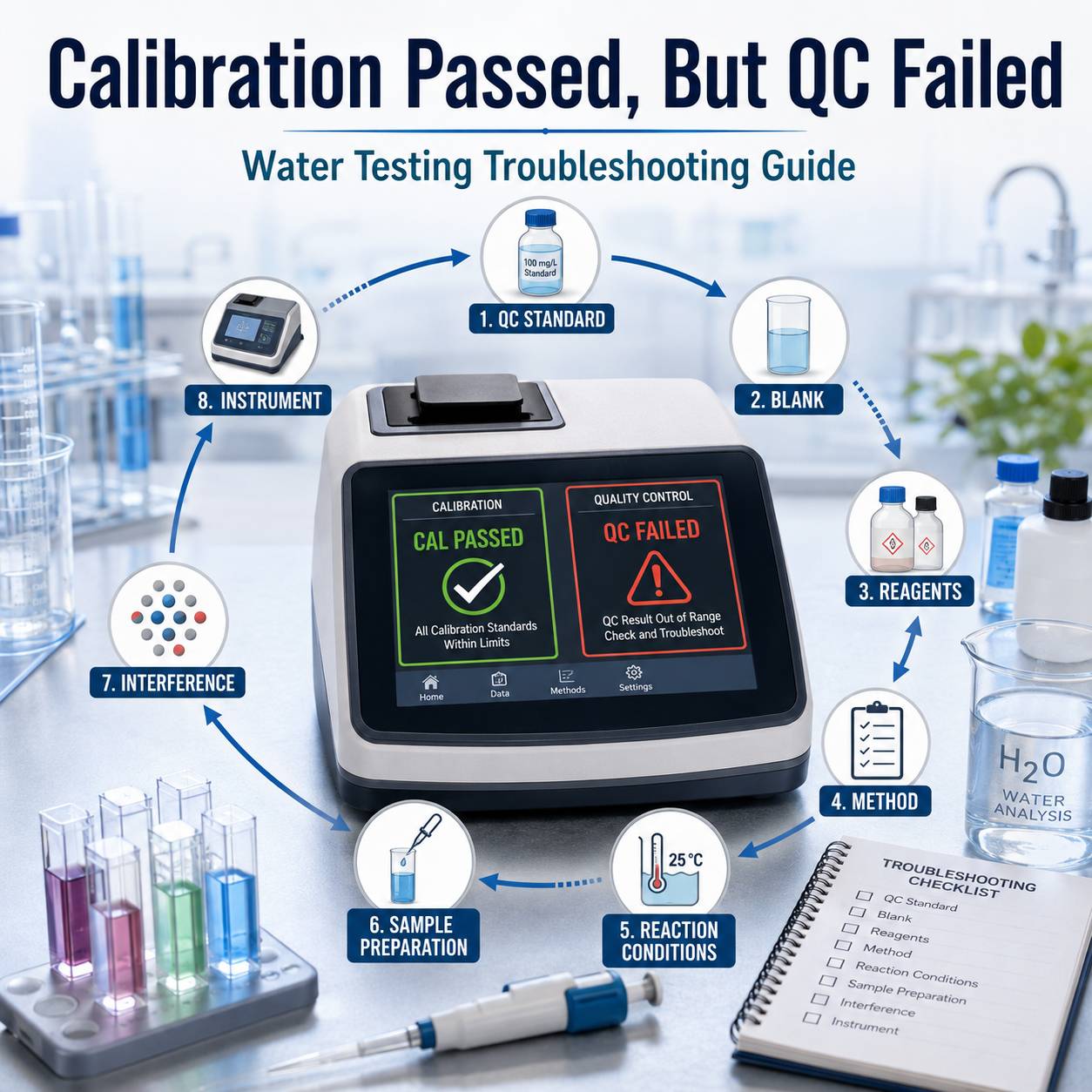
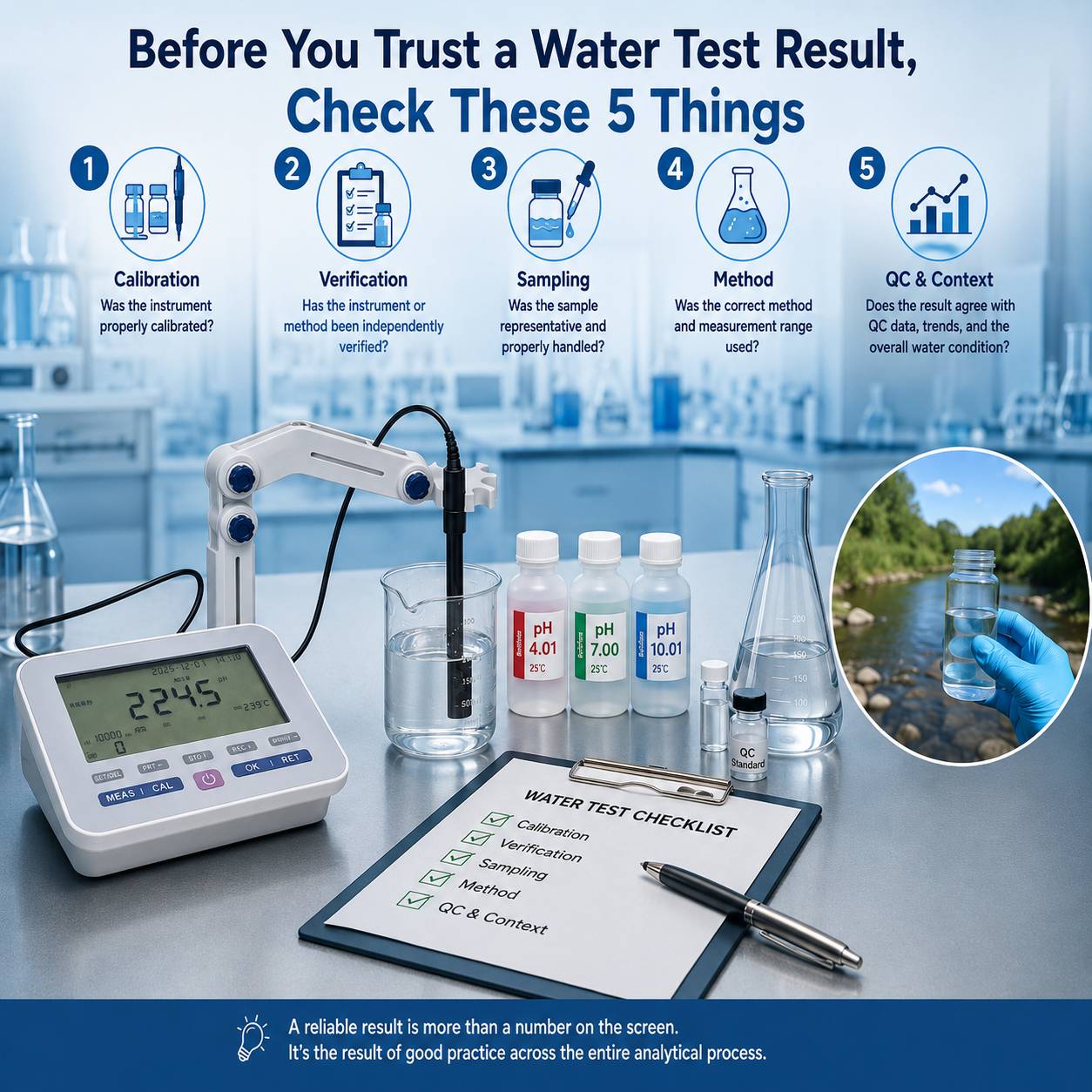
The fourth question is often overlooked: Can the laboratory consistently produce a reliable result for this parameter under routine working conditions?
A method is routine-ready when trained personnel can reproduce acceptable results under normal working conditions—not only during installation, demonstration, or initial validation. Routine readiness includes the complete measurement chain: sample collection, preservation, preparation, calibration, measurement, quality control, interpretation, reporting, and corrective action.
Routine measurement requires more than an instrument. It requires an operational system.
The Real Workflow Behind Every Parameter
Adding one parameter may require:
ü Correct sampling containers
ü Suitable preservation
ü Defined holding time
ü Sample filtration or digestion
ü Reagent storage
ü Standard solutions
ü Blank preparation
ü Calibration checks
ü Quality control samples
ü Appropriate measuring range
ü Interference evaluation
ü Waste handling
ü Equipment cleaning
ü Staff training
ü Recordkeeping
ü Result review
If any part of the workflow is weak, the final result may be unreliable.
Instrument Capability Is Only One Part of Method Capability
Laboratories sometimes select parameters by looking at the measurement menu of a multi-parameter analyzer. However, an instrument displaying a parameter name does not guarantee that the laboratory can measure it reliably in every sample type. The method may still depend on:
n Sample matrix
n Concentration range
n Turbidity
n Color
n Salinity
n Interfering ions
n Digestion efficiency
n Reagent quality
n Analyst technique
For example, a photometer may provide stable absorbance readings, but the reported concentration can still be incorrect if:
u The blank is unsuitable
u The sample contains interfering color
u The concentration exceeds the method range
u Digestion is incomplete
u Reagents are deteriorated
u The wrong program is selected
u The cuvette is contaminated
u The calibration is inappropriate for the matrix
Routine testing reliability depends on the complete method, not only the optical performance of the instrument.
Can the Laboratory Maintain the Method Over Time?
A method should not be evaluated only under ideal conditions. The laboratory should ask whether it can maintain the method during:
l High sample volume
l Staff changes
l Reagent shortages
l Instrument downtime
l Remote operation
l Different seasons
l Changing sample composition
l Emergency situations
A method that depends on one highly experienced analyst may not yet be a robust routine method. Similarly, a parameter that requires difficult preservation or complex sample preparation may not be suitable for frequent testing unless the laboratory has the necessary infrastructure.
Quality Control Must Be Defined Before Routine Use
Before a new parameter becomes routine, the laboratory should establish appropriate controls such as:
n Reagent blanks
n Method blanks
n Calibration verification
n Duplicate samples
n Spiked samples
n Certified or traceable control standards
n Control charts
n Acceptable recovery limits
n Repeatability criteria
n Corrective actions for failed QC
The specific QC plan depends on the method and intended use. However, one principle is universal: A result should not become routine before the laboratory has a routine way to verify that it is reliable.
A Practical Example: Should a Wastewater Laboratory Add Nitrate?
Consider a wastewater laboratory that already measures:
l pH
l COD
l Ammonia nitrogen
l Total phosphorus
l Suspended solids
l Conductivity
The laboratory is considering adding nitrate to its daily routine program. The four questions can help determine whether this is justified.
1. What decision will nitrate change?
Possible answers include:
n Evaluate whether nitrification is occurring
n Assess nitrogen conversion through the biological process
n Investigate incomplete denitrification
n Optimize anoxic operating conditions
n Support total nitrogen control
If no operational or regulatory decision depends on nitrate, daily testing may not be necessary.
2. What threshold or pattern will trigger action?
The laboratory may define:
n A normal nitrate range after the aerobic stage
n A warning level in the final effluent
n A nitrate difference between aerobic and anoxic zones
n A trend indicating declining denitrification efficiency
Without these interpretation rules, the result may be recorded but not used.
3. How quickly is the result needed?
If operators need nitrate results during the same shift, an in-house routine method may be appropriate. If the result is only needed for monthly process review, daily measurement may create unnecessary workload.
4. Can the workflow support the measurement?
The laboratory must evaluate:
n Expected nitrate concentration
n Suitable method range
n Potential nitrite or matrix interference
n Sample filtration requirements
n Reagent availability
n Quality control procedures
n Analyst workload
Only after these questions are answered should nitrate become part of the daily routine program.
Another Example: Adding a Trace Metal to Routine Testing
Suppose an industrial facility considers adding a trace metal to its daily water testing list. The metal may be important from an environmental or regulatory perspective, but daily in-house testing may not be the best solution.
The facility should ask:
l Does the process create a realistic risk of daily variation?
l Is there a defined action threshold?
l Does the result need to be available immediately?
l Can the laboratory achieve the required detection limit?
l Can contamination during sampling and preparation be controlled?
l Is external accredited laboratory analysis more appropriate?
l Could a simpler indicator parameter provide earlier warning?
In some cases, routine monitoring may use an operational indicator, while specialized metal analysis is performed periodically or when the indicator changes.
This is not a reduction in monitoring quality. It is a tiered monitoring strategy.
How Parameter Selection Changes Across Water Applications
Application | Main decision focus | Examples of parameters that may be prioritized |
Drinking water treatment | Source change, treatment performance, disinfection, compliance | pH, turbidity, disinfectant residual, conductivity, selected contaminants |
Wastewater treatment | Organic loading, biological treatment, nutrient removal, discharge control | COD, BOD, ammonia, nitrate, phosphorus, suspended solids, pH |
Industrial process water | Product quality, scaling, corrosion, contamination, equipment protection | pH, conductivity, hardness, silica, dissolved oxygen, selected ions |
Boiler and cooling water | Scaling, corrosion, concentration cycles, chemical control | Conductivity, pH, hardness, alkalinity, silica, phosphate |
Aquaculture water | Biological stress, oxygen availability, toxic nitrogen species | Dissolved oxygen, pH, temperature, ammonia, nitrite, salinity |
Environmental monitoring | Baseline conditions, pollution signals, trend detection | Turbidity, conductivity, nutrients, dissolved oxygen, site-specific contaminants |
These examples are illustrative rather than universal. The final parameter list should reflect the water source, process, regulatory requirements, risk profile, and intended decision.
Routine Testing, Screening, and Confirmatory Analysis Are Not the Same
One reason parameter lists become unnecessarily complicated is that different testing purposes are combined into one program. A clearer system separates three levels.
Level 1: Routine operational monitoring
Designed for frequent and repeatable decisions. Typical characteristics:
l Fast
l Practical
l Cost-controlled
l Easy to repeat
l Connected to daily operations
Level 2: Screening or early-warning testing
Designed to identify possible abnormalities.Typical characteristics:
l Broader than routine control
l May be triggered by an event
l Helps determine whether further investigation is needed
Level 3: Confirmatory or investigative testing
Designed to identify, verify, or quantify a specific issue.Typical characteristics:
l More selective
l More sensitive
l More expensive
l More complex
l Often performed less frequently
l May require specialized equipment or external laboratories
A parameter does not need to be measured every day to be important. Its value depends on being placed at the correct level of the monitoring program.
Common Reasons Laboratories Add Parameters Too Quickly
1. The instrument can measure it
Instrument capability is often mistaken for monitoring necessity. A large method menu can be useful, but it should not determine the routine program.
2. Another laboratory measures it
Different laboratories may have different:
l Water sources
l Treatment processes
l Regulations
l Risks
l Customers
l Operating objectives
A parameter that is essential in one laboratory may have little value in another.
3. The parameter is scientifically important
Scientific importance does not automatically create routine operational value. Some parameters are better suited to research, periodic surveys, or investigation.
4. More data appears more professional
A longer report may look more comprehensive, but unnecessary data can make interpretation slower. The quality of a testing program should be evaluated by the reliability and usefulness of its decisions, not by the number of reported values.
5. A previous incident created pressure to test everything
After a contamination event or process failure, organizations may respond by adding many parameters. A better response is to identify:
l What caused the failure
l Which indicator could provide early warning
l Which parameter requires routine control
l Which parameters should remain investigative
When Adding a New Parameter Is Justified
A new parameter is more likely to add real value when:
l A new regulatory requirement has been introduced
l The water source or process has changed
l A new contaminant risk has been identified
l Existing parameters cannot explain an operational problem
l Treatment performance requires additional control information
l A recurring abnormality needs earlier detection
l A customer or product specification requires it
l The laboratory now has a validated and sustainable method
l The result can trigger a clear and timely response
In these situations, expanding the testing program may be necessary. The goal is not to keep the parameter list permanently small. The goal is to ensure that every routine parameter has a defined purpose.
Routine Parameter Lists Should Be Reviewed, Not Only Expanded
Monitoring programs often grow over time but are rarely simplified. Once a parameter is added, it may remain on the reporting form for years, even if:
u The original risk no longer exists
u The process has changed
u The result is no longer reviewed
u No action has ever been triggered
u The test duplicates other information
u The cost is no longer justified
u A better indicator is available
Routine testing programs should therefore be reviewed periodically. The review should ask:
l Which parameters regularly support decisions?
l Which parameters provide early warning?
l Which parameters are required for compliance?
l Which parameters are rarely used?
l Which tests frequently fail QC?
l Which methods create delays?
l Which parameters belong in periodic or investigative testing instead?
An effective monitoring program is not static. It should evolve with the system, risk, regulation, and operational needs.
Final Perspective
Adding another parameter to routine water testing is not simply a technical decision. It is a workflow decision, a cost decision, a quality decision, and most importantly, a decision-support decision.
Before adding a parameter, ask:
1.What decision will this result change?
2.What threshold or pattern will trigger action?
3.How quickly is the result needed?
4.Can the workflow support reliable routine measurement?
When these four questions have clear answers, the new parameter is more likely to improve the monitoring program. When they do not, the parameter may generate more data without creating more control.
The strongest routine water testing programs are not necessarily those with the longest parameter lists. They are the programs in which every measurement has a clear purpose, a reliable method, and a defined next action.