+852 46135220

In water quality testing, expensive mistakes do not always come from major instrument failure, wrong methods, or complicated chemistry. The most common water testing mistakes are usually not dramatic instrument failures. They are small laboratory errors such as poor sample handling, incorrect sample mixing, wrong measurement range selection, contaminated calibration buffers, skipped blanks, dirty probes, expired reagents, or inconsistent operator technique.
None of these mistakes looks serious at first. But in routine water testing, These mistakes can become expensive because they affect data reliability, lead to repeated testing, delay reporting, cause wrong treatment decisions, and reduce confidence in laboratory results. In routine water quality testing, controlling small operational details is often just as important as choosing the right analyzer.
This is why reliable water testing is not only about buying a better analyzer. It is about controlling the small details that happen before, during, and after measurement.
Why Small Mistakes Become Expensive in Routine Water Testing
Routine water testing is different from one-time research analysis. In most laboratories, the same parameters are tested repeatedly: COD, ammonia nitrogen, nitrate, phosphate, pH, conductivity, turbidity, dissolved oxygen, residual chlorine, and other operational indicators.
Because the testing is repeated every day, small errors also repeat.
A single careless operation may only affect one result. But a repeated small mistake can affect an entire monitoring program. For example:
u If samples are not mixed consistently before COD testing, results may fluctuate even when the wastewater condition is stable.
u If pH calibration is done with old or contaminated buffer, every pH result after calibration may carry the same bias.
u If conductivity electrodes are not cleaned after high-salinity samples, later low-conductivity samples may be affected.
u If turbidity cuvettes are scratched or handled with fingerprints, readings may become unstable.
u If reagent blanks are skipped, chemical background error may be mistaken for real sample concentration.
In these cases, the laboratory may first suspect the instrument. But the real problem may not be the analyzer itself. It may be the small, uncontrolled steps around the analyzer.
In routine water quality testing, the real cost of a mistake is rarely limited to the price of one reagent or one repeated test. The cost may include:
u Extra labor for retesting
u Wasted reagents and consumables
u Delayed laboratory reports
u Incorrect treatment process adjustments
u Unnecessary chemical dosing
u Failed internal or external audits
u Customer complaints
u Loss of confidence in the laboratory
u Wrong compliance or operational decisions
This is why small testing mistakes can become expensive even when the instrument itself is working normally.
Mistake 1: Treating the Sample as If It Never Changes
One of the most common sources of water testing error is assuming that the sample remains the same after collection. It does not. Water samples can change because of temperature, biological activity, settling, volatilization, oxidation, precipitation, gas exchange, and chemical reactions. Some parameters are especially sensitive to time and field conditions. Different parameters respond to sample change in different ways. For example, pH may shift due to gas exchange with air. Dissolved oxygen can change rapidly after sampling. Residual chlorine may decay during storage. Suspended solids may settle and affect COD, turbidity, total phosphorus, or total nitrogen results. Ammonia and nutrient results may also be affected by biological activity if samples are not preserved or stored properly.
That is why sample preservation and holding time are important parts of analytical quality. EPA guidance on holding time and preservation shows that holding requirements depend on the method and the analyte; this means laboratories should not treat all water samples as if they can be stored and analyzed in the same way. This is especially important for parameters such as pH, dissolved oxygen, residual chlorine, sulfide, ammonia, nutrients, and some organic indicators.
For routine laboratories, the expensive mistake is not always that the sample was tested incorrectly. Sometimes the sample was no longer representative by the time it was tested.
Practical lesson
Before questioning the analyzer, ask:
l Was the sample collected correctly?
l Was the correct container used?
l Was the sample preserved if required?
l Was it stored at the correct temperature?
l Was it analyzed within the required time?
l Was it mixed properly before testing?
An analyzer can only measure the sample placed in front of it. It cannot recover information lost during poor sampling or storage.
Mistake 2: Not Mixing Samples Before Testing
This sounds simple, but it is one of the easiest mistakes to overlook. Many wastewater samples are not perfectly homogeneous. Suspended solids, sludge particles, oils, and fine particles may settle or float during storage or transport. If one technician tests the upper liquid and another technician tests a well-mixed sample, the results can be very different.
This matters especially for parameters affected by suspended or particulate matter, such as:
l COD
l Total phosphorus
l Total nitrogen
l Turbidity
l Color
l Suspended solids-related indicators
For COD testing, poor mixing can be a major problem. COD represents the oxygen demand of oxidizable substances in the sample. If organic solids are unevenly distributed, the portion transferred into the digestion vial may not represent the whole sample. The result may look like an instrument problem, but the real problem started before digestion.
Practical lesson
A small mixing habit can decide whether the result is meaningful. For routine labs, sample mixing should be defined clearly:
n Mix before taking aliquots.
n Avoid excessive shaking if it changes volatile components.
n Use consistent mixing practice between technicians.
n Record special sample conditions such as heavy solids, oil, foam, or strong color.
For many water samples, the question is not only whether the sample was collected correctly, but whether the aliquot taken for testing was representative. A well-collected sample can still produce unreliable results if the portion transferred into the test vial, digestion tube, cuvette, or beaker does not represent the original sample.
Mistake 3: Using the Wrong Measurement Range
Range selection is another small decision with large consequences. Many photometric water quality analyzers support different ranges for the same parameter. COD, ammonia nitrogen, phosphate, nitrate, and chlorine may have low, medium, and high range methods or reagent sets. Choosing the wrong range can create several problems:
u Low-concentration samples tested in a high range may lose sensitivity.
u High-concentration samples tested in a low range may exceed the calibration curve.
u Dilution may introduce additional uncertainty.
u Operators may misread “out of range” values as actual results.
u Repeated retesting wastes reagents, vials, labor, and time.
This is not just a method issue. It is also an instrument selection and workflow issue. A good analyzer should provide suitable ranges for the lab’s real samples. But the lab also needs a practical process for deciding which range to use.
Practical lesson
Before routine testing starts, laboratories should understand the typical concentration range of their samples. For wastewater plants, influent, aeration tank, secondary effluent, and final discharge may require different testing ranges. Using one range for all samples may look simple, but it often creates unnecessary cost and unreliable data.
For example, influent wastewater, process water, final effluent, drinking water, and environmental surface water should not automatically be tested with the same COD, ammonia, phosphate, or nitrate range. If the expected concentration is unknown, a screening test or proper dilution strategy may be needed before selecting the final analytical range. Range selection should be based on expected concentration, method sensitivity, sample matrix, and the decision the result needs to support.
Mistake 4: Thinking Calibration Solves Everything
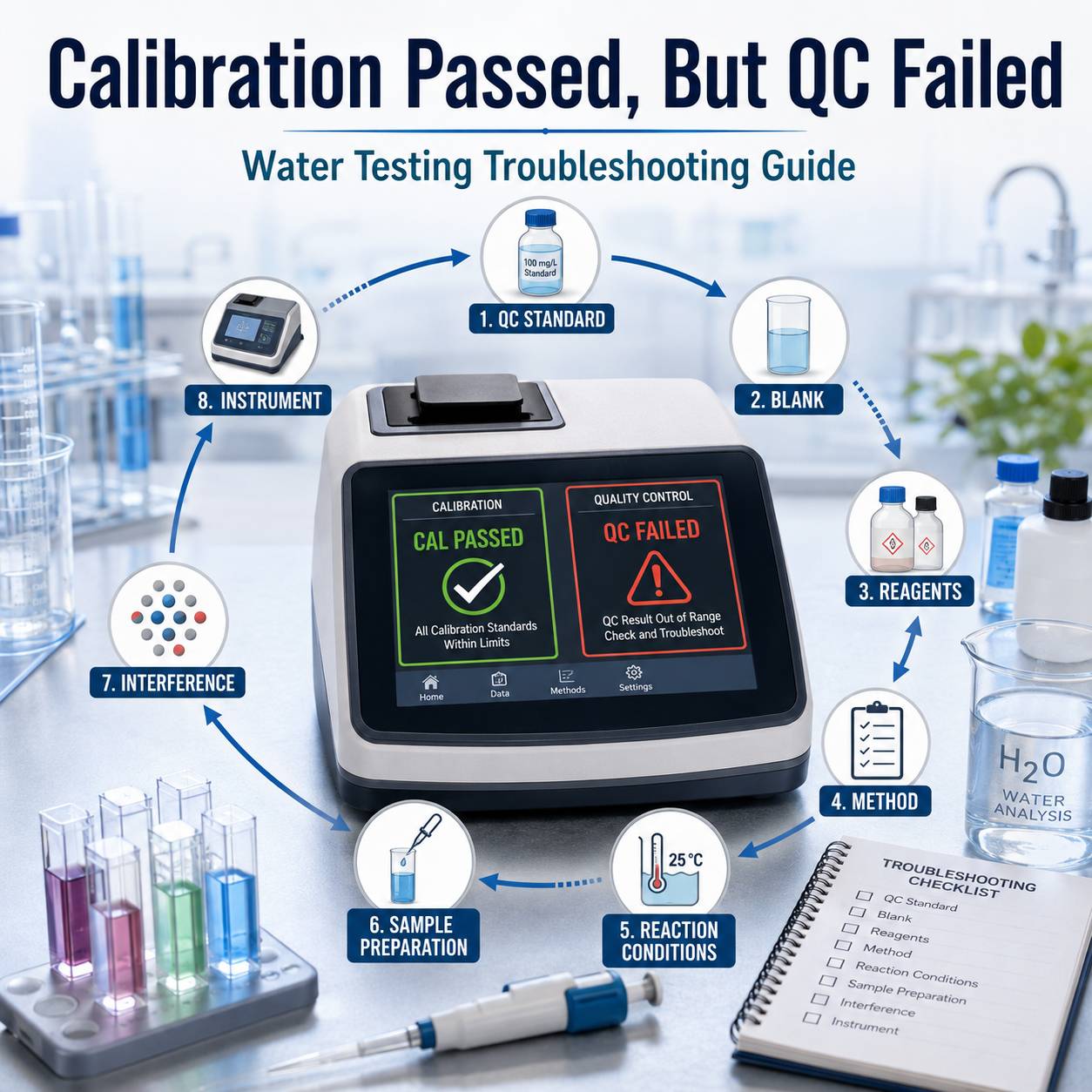
Calibration is essential, but calibration alone does not guarantee reliable results. Many routine labs calibrate instruments correctly but still get poor data because other small details are not controlled.
For electrochemical measurements such as pH, conductivity, and dissolved oxygen, calibration is only one part of the measurement system. The condition of the electrode or sensor, temperature compensation, sample stability, cleaning, storage solution, and operator technique also matter. For photometric measurements, calibration may be built into the instrument or method curve, but performance still depends on reagent quality, blank correction, cuvette cleanliness, wavelength stability, digestion quality, and correct sample preparation. EPA QA/QC guidance emphasizes that calibration verification and QC samples are part of analytical quality control, not optional decorations after calibration.
Practical lesson
A calibrated instrument can still produce unreliable data if:
u The electrode is aging or contaminated.
u The buffer solution is expired or polluted.
u The cuvette has fingerprints or scratches.
u The reagent blank is ignored.
u The sample matrix interferes with the method.
u The operator uses inconsistent timing or technique.
It is also important to distinguish calibration from calibration verification. Calibration adjusts or establishes the instrument response. Calibration verification checks whether the instrument and method are still producing acceptable results after calibration. In routine water testing, both are important. A meter may pass calibration at the beginning of the day, but verification standards, QC checks, or control samples may still be needed to confirm that the method remains reliable during routine operation.
Mistake 5: Skipping Blanks and Duplicates When the Lab Is Busy
In busy routine laboratories, QC steps are often the first things to be reduced. The logic is understandable:
“We already know this method.”
“The instrument worked yesterday.”
“The samples are urgent.”
“The blank is usually fine.”
“We do not have time to repeat.”
But this is exactly how small errors become expensive. Field blanks, reagent blanks, duplicates, spikes, and verification standards help laboratories detect contamination, bias, poor precision, reagent problems, and operational mistakes. EPA describes field blanks as deionized water treated as a sample to help identify contamination or errors during collection and analysis. EPA documentation also notes that duplicate or replicate samples are used to estimate measurement precision. Without these checks, the lab may not know whether an unusual result is caused by the water sample, the method, the reagent, the instrument, or the operator.
Practical lesson
QC does not slow down a good laboratory. QC prevents a laboratory from moving quickly in the wrong direction. Quality control is not only for accredited or regulatory laboratories. Even in small wastewater treatment plant labs, industrial water labs, aquaculture labs, or internal process-control labs, basic QC practices can prevent wrong decisions. A simple blank, duplicate, or check standard may reveal a problem before the result is used for dosing control, discharge judgment, or customer reporting.
For routine testing, the goal is not to run the maximum number of samples per day. The goal is to produce results that can be trusted for operational decisions.
Mistake 6: Cleaning Too Late
Instrument maintenance is often treated as a repair activity. But in routine water testing, many problems can be prevented by cleaning before the problem becomes visible. Examples include:
u pH electrodes coated by wastewater residue
u Conductivity probes affected by scale or salt deposits
u DO membranes fouled by biofilm
u Turbidity cuvettes scratched or stained
u Photometer sample chambers contaminated by leaks or residue
u Digestion block wells affected by spilled reagents
u Pipettes affected by poor tip fitting or contamination
These are not dramatic failures. The instrument may still turn on. The display may still look normal. The result may still appear reasonable. But the data may gradually drift.
Practical lesson
One reason maintenance problems are difficult to notice is that they often appear as gradual data drift rather than sudden failure. The analyzer may still pass basic operation checks. The display may still show stable numbers. But over time, dirty optical surfaces, fouled probes, aged electrodes, or contaminated sample chambers can reduce confidence in the trend data. For routine monitoring, trend reliability is often more important than a single impressive specification.
Preventive maintenance should be part of the testing workflow, not something done only after results become suspicious. A simple cleaning schedule may save more money than a more advanced instrument specification.
Mistake 7: Ignoring Temperature Effects
Temperature affects many water quality measurements. For electrochemical methods, temperature can influence electrode response, conductivity, dissolved oxygen saturation, and reaction behavior. For photometric testing, temperature may affect reaction rate, color development, digestion efficiency, and sample stability. USGS technical guidance notes that multiparameter instruments commonly include sensors for water temperature, specific conductance, pH, dissolved oxygen, and turbidity in water-quality studies, showing how closely field water-quality measurements are linked to environmental conditions.
In routine labs, temperature errors often happen quietly:
u Samples are tested immediately after being taken from a cold storage condition.
u Calibration buffers and samples are at very different temperatures.
u Digestion instruments do not reach or maintain the required temperature.
u Operators ignore temperature compensation limits.
u Field measurements are compared directly with lab measurements without considering sample change.
Practical lesson
Temperature is not just a background condition. It is part of the measurement environment. For parameters such as pH, conductivity, DO, COD, and colorimetric tests, temperature control and temperature awareness can directly affect data reliability.
Mistake 8: Reporting a Number Without Understanding the Decision Behind It
A water testing result is not just a number. It usually supports a decision.
Should the wastewater treatment process be adjusted?
Is discharge within control limits?
Is the sample abnormal enough to trigger investigation?
Should chemical dosing be changed?
Does the client need a retest?
Is the instrument suitable for this testing range?
When laboratories report numbers without linking them to decision value, small mistakes become harder to detect. For example, a COD result that is slightly high may lead to unnecessary operational adjustment. A pH value that is slightly biased may cause incorrect neutralization control. A conductivity reading affected by probe contamination may be mistaken for industrial discharge. A low ammonia result from poor sample preservation may hide a real treatment problem.
The cost is not only the retest. The cost is the wrong decision made from the wrong number.
Practical lesson
Routine testing should always ask:
l What decision will this result support?
l How accurate does the result need to be?
l What level of uncertainty is acceptable?
l What QC evidence supports the result?
l Does the result match process conditions and historical trends?
Data quality is not only an analytical issue. It is an operational issue.
Small Mistakes Are Often Workflow Problems, Not Individual Mistakes
In many laboratories, small water testing mistakes are not caused by careless people. They are caused by unclear workflows. If sample mixing is not defined, different technicians may handle the same sample differently. If range selection is not standardized, one operator may dilute while another operator chooses a different method range. If cleaning and maintenance are not scheduled, probes and cuvettes may only be checked after abnormal results appear.
A good routine testing workflow should make the correct operation easy to repeat. This includes:
n clear sample handling instructions
n defined calibration and verification frequency
n standard range selection rules
n routine cleaning and maintenance schedule
n QC acceptance criteria - proper record keeping
n operator training for abnormal results
Common Small Mistakes and Their Possible Costs
Small Mistake | Possible Result | Possible Cost |
Sample not mixed before testing | Poor repeatability, unstable COD or turbidity results | Retesting, wrong process judgment |
Wrong measurement range selected | Out-of-range result or poor sensitivity | Wasted reagents, delayed report |
Contaminated calibration buffer | Biased pH or conductivity data | Incorrect adjustment or dosing |
Blank skipped | Background error not detected | False high or false low results |
Dirty cuvette or probe | Data drift or unstable readings | Loss of confidence in trend data |
Expired reagent used | Weak color development or inaccurate result | Failed QC, repeated testing |
Poor temperature control | Inconsistent electrochemical or colorimetric results | Unreliable comparison between samples |
Result reported without review | Abnormal value accepted too quickly | Wrong operational or compliance decision |
Reliable data depends less on one perfect operator and more on a repeatable system
What This Means When Choosing Water Testing Instruments
When selecting instruments for routine water testing, many users focus mainly on technical specifications:
l Detection range
l Resolution
l Accuracy
l Wavelength range
l Number of parameters
l Data storage
l Portability
l Brand reputation
l Price
These are important. But they are not enough. For real laboratory operation, users should also ask:
1.Is the instrument suitable for the lab’s most common sample types?
Wastewater, drinking water, industrial process water, aquaculture water, and environmental samples may require different ranges and methods.
2.Does the instrument match the lab’s operator skill level?
A very advanced instrument may not improve data quality if the workflow cannot support it.
3.Are reagents, consumables, electrodes, and spare parts easy to manage?
The long-term cost of testing is not only the purchase price.
4.Is the method simple enough for daily repeatability?
Routine testing needs stable operation, not only high capability.
5.Can the instrument support QC practices?
Blank correction, calibration verification, duplicate testing, data records, and method consistency matter in daily use.
6.Does the supplier understand the application?
Instrument selection should be based on real sample conditions and testing goals, not only catalogue specifications.
The best instrument for routine water testing is not always the most advanced one. It is the one that fits the laboratory’s real workflow and helps reduce small operational mistakes.
Practical Checklist: Small Details That Prevent Expensive Mistakes
Phase | Steps |
Before testing | Confirm sample ID and collection time. |
Check whether preservation or temperature control is required. | |
Mix the sample properly if the method requires it. | |
Choose the correct method and range. | |
Inspect reagent condition and expiry date. | |
Confirm instrument status and calibration condition. | |
Prepare blanks, standards, and duplicates where needed. | |
During testing | Use clean glassware, cuvettes, vials, and pipette tips. |
Avoid fingerprints, bubbles, and residue in optical measurements. | |
Keep digestion time and temperature consistent. | |
Control reaction time for colorimetric methods. | |
Rinse electrodes properly between samples. | |
Watch for out-of-range warnings or unstable readings. | |
Record unusual sample appearance, odor, color, turbidity, or solids. | |
After testing | Compare results with historical trends. |
Verify abnormal results before reporting. | |
Clean probes, cuvettes, and sample chambers. | |
Store electrodes correctly. | |
Record QC results. | |
Review whether retesting is needed. | |
Do not report a number that does not make operational sense without checking the process. |
These steps are simple. But they are often the difference between useful data and expensive confusion.
Conclusion
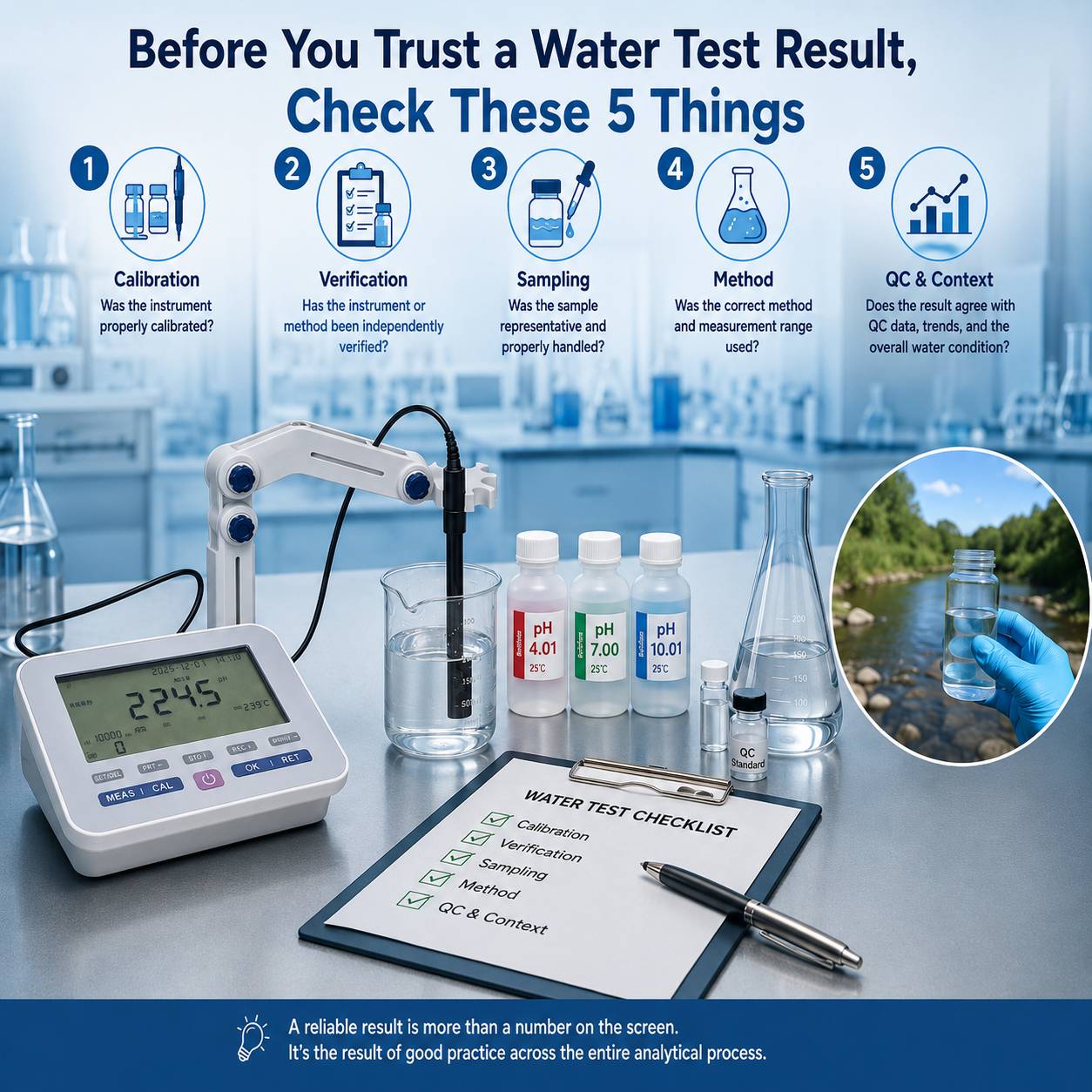
I In water quality testing, reliable data is rarely created by the analyzer alone. It is created by the full testing system: sample collection, sample preservation, mixing, method selection, measurement range, calibration, quality control, instrument maintenance, operator technique, and result review. Small mistakes in any of these steps can lead to expensive consequences, including repeated testing, wasted reagents, delayed reports, wrong treatment decisions, and reduced confidence in laboratory data.
For routine water testing laboratories, the most practical way to improve data reliability is not always to buy the most advanced instrument first. It is to control the small details that decide whether the final number can be trusted.