+852 46135220

In many laboratories, the photometer is used very broadly. As long as an instrument can measure absorbance at a selected wavelength, it is often assumed to be “good enough” for water quality analysis.
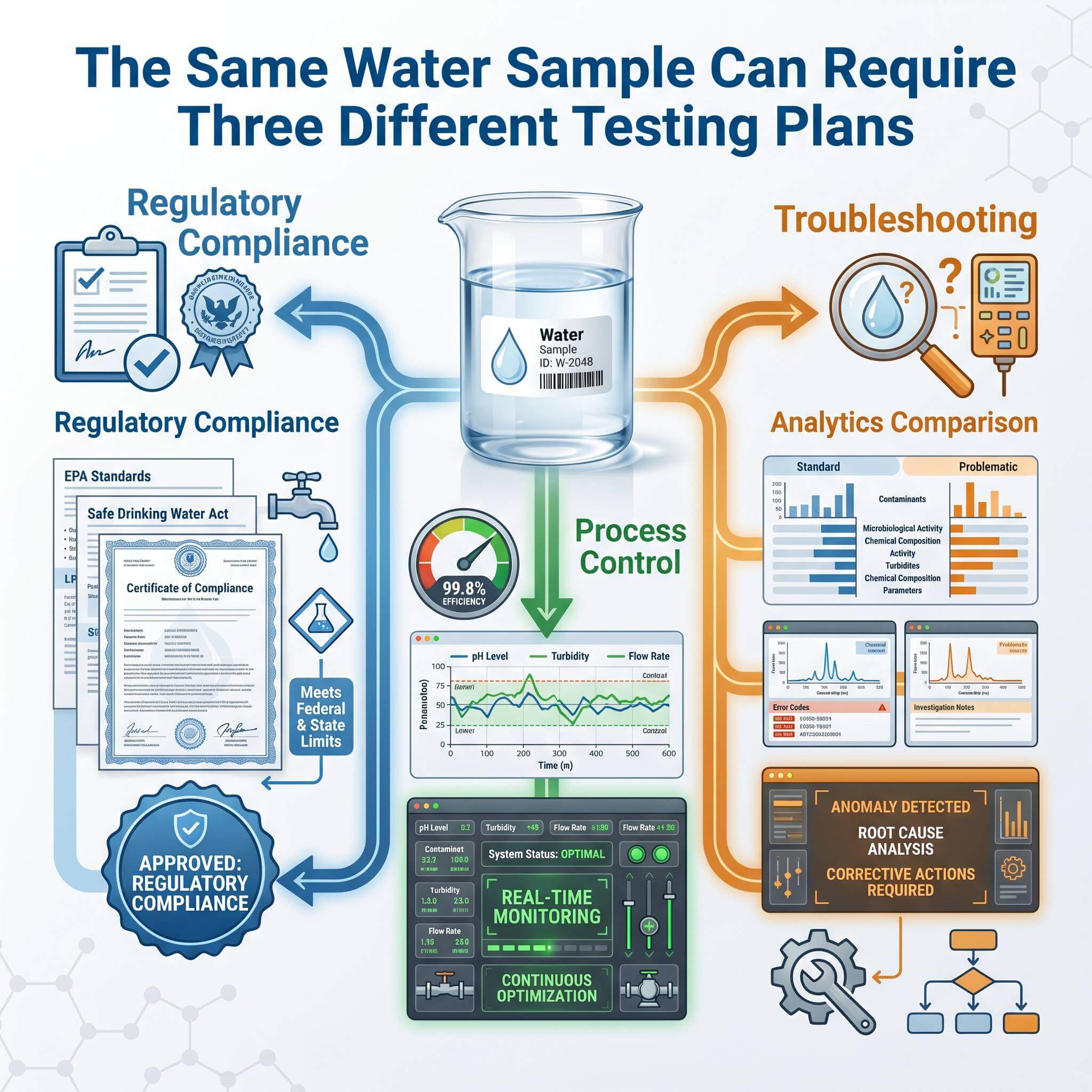
However, in real industrial and municipal wastewater testing scenarios, there is a fundamental difference between a dedicated photometer water quality analyzer and a general-purpose photometer. A photometer water quality analyzer should be understood as an application-specific analytical system rather than a basic optical instrument. Its primary value lies in error prevention, workflow standardization, and regulatory reliability—not in optical versatility.
From the perspective of laboratory management and frontline analysts, a photometer water quality analyzer is not a simplified version of a conventional photometer. It is a complete analytical system, purpose-built for environmental and wastewater laboratories.
1. A Fundamental Difference in Design Philosophy: Measurement Device vs. Analytical System
A general-purpose photometer is a measurement device at its core:
l Primary function: Measure absorbance or transmittance at a selected wavelength
l User responsibility: Manually select wavelengths, build calibration curves, and calculate concentrations externally (e.g. Excel or manual calculation)
l Design assumption: The operator has sufficient analytical and spectroscopic expertise and bears full responsibility for data correctness
A dedicated photometer water quality analyzer is designed as a complete analytical system by contrast:
ü Primary function: Integrated measurement → method control → concentration calculation → result consistency
ü User responsibility: Follow standardized procedures and obtain ready-to-use concentration results
ü Design assumption: Operators may rotate, may not be analytical specialists, and the instrument must actively prevent common mistakes
Engineering conclusion: In routine water quality testing, operator dependency is the largest source of human error. The core engineering value of a photometer water quality analyzer lies in systematically reducing this risk through design, rather than relying on operator expertise.
2. Wavelength Selection: Manual Setting vs. Method-Bound Control
Standard water quality analysis methods clearly define fixed analytical wavelengths:
l COD (dichromate method): After digestion, Cr³⁺ absorbance measured at specific visible wavelengths (e.g. ~600 nm or ~440 nm, depending on range)
l Ammonia nitrogen: Color complexes measured at 420 nm (Nessler) or 697 nm (salicylate)
l Total phosphorus / total nitrogen: Fixed endpoint wavelengths after digestion and color development
Engineering risks with general photometers:
u Operators must remember or manually look up the correct wavelength
u High risk of incorrect wavelength selection (e.g. mixing COD low-range and high-range wavelengths)
u Poor consistency between operators and shifts
Engineering advantages of photometer water quality analyzers:
ü Wavelengths are hardware-locked or software-bound to specific methods
ü Wavelength setting errors are completely eliminated
ü Data consistency is ensured across operators, batches, and instruments
Practical evidence: Internal statistics from a environmental monitoring laboratories show that wavelength selection errors account for over 30% of human-related COD measurement errors in labs using non-dedicated photometers. Incorrect wavelength selection does not produce obvious abnormal signals. Instead, it silently generates systematic errors that may remain undetected without external QC checks.
3. From “Readings” to “Results”: The Value of Built-in Method Libraries
A standard photometer outputs absorbance values. However, a laboratory needs concentration results (mg/L).
Typical workflow with a general photometer:
1.Measure absorbance of standards
2.Build calibration curves in Excel
3.Measure sample absorbance and calculate concentration
4.Manually record and report results
Each step introduces potential errors: incorrect data entry, wrong formulas, rounding mistakes, transcription errors.
Engineering-driven design of photometer water quality analyzers:
ü Built-in standard methods (COD, ammonia, total phosphorus, total nitrogen, nitrate, nitrite, Cr⁶⁺, etc.)
ü Direct concentration display (mg/L)
ü Compatibility with widely used reagent brands and standard methods
ü Advanced models support dilution recognition and automatic back-calculation
Engineering value: Analysts are freed from repetitive calculations and manual recording, allowing them to focus on sample preparation and quality control, which are the true determinants of analytical accuracy. By integrating method libraries, photometer water quality analyzers eliminate four major error sources: manual wavelength input, external curve fitting, calculation mistakes, and transcription errors.
4. Calibration Curve Management: From Temporary Fits to Quality Assets
Most general photometers support only basic single-point or two-point calibration, with limited traceability.
Dedicated photometer water quality analyzers support laboratory quality systems through advanced calibration management:
l Multi-point curve fitting: Linear, quadratic, and higher-order models
l Curve libraries: Multiple ranges, parameters, and time periods stored
l Traceability: Each curve linked to preparation date, standard batch, operator, and validity period
l Curve verification: Single-point correction for drift without full recalibration
Engineering significance: For complex matrices such as high-chloride, high-salinity, or industrial wastewater, matrix-matched calibration curves are critical for accuracy. Photometer water quality analyzers elevate calibration curves from temporary tools to auditable quality assets. In regulatory and third-party audits, traceable calibration curves and documented validity periods are often more important than theoretical optical performance. Dedicated analyzers align naturally with these compliance expectations.
5. Full Workflow Integration: Beyond Single-Point Measurement
Water quality analysis is never just “insert sample and read result”. A complete testing cycle includes:
l Sample pretreatment: digestion, masking, extraction
l Reaction control: temperature, digestion time, color development time
l Batch processing: dozens of samples per run
l Data handling: storage, reporting, archiving
Integrated workflow design in photometer water quality analyzers:
ü Built-in timers for COD digestion, ammonia reaction, phosphorus color development
ü Dual optical path / cuvette compatibility (16 mm tubes, 25 mm cuvettes) without sample transfer
ü Large internal data storage with full audit trails (sample ID, method, raw absorbance, concentration, operator)
ü USB, RS232, Bluetooth, Ethernet, or LIMS connectivity
A general photometer offers none of these features without external systems or manual workarounds.
6. Environmental Adaptability: Laboratory Precision vs. Industrial Reliability
Wastewater laboratories are not controlled research environments:
u Temperature and humidity fluctuate
u Operators change frequently
u Sample throughput is high
u Instrument downtime directly impacts compliance
Engineering characteristics of photometer water quality analyzers:
ü No moving optical components: Fixed filters or LED optics instead of scanning gratings
ü Long-life light sources: LEDs often exceed 50,000 hours
ü Environmental compensation: Temperature correction and optical self-stabilization
ü Low training threshold: New staff can master routine operation within 1–2 hours
This is why many large wastewater treatment plants find that dedicated photometer water quality analyzers deliver more stable data than high-end spectrophotometers in daily operation. In high-frequency wastewater monitoring, long-term measurement stability is often more critical than marginal gains in optical precision. Consistency across time and operators defines data usability.
7. The Proper Role of General Photometers: Not Obsolete, but Specialized
General photometers and spectrophotometers remain valuable for:
l Education and training
l Method development and research
l Low-frequency, non-standard analysis
However, for routine COD, ammonia, total phosphorus, and total nitrogen compliance testing, they are rarely the most efficient or lowest-risk choice.
Conclusion: Professional Tools for Professional Applications
A normal photometer measures light.
A photometer water quality analyzer manages analytical risk. It is neither a downgraded spectrophotometer nor a simplified photometer. It is an application-engineered analytical system, designed for:
ü Standardized methods
ü High-frequency testing
ü Multi-operator environments
ü Strict regulatory compliance
The key question in instrument selection should not be: “How advanced is the technology?”
but rather: “How well does this instrument support real laboratory workflows?”
In water quality analysis, application-driven precision always outperforms generic versatility.
For environmental and wastewater laboratories focused on routine compliance and process control, a multi-parameter photometer water quality analyzer with built-in standard methods and digestion compatibility represents a practical and low-risk solution.
Example: iWannaMP Multi-Parameter Photometer Water Quality Analyzer