+852 46135220

In routine water testing, many users focus on the instrument first.
If the result looks abnormal, the common questions are often:
“Is the meter accurate?”
“Is the reagent expired?”
“Does the instrument need calibration?”
“Is the method suitable?”
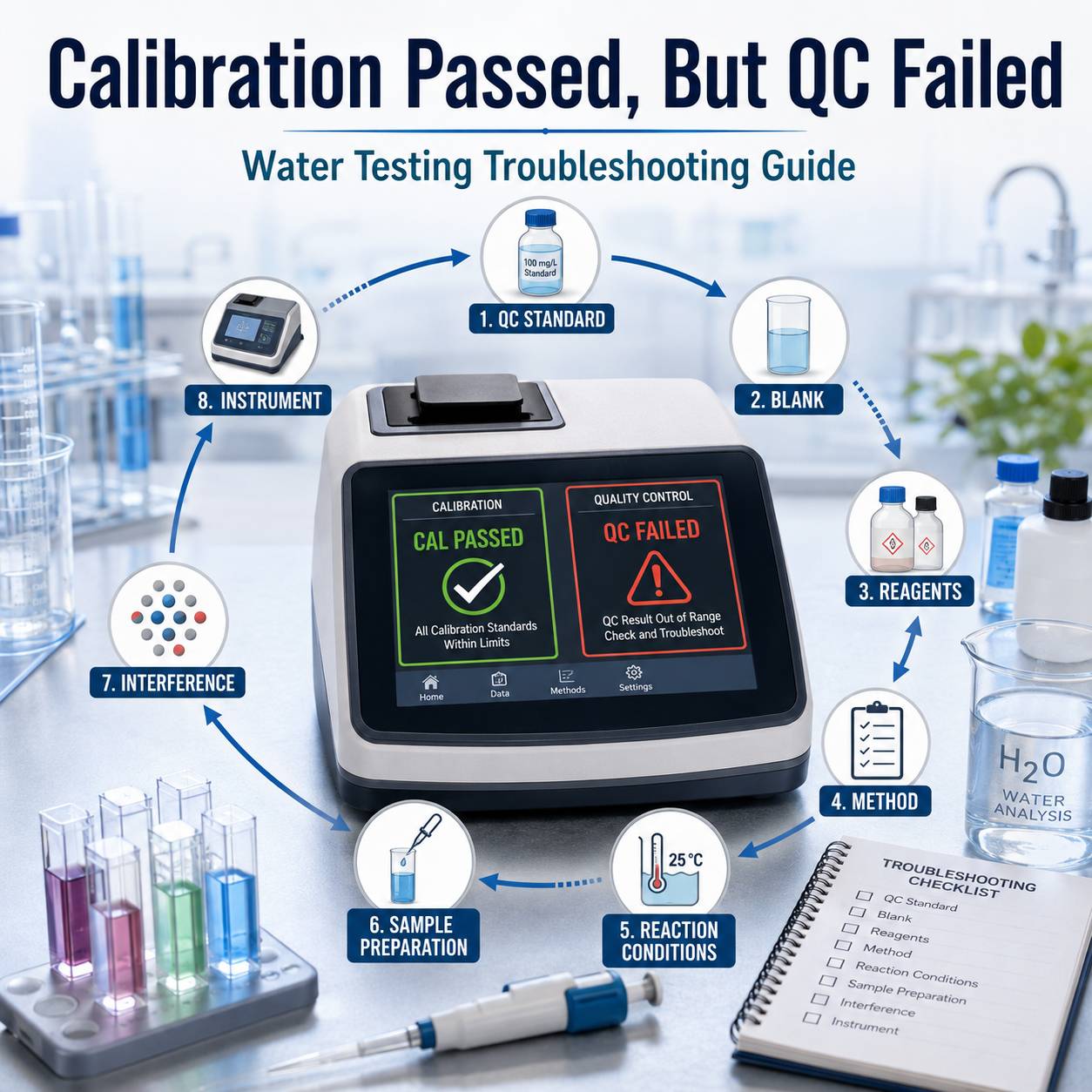
These questions are important. But in many real testing situations, the problem is not only the instrument, the reagent, or the calibration.
A hidden problem is often ignored: interference from the water sample itself. Interference in routine water testing means that substances or conditions in the water sample affect the test result, even though they are not the target parameter being measured. Common sources of interference include sample color, turbidity, suspended solids, oxidizing or reducing agents, high salinity, abnormal pH, temperature variation, and complex wastewater matrix effects. These factors can cause water testing results to appear higher, lower, unstable, or misleading, even when the instrument, reagent, and calibration are correct.
A stable reading does not always mean a correct reading. A calibrated instrument does not automatically remove sample interference. A standard method still needs the right sample conditions. Understanding interference is one of the keys to improving water testing reliability.
What does “interference” mean in water testing?
In practical terms, water testing interference is a sample matrix effect. The target parameter may be chlorine, COD, ammonia, phosphate, nitrate, pH, or conductivity, but the surrounding sample matrix may contain color, particles, salts, organic matter, metals, disinfectants, or other chemicals that affect the measurement process. This is why two samples with the same target concentration may produce different results if their background composition is different.
For example, when testing free chlorine, the target is free available chlorine. But if the water also contains strong oxidizing agents, color, turbidity, or certain chemical residues, the reaction or optical reading may be affected. When testing ammonia nitrogen by a colorimetric method, the target is ammonia. But sample color, turbidity, high concentrations of certain ions, or strong disinfectants may affect color development or absorbance. When measuring pH, the target is hydrogen ion activity. But temperature, low ionic strength, high suspended solids, electrode contamination, or unstable sample conditions may influence the reading.
Interference does not always mean the result is completely wrong. Sometimes it only causes a small bias. But in routine testing, small bias can still be important when the result is close to a control limit, discharge standard, or process decision point.
Why interference is often missed in routine testing
Interference is difficult to detect because it does not always look like an obvious error. If an instrument cannot be turned on, the problem is clear. If calibration fails, the problem is visible. If the reagent is expired, the problem can be checked.
But interference is different. The instrument may operate normally. The calibration may pass. The reagent may be within shelf life. The result may look stable. The value may even look reasonable. This is why interference is a hidden problem.
In daily testing, users may only see the final number, but not the sample conditions behind that number. If the sample contains color, turbidity, suspended solids, oxidants, reducing agents, organic matter, metal ions, high salinity, or other matrix components, the test result may be affected before the operator realizes it. Routine water testing is not only about reading a number. It is also about understanding whether the number truly represents the target parameter.
Common types of interference in water testing
Type of interference | How it affects testing | Common affected parameters |
Sample color | Adds background absorbance and affects colorimetric readings | Chlorine, phosphate, ammonia, nitrate, COD |
Turbidity and particles | Scatter light and increase apparent absorbance | Photometric and spectrophotometric tests |
Oxidizing agents | React with reagents or target substances | Chlorine, ammonia, COD |
Reducing agents | Consume oxidants and lower measured values | Chlorine, COD, disinfectant residuals |
High salinity | Changes reaction behavior or causes chloride interference | COD, conductivity, photometric tests |
Abnormal pH | Affects color development and chemical forms | Chlorine, ammonia, phosphate |
Temperature variation | Changes reaction rate, electrode response, and solubility | pH, DO, conductivity, colorimetric tests |
1. Color interference
Color is one of the most common problems in photometric and colorimetric testing. Many water tests are based on color development. A reagent reacts with the target substance and produces a specific color. The instrument then measures absorbance at a selected wavelength.
However, if the sample already has its own color, the instrument may not be measuring only the color produced by the chemical reaction. It may also read part of the original sample color. This can be a serious issue in:
l Dyed wastewater
l Textile wastewater
l Tannery wastewater
l Surface water with humic substances
l Industrial discharge
l Highly colored process water
For example, in a colorimetric phosphate test, a blue color may be formed during the reaction. If the sample itself is yellow, brown, or green, the final absorbance may not represent only the phosphate reaction. In these cases, sample blank correction, dilution, filtration, or a more suitable analytical method may be required.
For colored samples, a sample blank is often useful because it helps separate the original sample color from the color produced by the reagent reaction. This is especially important in colorimetric water testing, where the final absorbance may include both the reaction color and the sample background color. However, sample blank correction should follow the method instructions. It cannot correct every type of chemical interference.
2. Turbidity and suspended solids interference
Turbidity can interfere with optical measurements because suspended particles scatter light. For a photometer or spectrophotometer, turbidity does not only make the sample look cloudy. It can change how light passes through the cuvette. Suspended particles may scatter the light beam and make the instrument report a higher apparent absorbance than the actual chemical reaction would produce. This is one reason why photometric water testing should not rely only on the displayed result. The visual condition of the sample also matters.
Turbidity may affect tests such as:
l Ammonia nitrogen
l Phosphate
l Nitrate
l Nitrite
l COD colorimetric methods
l Chlorine
l Iron
l Manganese
l Silica
Even if the chemical reaction is correct, the optical reading may still be affected by particles in the sample. This is why some samples need filtration, settling, centrifugation, or sample blank correction before testing. However, sample treatment must be done carefully because filtering or settling may also remove part of the target analyte in some cases.
The key question is not simply “Should we filter the sample?”
The better question is: Will filtration remove only interference, or will it also change the analyte concentration?
3. Chemical interference
Chemical interference happens when another substance in the sample reacts with the reagent, consumes the target chemical, blocks the reaction, or produces a similar response. Chemical interference may create either a positive bias or a negative bias. A positive bias means the reported value is higher than the true concentration. A negative bias means the reported value is lower than the true concentration. In routine water testing, both situations are risky because they may lead to wrong process decisions or incorrect compliance judgment.
For example:
u Oxidizing agents may interfere with chlorine, ammonia, or COD testing.
u Reducing agents may consume disinfectants and lower measured chlorine.
u Chloride can interfere with COD testing, especially in high-salinity samples.
u Nitrite may interfere with some nitrate testing methods.
u Iron, manganese, or other metals may affect color reactions.
u Strong acids or alkalis may change reaction conditions.
u Organic matter may consume oxidants or affect color development.
Chemical interference is especially important in wastewater and industrial water because the sample matrix is often complex and variable. Two samples with the same target concentration may give different test results if their background chemistry is different.
4. High salinity interference
High salinity is common in seawater, aquaculture water, brine, cooling water, desalination processes, and some industrial wastewater. Salinity can affect water testing in several ways.
For electrochemical measurements, high ionic strength may influence electrode response and junction potential. For colorimetric methods, salts may affect reaction kinetics, reagent behavior, or background absorbance. In COD testing, chloride interference is one of the most important matrix problems, especially for saline water, seawater, industrial wastewater, or samples with high dissolved salts. If chloride is not properly controlled or masked, it may be oxidized during digestion and cause the COD result to appear higher than the actual organic pollution level. For this reason, COD testing should always consider the sample source, chloride level, digestion method, reagent range, and dilution strategy.
High-salinity samples require special attention because standard freshwater methods may not always be suitable. In these cases, users should confirm whether the method is validated for saline water, whether chloride masking is required, and whether dilution is acceptable.
5. pH and alkalinity effects
Many colorimetric reactions are pH-dependent. If the sample pH is outside the expected range, the chemical reaction may not proceed correctly. Some reagent systems include buffers, but very acidic or very alkaline samples may exceed the buffering capacity. This can lead to incomplete reaction, wrong color development, precipitation, or unstable readings.
pH and alkalinity can also affect the actual form of certain substances in water. For example, ammonia exists as ammonium ion and free ammonia depending on pH and temperature. Chlorine exists in different forms depending on pH. These chemical forms may influence both measurement and interpretation. Therefore, pH is not only a parameter to measure. It is also a condition that may affect other test results.
A common misunderstanding is that pH calibration can solve all pH measurement problems. Calibration only checks and adjusts the electrode response against standard buffer solutions. It does not remove sample-related problems such as electrode coating, low ionic strength, unstable temperature, suspended solids, or a contaminated reference junction. This is why a pH meter may pass calibration but still produce unreliable readings in difficult water samples.
6. Temperature interference
Temperature can affect both chemical reactions and electrode measurements. For colorimetric testing, temperature may influence reaction speed, color development time, and final color intensity. If a method requires a specific reaction time, the actual temperature can affect whether the reaction is complete.
For pH, conductivity, dissolved oxygen, and ORP testing, temperature compensation is important, but it does not solve every problem. Temperature compensation corrects part of the measurement behavior, but it does not remove all chemical or sample-related effects. For example, dissolved oxygen changes with temperature because oxygen solubility changes. Conductivity changes with temperature because ion mobility changes. pH measurement can be affected by both electrode response and the actual temperature-dependent chemistry of the sample.
In routine testing, temperature should not be treated as a minor detail.
7. Reagent and reaction interference
Some interferences are directly related to the reagent reaction itself. In colorimetric testing, the final result depends on a controlled chemical reaction. If the sample contains substances that slow down, accelerate, inhibit, or imitate the reaction, the result can be biased. Common symptoms include:
u Weak color development
u Color that fades quickly
u Unexpected color tone
u Precipitation after adding reagent
u Reading changes with time
u Poor recovery after dilution
u Large difference between duplicate tests
These symptoms often indicate that the problem is not only instrument accuracy. The sample matrix may be affecting the reagent chemistry.
Parameter-specific examples of interference
Chlorine testing
Chlorine testing is widely used in drinking water, swimming pools, cooling water, and disinfection control. Common interferences may include:
u Sample color
u Turbidity
u Oxidizing agents
u Reducing agents
u High manganese or iron
u Very high chlorine concentration
u Incorrect pH range
u Delay between sampling and testing
Chlorine is also unstable. It can react quickly with organic matter, ammonia, metals, and reducing substances. This means that sampling and timing are critical. For chlorine, the result may change not only because of instrument performance, but also because the sample itself changes after collection.
COD testing
COD is one of the most important parameters in wastewater analysis, but it is also affected by sample matrix. Common interference factors include:
u Chloride
u Suspended solids
u Incomplete homogenization
u High organic load beyond the method range
u Inconsistent digestion temperature or time
u Incomplete mixing after digestion
u Color or turbidity after digestion
For COD, sample preparation is very important. If the sample contains suspended organic particles and is not properly homogenized, two test portions from the same bottle may produce different results. A COD value is not only a reading from the instrument. It is the result of sampling, homogenization, digestion, cooling, optical measurement, and calculation.
Ammonia nitrogen testing
Ammonia nitrogen testing can be affected by:
u Turbidity
u Sample color
u Residual chlorine or oxidants
u High concentrations of certain metal ions
u Strong pH deviation
u Matrix differences between clean water and wastewater
u Delay before analysis
In wastewater, ammonia may also change due to biological activity if the sample is not preserved or tested promptly. This makes sample handling especially important. When ammonia results are unstable or inconsistent, the problem may come from the sample condition, not only the reagent or instrument.
Nitrate and nitrite testing
Nitrate and nitrite testing may be affected by:
u Sample color
u Turbidity
u Nitrite interference in nitrate methods
u Reducing or oxidizing substances
u High organic matter
u Strong matrix effects in industrial wastewater
Because nitrate and nitrite are related nitrogen species, method selection and interference understanding are important. In some testing workflows, nitrite correction may be necessary depending on the method.
Phosphate testing
Phosphate testing is often based on color formation, so it can be affected by:
u Sample color
u Turbidity
u Silica in some conditions
u Arsenate in some methods
u Strong oxidants or reducing agents
u Incomplete digestion for total phosphorus
u Contamination from glassware or detergents
Low-level phosphate testing is especially sensitive to contamination and interference. Clean sample containers, proper blanks, and careful handling are essential.
pH measurement
pH measurement looks simple, but interference and measurement errors are common.
Typical problems include:
u Dirty or coated electrode bulb
u Clogged reference junction
u Low ionic strength water
u High temperature difference between sample and electrode
u Unstable samples with CO₂ absorption or release
u Strong suspended solids
u Poor sample mixing
u Inadequate electrode storage
A stable pH reading does not always mean the electrode is clean or the result is representative. Electrode condition and sample matrix must both be considered. That's why pH is one of the most misunderstood parameters in routine water testing.
Conductivity and TDS measurement
Conductivity measurement is generally fast and reliable, but it can still be affected by:
u Temperature
u Cell constant calibration
u Electrode contamination
u Air bubbles
u High suspended solids
u Incorrect TDS conversion factor
u Non-standard sample composition
TDS calculated from conductivity is not a direct measurement of all dissolved solids. It is an estimated value based on a conversion factor. If the sample composition is unusual, the TDS value may not accurately represent the real dissolved solids content.
Warning signs that interference may be present
Interference should be considered when one or more of the following situations occur:
l The result is stable but does not match process conditions.
l Duplicate tests show large differences.
l Diluted samples do not produce proportional results.
l The sample has strong color or turbidity.
l The result is near the regulatory limit.
l The sample comes from complex industrial wastewater.
l Different methods give significantly different values.
l The blank value is unusually high.
l Color development is abnormal.
l The result changes significantly with reaction time.
l The same instrument works well with standards but poorly with real samples.
A very important point is this: If the instrument performs correctly with standard solutions but gives strange results with real samples, the problem may be sample interference.
How to reduce interference in routine water testing
1. Use sample blanks when necessary
A sample blank helps correct the background color or turbidity of the sample. In many photometric tests, the sample itself may absorb or scatter light. A blank can help separate the sample background from the color produced by the reagent reaction. However, sample blank correction must match the method instructions. It should not be applied casually without understanding the test chemistry.
2. Dilute the sample carefully
Dilution can reduce the concentration of interfering substances and bring the target parameter into the method range. But dilution must be done carefully. If the diluted result is not proportional to the original sample, this may indicate matrix interference, reaction limitation, or sample heterogeneity. For example, if a 2× dilution gives a result that does not match the expected relationship, the sample matrix may be affecting the test. Dilution is not only a way to reduce concentration. It is also a useful tool for checking method reliability.
3. Filter or settle turbid samples when appropriate
For some dissolved parameters, filtration may reduce particle interference. But filtration is not always suitable. If the target analyte is partly attached to suspended solids, filtration may lower the result. For total parameters, filtration may be inappropriate because the suspended fraction is part of the measurement target. Before filtering, users should confirm whether the method measures dissolved, total, or reactive forms.
4. Check the method range
Testing outside the method range is a common cause of unreliable results. If the concentration is too high, the color reaction may exceed the linear range. If the concentration is too low, the signal may be close to the detection limit. Both situations can produce misleading results. Routine testing should always confirm:
l Method range
l Detection limit
l Sample dilution requirement
l Expected concentration level
l Whether the result is close to the upper or lower limit
5. Use quality control checks
Quality control is not only for formal laboratories. It is also useful in routine testing. Practical QC checks may include:
l Reagent blank
l Standard solution check
l Duplicate sample test
l Spiked recovery test
l Dilution check
l Calibration verification
l Control sample testing
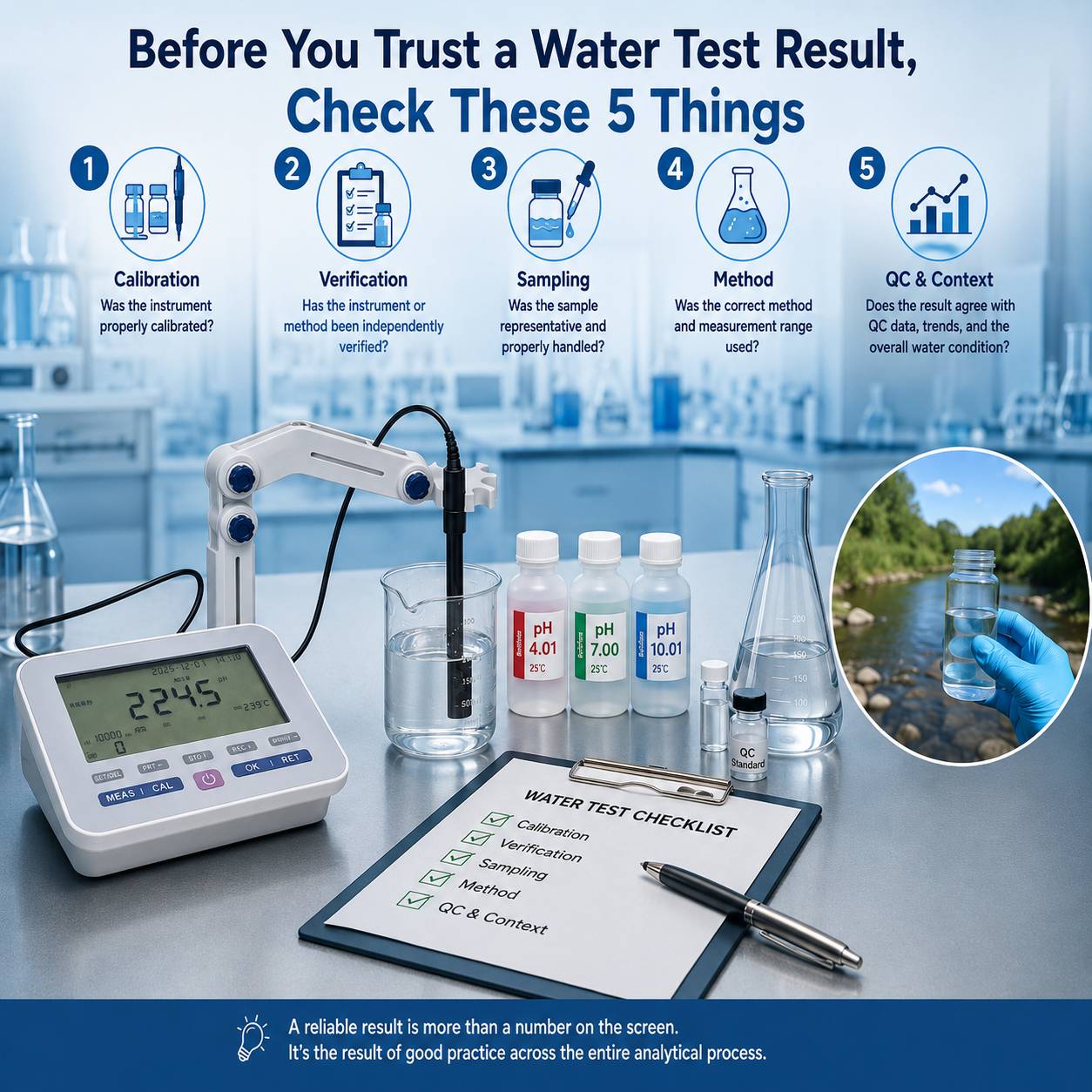
These checks help identify whether the problem comes from the instrument, reagent, operator, or sample matrix. For routine users, even simple QC habits can greatly improve result confidence.
6. Understand the sample source
The more complex the sample source, the higher the risk of interference. For example:
n Drinking water usually has a simpler matrix than textile wastewater.
n Swimming pool water is different from industrial cooling water.
n Aquaculture water is different from municipal wastewater.
n Surface water after rainfall is different from normal surface water.
The same method may perform differently in different sample types.
Before choosing a testing method, users should consider:
l Where the sample comes from
l What chemicals may be present
l Whether the sample is colored or turbid
l Whether the matrix changes frequently
l Whether the parameter is dissolved, total, or reactive
l Whether the method is suitable for that sample type
Good testing starts before the instrument is turned on.
Instrument selection also matters
Interference cannot be solved only by buying a more expensive instrument. But choosing the right instrument and method can help reduce testing risk. For routine water testing, users should consider:
l Suitable wavelength selection
l Method range
l Reagent stability
l Sample blank function
l Calibration and verification options
l Ease of dilution and sample preparation
l Data recording and traceability
l Application suitability for wastewater, drinking water, or field testing
For example, a portable photometer may be suitable for fast field checks and routine monitoring. A laboratory spectrophotometer may provide more flexibility for wavelength selection and method development. An electrochemical meter may be suitable for parameters such as pH, conductivity, dissolved oxygen, and ORP, but probe maintenance and sample conditions are critical.
The best choice depends on the application, sample type, accuracy requirement, and operator skill level.
How to check whether interference is affecting the result
In routine water testing, users can perform several simple checks before assuming the instrument is wrong:
1.Test a standard solution: If the standard gives the correct value, the instrument and reagent are likely working properly.
2.Run a sample blank: This helps check whether sample color or turbidity is affecting the optical reading.
3.Repeat the test with dilution: If the diluted result is not proportional, matrix interference may be present.
4.Test duplicate samples: Large differences between duplicates may indicate poor sample mixing, suspended solids, or unstable reaction conditions.
5.Compare with another method when possible: If two methods give very different results, the sample matrix or method suitability should be reviewed.
Conclusion
Interference is one of the most important hidden problems in routine water testing. When a result is unexpected, the instrument is not always the first problem. The sample itself may contain color, turbidity, suspended solids, oxidants, reducing agents, salts, metals, organic matter, or other substances that affect the test.
For users in wastewater treatment, environmental monitoring, industrial water control, aquaculture, drinking water, and pool water management, understanding interference can help improve result reliability and avoid wrong decisions.
A reliable water test is not only about using the right instrument. It is about understanding the full testing process: sample, method, reagent, instrument, and interpretation. Only when these parts work together can routine water testing provide results that are not only stable, but also meaningful.