+852 46135220

In water quality testing, people often compare field testing and laboratory testing as if they are simply two versions of the same task. One happens outside. The other happens inside a laboratory.
But in real water analysis work, the difference is much deeper than location. Field testing refers to water quality measurements performed directly at or near the sampling location, often using portable meters or photometers, test kits, or on-site sensors. Laboratory testing refers to water analysis performed under controlled conditions using benchtop instruments, defined methods, sample preparation procedures, calibration systems, and quality control checks. The difference is not only where the test is performed, but also why the test is performed, how the sample is controlled, and what type of decision the result supports.
Field testing and laboratory testing are designed for different decisions, different timelines, different levels of control, and sometimes even different interpretations of the same parameter. This is why a portable water quality analyzer, a field photometer, a laboratory photometer, a digestion instrument, and a spectrophotometer should not be evaluated by the same standards alone. Each one plays a different role in the complete water quality testing workflow.
A good water testing program does not ask only: Which instrument is more accurate?
It should also ask: Where will the result be used, how fast is the decision needed, and how stable is the sample before analysis?
Field Testing Answers Immediate Questions
Field testing is usually performed at the sampling site, treatment plant, aquaculture pond, industrial outlet, drinking water point, or environmental monitoring location. Its main purpose is not always to produce the most comprehensive laboratory report. In many cases, field testing is used to support immediate operational decisions. For example:
l Is the pH within a safe operating range?
l Is residual chlorine still present at the point of use?
l Has conductivity suddenly changed?
l Is dissolved oxygen too low for aquaculture or biological treatment?
l Is turbidity increasing after filtration?
l Does wastewater require further treatment before discharge?
l Is there a sudden abnormal condition that needs attention?
In these cases, the value of field testing comes from speed, direct observation, and real-time response. A result obtained immediately on site may be more useful than a more precise result obtained too late.
This is especially true for unstable parameters such as pH, dissolved oxygen, temperature, residual chlorine, and sometimes turbidity. These values can change during sample transport, storage, or exposure to air. For these parameters, field testing is not just convenient. It may be necessary for data reliability.
Laboratory Testing Answers Controlled and Documented Questions
Laboratory testing has a different role. It is usually performed under more controlled conditions, with stable instruments, trained operators, defined methods, proper sample preparation, calibration procedures, quality control checks, and documentation. Laboratory testing is better suited for:
l Compliance testing
l Detailed analysis
l Method-based reporting
l Complex sample preparation
l Multi-parameter confirmation
l Low-level detection
l Repeatability checks
l Dispute resolution
l Historical data comparison
l More complete water quality evaluation
For example, COD, ammonia nitrogen, nitrate, phosphate, total phosphorus, total nitrogen, metals, and many organic indicators often require controlled laboratory procedures, digestion, reagent reaction time, wavelength selection, blank correction, calibration, or sample dilution. These are not always suitable for simple field measurement.
A laboratory result may take more time, but it is usually more controlled, more traceable, and more suitable for formal decision-making. This is why laboratory testing remains essential in municipal wastewater plants, environmental laboratories, industrial water treatment facilities, food and beverage plants, research institutions, and third-party testing organizations.
The Same Parameter May Have Different Meanings in the Field and in the Laboratory
One common misunderstanding is to assume that the same parameter always has the same testing purpose. In reality, the same parameter may serve different jobs depending on where and how it is measured.
pH
In the field, pH is often used as an immediate condition indicator. It helps operators understand whether water is acidic, neutral, or alkaline at the actual point of sampling. In the laboratory, pH may be used as part of a controlled report, but it can already be affected by temperature change, CO₂ exchange, holding time, and sample handling. For this reason, field pH measurement is often very important when real-time condition matters.
Conductivity
Field conductivity is useful for detecting sudden changes in dissolved ionic content. It can quickly indicate mixing, contamination, salinity change, chemical dosing problems, or process instability. Laboratory conductivity is more controlled and may be useful for documentation, comparison, or high-purity water monitoring, especially when temperature compensation and proper electrode maintenance are well managed.
Residual Chlorine
Residual chlorine is highly time-sensitive. A field result at the point of use may better reflect real disinfection conditions than a delayed laboratory result. If the sample is transported for too long, the chlorine level may drop before testing.
COD
COD testing usually requires digestion, reagents, heating time, cooling, and photometric measurement. This makes it more suitable for laboratory or near-laboratory testing. Portable COD testing can be useful in some field-supported applications, but it still requires proper digestion conditions, safety control, and method discipline. This is why COD should not be treated like pH or conductivity. It is not simply a “quick reading” parameter.
Field Testing Is Not Automatically Less Professional
Some users assume that field testing is less professional than laboratory testing. This is not always true. A well-designed field testing workflow can provide highly valuable data, especially when the test is performed immediately, with properly calibrated portable instruments, clean electrodes, fresh reagents, and good sampling practice.
Field testing becomes unreliable not because it is done outside the laboratory, but because the workflow is often less controlled. Common field testing problems include:
u Poor sampling location
u Dirty sample containers
u Instruments not calibrated before use
u Electrodes not properly rinsed
u Old or damaged probes
u Reagents exposed to heat or sunlight
u Incorrect reaction time
u Bubbles or particles affecting optical readings
u No temperature compensation
u No record of sampling conditions
u Operator rushing the procedure
In other words, field testing can be very useful, but it needs discipline. A portable instrument does not remove the need for good testing practice.
Laboratory Testing Is Not Automatically Error-Free
Laboratory testing is more controlled, but that does not mean it is always correct. Many errors can still occur in laboratory water analysis. For example:
u The sample changed before arriving at the lab
u The wrong preservation method was used
u Holding time was exceeded
u The sample was not mixed properly before testing
u The dilution factor was incorrect
u The reagent blank was not handled properly
u The calibration curve was not suitable for the sample range
u The digestion temperature or time was not controlled
u The cuvette or vial was contaminated
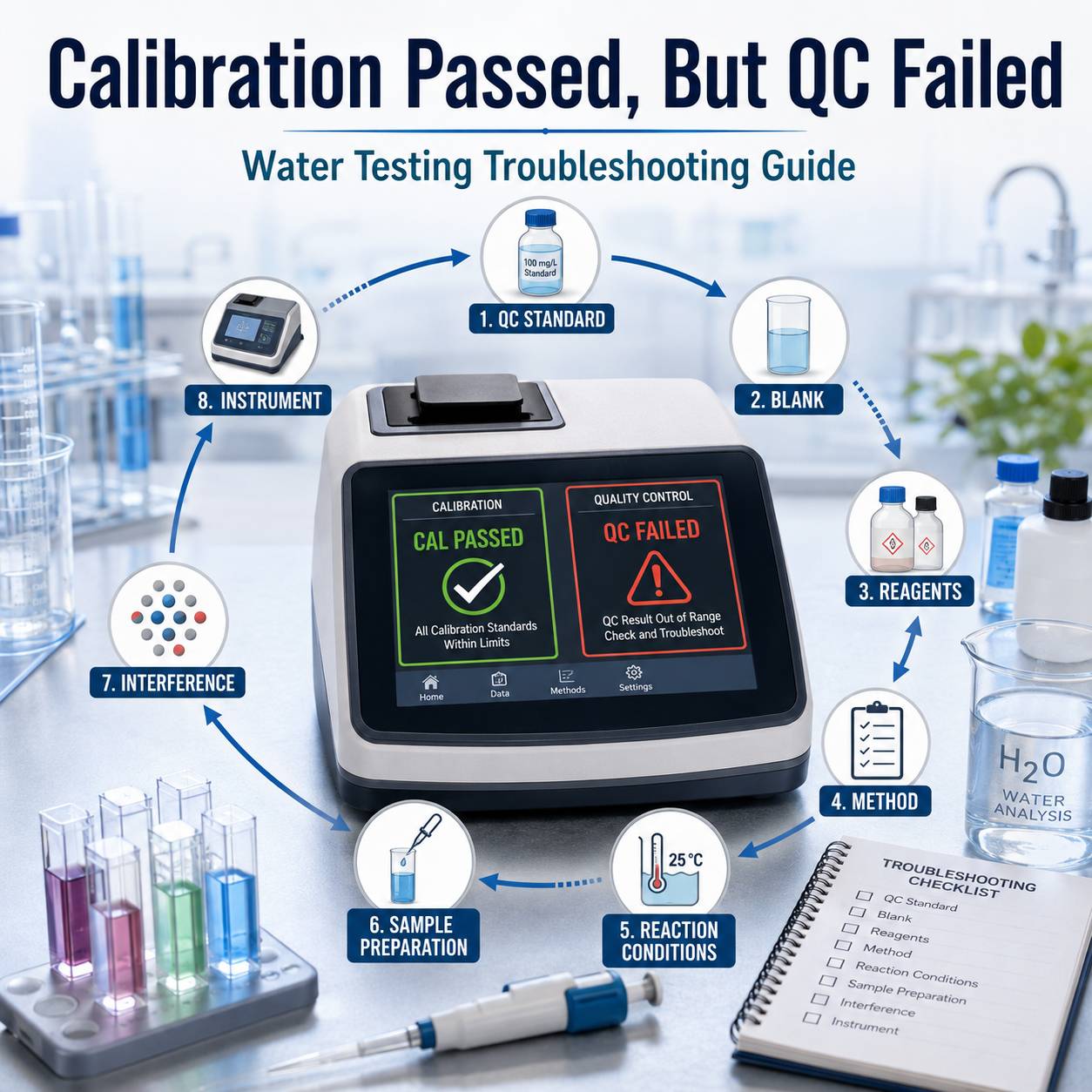
u The instrument was advanced, but the workflow was weak
This is why a laboratory result should not be judged only by the instrument model.
Good laboratory data comes from a complete system: sample quality + method selection + instrument performance + operator technique + quality control.
If any part of this system is weak, the final result may still be misleading.
The Biggest Difference Is the Decision Behind the Test
The most important difference between field testing and laboratory testing is not the instrument. It is the decision that the result is meant to support.
Field Testing vs Laboratory Testing in Water Quality Analysis
Comparison Point | Field Testing | Laboratory Testing |
Main purpose | Immediate on-site decision-making | Controlled and documented analysis |
Typical location | Sampling point, plant, pond, outlet, distribution system | Laboratory or controlled benchtop-testing area |
Common instruments | Portable pH meter, conductivity meter, DO meter, chlorine tester, turbidity meter, portable photometer | Benchtop photometer, spectrophotometer, COD reactor, digestion instrument, laboratory pH/EC meter |
Best for | Adjust chemical dosing, check treatment stability, confirm disinfection condition, monitor aquaculture water, detect sudden pollution, screen multiple locations quickly | Compliance reporting, discharge monitoring, process evaluation, historical data comparison, method validation, regulatory documentation, detailed parameter analysis |
Main advantage | Speed and real-time response | Control, repeatability, traceability |
Main limitation | Environmental variation and operator influence | Sample may change before analysis |
Common parameters | pH, temperature, conductivity, DO, residual chlorine, turbidity | COD, ammonia nitrogen, nitrate, phosphate, total phosphorus, total nitrogen, metals |
Common Misunderstandings About Field and Laboratory Testing
A few misunderstandings often lead to poor water quality decisions:
u Thinking that laboratory testing is always more “correct” than field testing
u Using field testing results for formal compliance without method confirmation
u Believing that a more advanced instrument can solve poor sampling practice
u Comparing field and laboratory results without considering time delay and sample stability
u Choosing instruments before defining which parameters and decisions matter most
In routine water analysis, the best result is not always the most complex result. It is the result that matches the sample condition, method requirement, and decision purpose.
Which Water Quality Parameters Are Better for Field Testing or Laboratory Testing?
Not all water quality parameters should be tested in the same way. Some parameters are better measured directly in the field because they are unstable, time-sensitive, or closely related to immediate process control. Other parameters are better tested in the laboratory because they require controlled reaction conditions, digestion, reagent development, blank correction, dilution, or formal quality control procedures.
In routine water quality analysis, the key question is not simply whether a parameter can be tested in the field or in the laboratory. The better question is: Does this parameter need an immediate on-site result, or does it require controlled laboratory confirmation?
The table below shows how common water quality parameters are usually assigned in practical testing workflows.
Parameter | Better for Field Testing | Better for Laboratory Testing | Main Reason |
Temperature | Yes | Sometimes | Temperature changes quickly and affects many other measurements. |
pH | Yes | Sometimes | pH may change after sampling due to CO₂ exchange, temperature change, and sample handling. |
Conductivity | Yes | Yes | Field testing helps detect immediate ionic changes; laboratory testing provides more controlled documentation. |
TDS | Yes | Sometimes | Often calculated from conductivity and useful for quick on-site screening. |
Dissolved Oxygen | Yes | Rarely | DO can change rapidly after sampling, especially due to aeration, biological activity, and temperature change. |
Residual Chlorine | Yes | Rarely | Chlorine residual can decay quickly during transport or storage. |
ORP | Yes | Sometimes | ORP is condition-sensitive and often used for real-time process control. |
Turbidity | Yes | Yes | Field testing supports quick checks; laboratory testing gives better control for formal reporting. |
Salinity | Yes | Sometimes | Useful for quick field screening in aquaculture, seawater, and brackish water applications. |
COD | Sometimes | Yes | Usually requires digestion, heating, reagents, reaction time, and photometric measurement. |
Ammonia Nitrogen | Sometimes | Yes | Field screening is possible, but laboratory testing gives better control over reaction conditions and interference. |
Nitrate | Sometimes | Yes | Often requires reagent reaction, wavelength selection, and method control. |
Nitrite | Sometimes | Yes | Can be screened in the field, but laboratory testing improves repeatability and documentation. |
Phosphate | Sometimes | Yes | Usually depends on colorimetric reaction, reagent timing, and optical measurement. |
Total Phosphorus | No | Yes | Requires digestion or conversion before measurement. |
Total Nitrogen | No | Yes | Requires controlled digestion or chemical conversion. |
Hardness | Sometimes | Yes | Field kits can screen hardness, but laboratory methods are more suitable for accurate reporting. |
Iron | Sometimes | Yes | Often affected by oxidation state, sample preservation, reagent reaction, and matrix interference. |
Manganese | Sometimes | Yes | Usually requires controlled colorimetric or instrumental analysis. |
Sulfate | Sometimes | Yes | Laboratory testing is preferred when accuracy and method control are required. |
Chloride | Sometimes | Yes | Field screening is possible, but laboratory testing is better for documented results. |
Heavy Metals | No | Yes | Usually require controlled sample preservation, digestion, and advanced analytical methods. |
BOD | No | Yes | Requires controlled incubation time and laboratory conditions. |
Color | Sometimes | Yes | Field observation is useful, but laboratory measurement gives more consistent and comparable data. |
In practice, many water quality programs use both field testing and laboratory testing together.
Field testing is most useful for parameters that answer: What is happening at this location right now?
Laboratory testing is most useful for parameters that answer: What is the confirmed result under controlled conditions?
For example, a wastewater treatment plant may use field meters to check pH, temperature, conductivity, dissolved oxygen, and residual chlorine during daily operation. At the same time, the laboratory may use a COD digestion instrument, photometer water quality analyzer, spectrophotometer, and standard methods to measure COD, ammonia nitrogen, phosphate, total phosphorus, total nitrogen, and other parameters. This combined workflow helps operators respond quickly on site while still keeping reliable laboratory data for compliance, reporting, and long-term process evaluation.
Why Field and Laboratory Results May Not Match Exactly
Field and laboratory results may differ because they are often measured under different time conditions, sample conditions, methods, instruments, and quality control environments. This does not always mean one result is wrong. Differences may come from:
1. Time delay
The sample may change between collection and laboratory analysis.
2. Temperature change
Temperature affects pH, conductivity, dissolved oxygen, reaction speed, and chemical equilibrium.
3. Sample instability
Some parameters are not stable after sampling.
4. Different methods
Field kits and laboratory methods may use different chemistry, ranges, reaction times, or calibration systems.
5. Sample matrix effects
Wastewater, industrial water, seawater, colored water, and high-turbidity samples may interfere with some measurements.
6. Operator technique
Both field and laboratory testing require consistent procedure.
7. Instrument range
A result near the upper or lower limit of an instrument’s range may be less reliable.
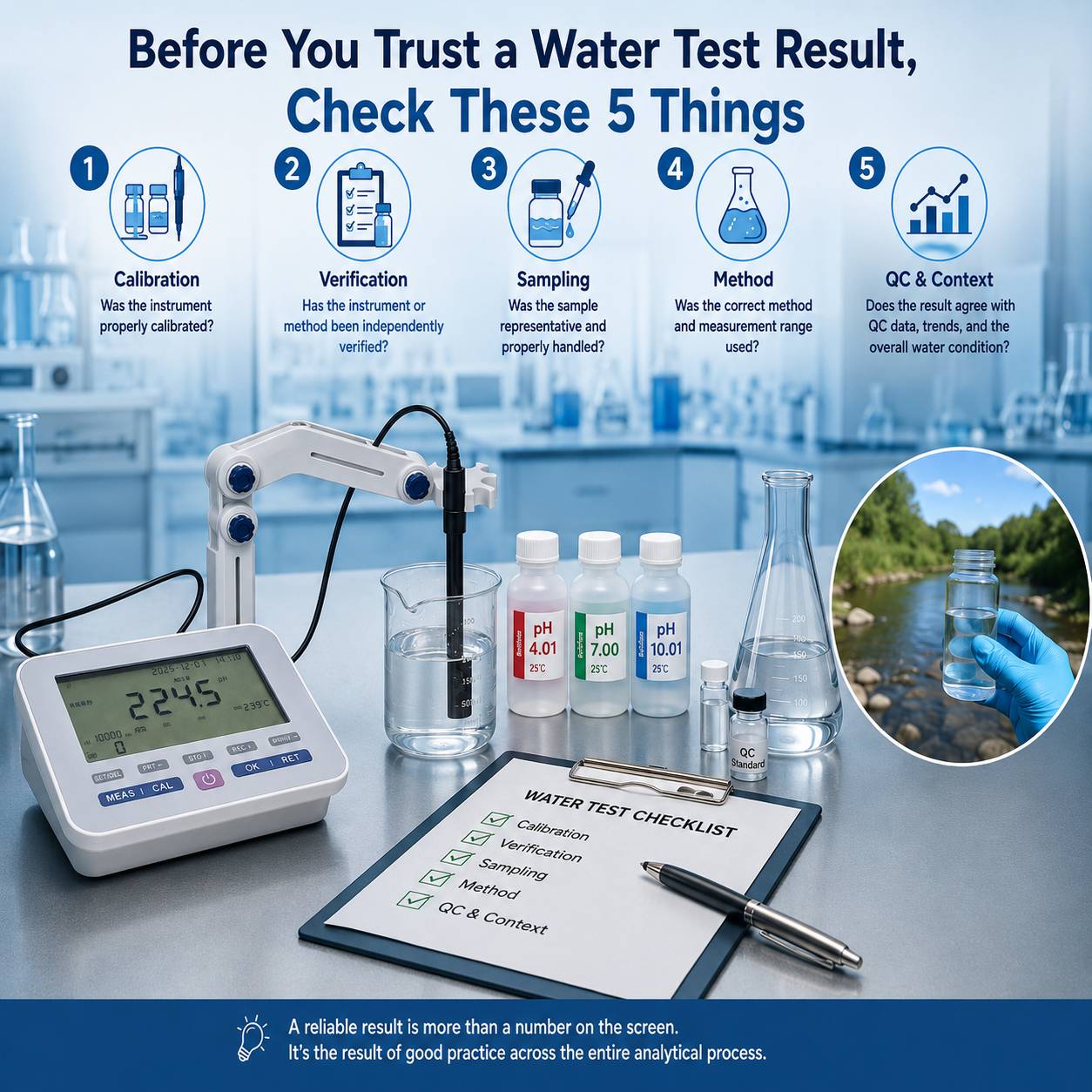
This is why result comparison should always consider the full testing context. A number without method information is incomplete data.
How to Build a Better Water Testing Workflow
A strong water quality testing program should not treat field testing and laboratory testing as competitors. They should work together. A practical workflow may look like this:
Step 1: Use field testing for immediate condition checks
Measure parameters that can change quickly or support real-time control, such as pH, temperature, conductivity, dissolved oxygen, residual chlorine, and turbidity.
Step 2: Collect samples correctly
Use suitable bottles, avoid contamination, record sampling location and time, and preserve samples properly when needed.
Step 3: Use laboratory testing for confirmed analysis
Analyze parameters that require controlled reaction conditions, digestion, photometric measurement, or formal documentation.
Step 4: Compare results with context
Do not compare field and laboratory data blindly. Consider time, temperature, method, range, sample handling, and purpose.
Step 5: Use the data to support decisions
The goal of water testing is not only to produce numbers. The goal is to make better decisions about safety, compliance, treatment, and process control.
Choosing Instruments Based on the Testing Job
When selecting water quality testing instruments, users should first define the testing scenario, target parameters, sample type, required accuracy, reporting purpose, and whether the result is needed for field screening, process control, or laboratory confirmation.
Instrument Requirements for Field Testing and Laboratory Testing
Comparison Point | Field Testing | Laboratory Testing |
Main purpose | Fast on-site measurement and immediate process decisions | Controlled analysis, method-based testing, and documented results |
Portability | Very important; instruments should be easy to carry and use on site | Less important; instruments are usually placed on a laboratory bench |
Response speed | Fast response is essential for real-time decisions | Speed is useful, but stability, repeatability, and method control are more important |
Operation | Simple operation is preferred because field conditions may be less controlled | Operation can be more detailed because trained users and controlled workflows are usually available |
Durability | Durable design and outdoor protection are important | Structural durability is still needed, but environmental protection is usually less critical |
Power supply | Battery operation is important for field use | Stable power supply is usually available in the laboratory |
Measurement stability | Stable probe performance is important under changing field conditions | Measurement stability and repeatability are critical for reliable laboratory data |
Calibration | Easy and quick calibration is preferred | Calibration support should be more complete and suitable for method-based analysis |
Optical performance | Useful for portable photometers, but usually focused on practical field screening | Good optical performance and accurate wavelength selection are important for photometers and spectrophotometers |
Method compatibility | Usually focused on common field parameters and fast screening methods | Very important for COD, ammonia nitrogen, phosphate, nitrate, metals, and other routine laboratory parameters |
Digestion support | Usually limited; not suitable for many digestion-based tests | Reliable digestion support is important for COD, total phosphorus, total nitrogen, and related parameters |
Data recording | Practical data recording is useful for field notes and site comparison | Data storage and traceability are important for reporting, quality control, and historical comparison |
Accessories | Portable probes, field cases, batteries, simple reagents, and protective accessories | Suitable cuvettes, vials, digestion tubes, reagents, standards, and laboratory accessories |
Typical instruments | Portable pH meters, conductivity meters, dissolved oxygen meters, chlorine testers, turbidity meters, portable photometers | Benchtop photometer water quality analyzers, spectrophotometers, COD digestion instruments, pH meters, conductivity meters, and other laboratory analyzers |
For many routine water laboratories, the practical solution is not a single universal instrument, but a combination of portable meters, photometer water quality analyzers, digestion instruments, and, when necessary, spectrophotometers. This allows users to separate fast on-site checks from controlled laboratory analysis while keeping the workflow efficient and cost-effective.
A Practical Example: Wastewater Testing
In a wastewater treatment plant, field testing and laboratory testing often work together.
Field testing may be used for:
l pH at inlet and outlet
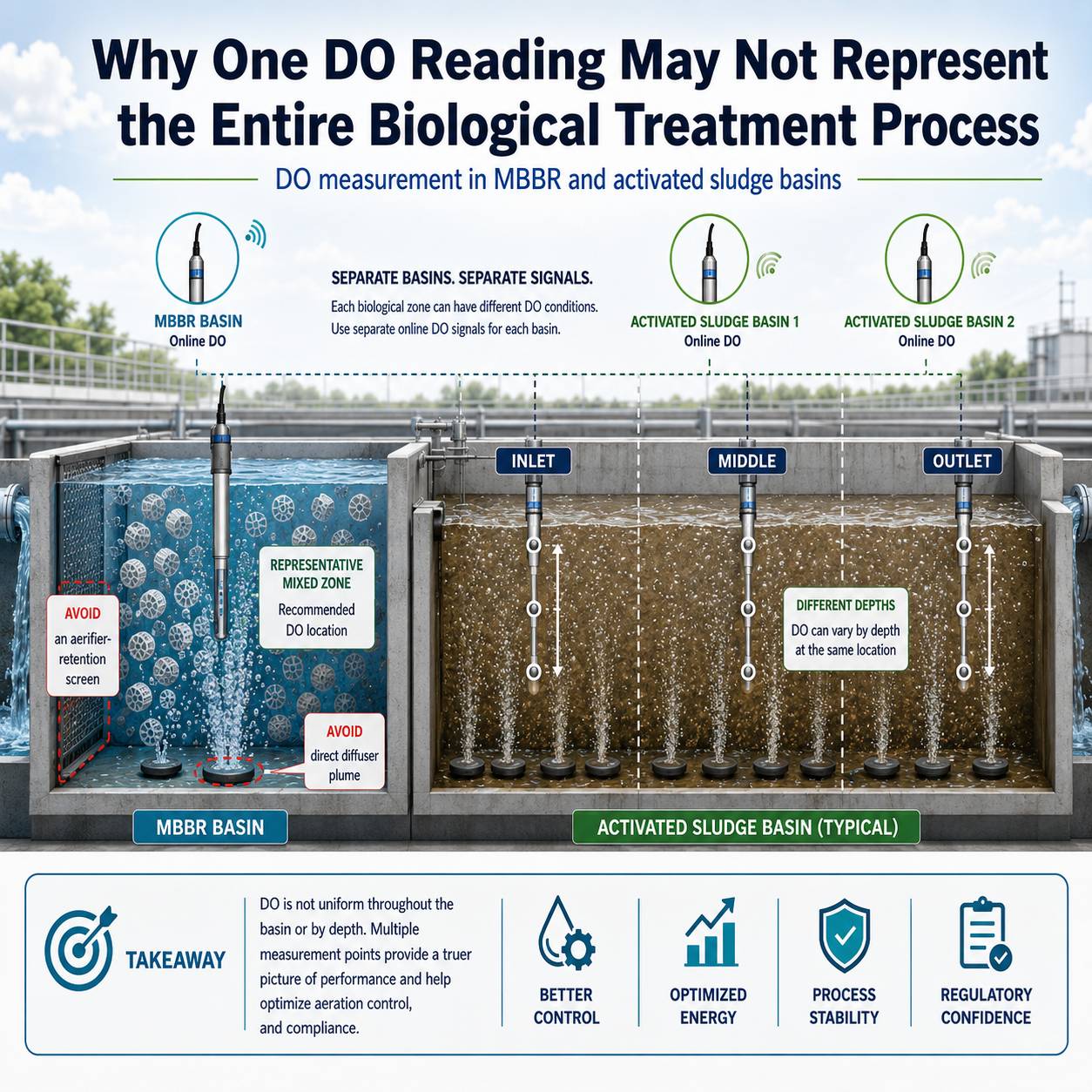
l DO in aeration tanks
l Conductivity changes
l Temperature
l Turbidity or suspended solids screening
l Quick ammonia or phosphate checks in some cases
Laboratory testing may be used for:
n COD
n Ammonia nitrogen
n Total nitrogen
n Total phosphorus
n BOD
n Suspended solids
n Metals
n Compliance reporting
The field data helps operators respond quickly. The laboratory data helps confirm treatment performance and compliance. Neither one replaces the other. Together, they create a more complete picture of the water system.
A Practical Example: Drinking Water Testing
In drinking water systems, field testing is often essential for parameters that change during distribution.
Field testing may include:
l Residual chlorine
l pH
l Conductivity
l Turbidity
l Temperature
Laboratory testing may include:
n Microbiological analysis
n Metals
n Nutrients
n Organic indicators
n More detailed chemical analysis
A clear water sample may look safe, but without proper testing, important risks can still be missed. This is why both field and laboratory testing are important for drinking water monitoring.
Field Testing and Laboratory Testing Should Not Be Judged by the Same Standard
A field instrument should not be expected to do everything a laboratory system can do. A laboratory instrument should not be expected to replace real-time field observation. Each has its own value.
Field testing is strongest when the question is: What is happening here, right now?
Laboratory testing is strongest when the question is: What is the confirmed result under controlled conditions?
When users understand this difference, they can avoid overbuying, under-testing, or misinterpreting water quality data.
FAQ
What is the main difference between field testing and laboratory testing in water quality analysis?
Field testing is performed on site and is mainly used for immediate decisions. Laboratory testing is performed under controlled conditions and is better suited for confirmed analysis, documentation, and compliance reporting.
Is field water testing less accurate than laboratory testing?
Not always. Field testing can be reliable when the instrument is properly calibrated and the procedure is well controlled. However, field conditions often introduce more variables, such as temperature, operator technique, sample handling, and environmental interference.
Which water quality parameters should be tested in the field?
Common field parameters include pH, temperature, conductivity, TDS, dissolved oxygen, residual chlorine, ORP, salinity, and turbidity. These parameters are often time-sensitive or useful for immediate operational control.
Which parameters are better tested in the laboratory?
COD, ammonia nitrogen, nitrate, phosphate, total phosphorus, total nitrogen, metals, hardness, and many colorimetric parameters are often better tested in a laboratory or controlled bench-testing environment.
Why do field and laboratory water test results sometimes differ?
Differences may come from sample changes, time delay, temperature variation, different methods, preservation conditions, matrix interference, operator technique, or instrument range limitations.
Should a water treatment plant use field testing or laboratory testing?
Most water treatment plants need both. Field testing supports immediate process control, while laboratory testing supports confirmed analysis, trend monitoring, and compliance reporting.
Can field testing replace laboratory testing?
Field testing cannot fully replace laboratory testing. It is useful for immediate on-site checks and time-sensitive parameters, but laboratory testing is still needed for controlled analysis, compliance reporting, complex chemical parameters, and formal documentation.
Why is pH often tested in the field instead of only in the laboratory?
pH can change after sampling due to temperature variation, CO₂ exchange, biological activity, or sample handling. Measuring pH in the field often gives a better picture of the actual water condition at the sampling point.
What instruments are commonly used for routine water quality testing?
Common instruments include portable pH meters, conductivity meters, dissolved oxygen meters, chlorine testers, turbidity meters, photometer water quality analyzers, COD digestion instruments, and spectrophotometers. The right choice depends on the parameter, sample type, method requirement, and testing purpose.
Conclusion
Field testing and laboratory testing are not the same job. They use different tools, support different decisions, and require different expectations.
Field testing provides speed, immediacy, and on-site understanding. It is strongest when the question is: what is happening here, right now? Laboratory testing provides control, documentation, and more complete analytical confidence. It is strongest when the question is: what is the confirmed result under controlled conditions?
For routine water quality analysis, the best approach is not to choose one and ignore the other. The better approach is to build a testing workflow where each method is used for the job it does best.
Because reliable water quality data does not come from the instrument alone. It comes from matching the right parameter, the right method, the right instrument, and the right decision.