+852 46135220

pH is one of the most common parameters in water testing. It is widely used in drinking water, wastewater, industrial process water, cooling water, boiler water, aquaculture, environmental monitoring, and laboratory quality control.
Because pH measurement is so common, it is often treated as a simple routine operation:
l Place the electrode into the sample;
l Wait for the reading;
l Record the value.
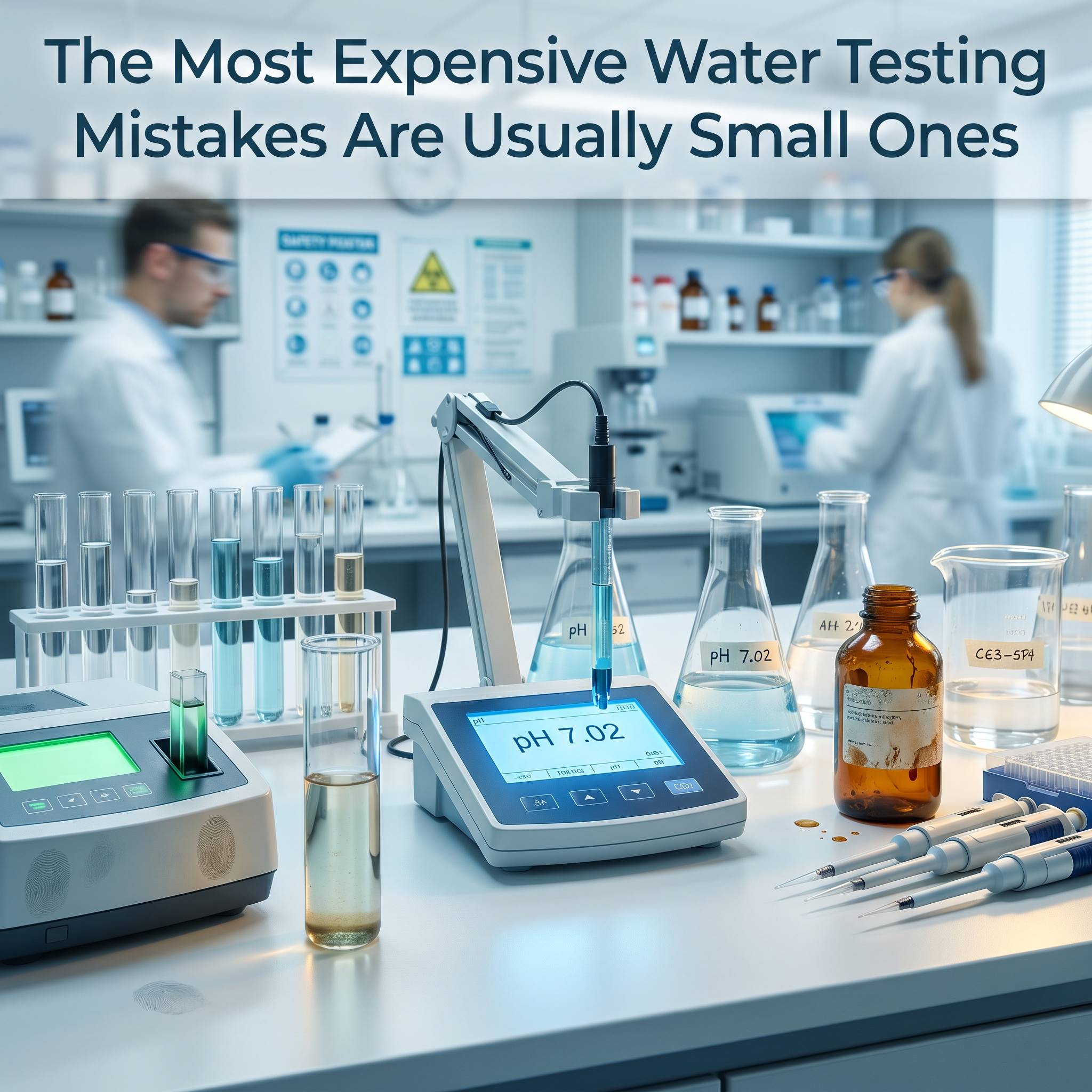
However, in reality, reliable pH measurement in water testing depends on controlling the entire measurement system, not only the pH meter. The most important factors include proper pH electrode selection, fresh calibration buffers, stable temperature conditions, sample matrix awareness, sufficient reading stabilization time, and correct electrode cleaning and storage. In routine water analysis, a pH result should only be trusted when the measurement process behind the number is controlled.
For routine water testing, the real question is not only:
“What is the pH value?”
The more important question is:
“Can this pH value be trusted?”
Why pH Data Reliability Is Critical in Water Testing
pH affects many physical, chemical, and biological processes in water systems. In wastewater treatment, pH can affect biological activity, chemical dosing, coagulation, nitrification, and discharge compliance. In drinking water treatment, pH influences corrosion control, disinfection efficiency, taste, and distribution system stability. In industrial water systems, pH is closely related to scaling, corrosion, process control, and equipment protection.
Even a small pH error may lead to incorrect operational decisions. For example, an operator may adjust chemical dosing based on an unstable pH reading. A laboratory may report a value that does not truly represent the sample condition. A process engineer may misjudge whether the water system is within its controlled range.
Therefore, pH measurement should not be regarded merely as a basic test. It is a routine measurement that requires proper control.
A pH Meter Alone Cannot Guarantee Reliable Data
Many users mainly focus on the technical specifications of the pH meter, such as resolution, accuracy, display mode, data storage, or automatic temperature compensation. These features are important, but they alone cannot guarantee reliable results. In practical water testing, the pH electrode often plays an even more critical role than the meter itself.
A complete pH measurement system includes:
l the pH meter;
l the pH electrode;
l the reference system;
l calibration buffers;
l sample conditions;
l the operator’s measurement technique;
l electrode cleaning and storage practices.
If any part of this system is not properly controlled, the final pH value may become unreliable.
For example, a high-precision pH meter connected to an aged, dry, contaminated, or unsuitable electrode can still produce poor-quality data. Similarly, even if the electrode is properly designed, readings may still become unstable if the calibration buffers are contaminated or if samples are measured under inconsistent conditions.
Reliable pH data comes from the entire measurement process, not from a single instrument specification. In other words, pH measurement accuracy is not determined by the meter specification alone. It is determined by the compatibility between the meter, electrode, sample, calibration method, and operator practice
1. Electrode Selection Directly Affects pH Measurement Reliability
Not all water samples are suitable for the same type of pH electrode. In routine water testing, sample characteristics can vary greatly. Some samples are clean and contain low levels of suspended solids. Others may contain oil, sludge, organic matter, salts, chemicals, or high concentrations of pollutants. Some samples have low ionic strength, while others have high conductivity. Some are measured in the laboratory, while others are measured directly in the field or in a process line.
Different sample types place different requirements on pH electrodes.
u For relatively clean water samples, a standard laboratory pH electrode may be sufficient. But for wastewater, industrial process water, or samples containing suspended solids, the electrode junction is more likely to become blocked or contaminated, resulting in slow response, drifting readings, or unstable results.
u For low-conductivity samples, such as purified water, reverse osmosis permeate, and deionized water, pH measurement can be more difficult because the sample has extremely low ionic strength. In such cases, the reading may continue to drift and require a longer time to stabilize. Choosing a suitable electrode and using the correct measurement technique are essential.
u For high-temperature or chemically aggressive samples, the electrode material and reference system should also be carefully considered.
This means electrode selection should be based on the sample matrix, not only on the pH range.
A practical question engineers should ask is: “What type of water sample will this electrode measure most frequently?”
The answer to this question often determines whether the pH result will be stable and reliable.
Engineer’s Extended Reading: Key Technical Points in Electrode Selection
The type of pH glass membrane should match the sample temperature range and chemical compatibility requirements. For solutions containing HF or strong alkali, special materials may be required, such as antimony electrodes or HF-resistant glass.
The design of the reference junction, such as ceramic, fiber, open junction, or sleeve junction, directly affects contamination resistance and response speed. Porous ceramic junctions are suitable for clean water samples, while removable sleeve junctions are more suitable for samples with high suspended solids or a strong tendency to contaminate the electrode.
The choice of reference electrolyte, such as 3 mol/L KCl gel versus refillable liquid electrolyte, affects the stability and service life of the reference electrode. Engineers should select electrodes based on sample conductivity, temperature, chemical composition, and contamination tendency. The electrode should be treated as a critical sensing component matched to the application, not as a universal consumable.
2. Calibration Is Not Just a Formal Step
Calibration is one of the most important steps in pH measurement, but it is often treated as a simple routine procedure. In practice, calibration quality directly affects measurement reliability.
The response of a pH electrode changes over time. Due to aging, contamination, dehydration, or changes in the reference system, both the electrode slope and zero-point offset may change. Calibration helps the instrument understand the current response condition of the electrode.
However, calibration only works properly when it is performed correctly. Several factors are critical.
u First, buffer solutions must be fresh and clean. If the calibration buffer is contaminated, expired, or reused too many times, the calibration result may be misleading.
u Second, the selected calibration points should cover the expected sample range. For most routine water samples, two-point calibration is commonly used. If the expected pH range is wide or stricter control is required, three-point calibration may be more appropriate.
u Third, the electrode should be thoroughly rinsed between different buffers and between buffer and sample. Cross-contamination between buffers can affect calibration accuracy.
u Fourth, calibration status should be checked regularly. The required frequency depends on the application, sample type, electrode condition, and laboratory quality requirements. In demanding routine testing, daily calibration or verification may be necessary.
A stable calibration result does not automatically mean that every sample measurement will be reliable. Calibration controls the meter-electrode response under buffer conditions. Real water samples may still introduce matrix effects, extended stabilization time, or contamination problems. Therefore, calibration should be understood as part of quality control, not simply as a button pressed before measurement.
Engineer’s Extended Reading: Diagnostic Meaning of Calibration Slope and Zero-Point Drift
The Nernst equation defines the theoretical slope of a pH electrode, which is 59.16 mV/pH at 25°C. In actual calibration, the slope is usually expressed as a percentage of the theoretical value.
A new electrode should generally have a slope greater than 95%, which is approximately 56.2 mV/pH. If the slope of an electrode in use drops below 85%, or approximately 50 mV/pH, this usually indicates severe aging or contamination.
If the zero-point drift, meaning the potential offset at pH 7, exceeds ±30 mV, it usually suggests contamination of the reference electrode or blockage of the junction. Recording and tracking slope and zero-point trends is a key method for engineers to evaluate electrode health and arrange maintenance or replacement in advance. This is far more useful than relying only on a simple pass/fail calibration result.
3. Temperature Affects More Than the Instrument Reading
Temperature is another key factor in pH measurement. Many pH meters are equipped with automatic temperature compensation, also known as ATC. This function is useful because electrode response changes with temperature. ATC helps compensate for the effect of temperature on electrode response slope.
However, one common limitation must be clearly understood: Automatic temperature compensation does not change the chemistry of the sample.
The actual pH of a water sample may change with temperature because chemical equilibria in the water can shift. For example, the carbonate system, ammonia-ammonium balance, and other chemical reactions are temperature-dependent.
This means ATC helps correct the electrode response, but it cannot make a pH value measured at one temperature exactly equivalent to a pH value measured at another temperature.
For reliable routine testing, users should pay attention to the following:
l measure samples under consistent temperature conditions;
l record sample temperature when necessary;
l allow the electrode and sample to reach reasonable temperature equilibrium;
l avoid directly comparing pH results measured under very different conditions.
In routine water analysis, consistency is often just as important as instrument resolution.
Engineer’s Extended Reading: Engineering Strategies for Managing Temperature Effects
A 5°C change in sample temperature may cause a pH change of 0.1 to 0.2 units, depending on the buffering capacity of the sample. In precision control applications, such as power plant boiler feedwater or pharmaceutical water, the sample temperature should be controlled within 25 ± 2°C during measurement. Alternatively, dedicated instruments with built-in temperature conversion tables may be used to record the “25°C equivalent pH value.”
It is important to note that ATC only compensates for changes in electrode slope, or the Nernst factor. It does not compensate for the true temperature coefficient of the solution itself, expressed as ΔpH/ΔT. For high-purity water, temperature-related changes in CO₂ solubility in an open system can significantly affect pH. Measurement should be performed in a closed flow-through cell to avoid interference from atmospheric CO₂.
4. Low-Conductivity Water Is Not Easy to Measure
Many users assume that clean water is easier to test. However, for pH measurement, this is not always true. Low-conductivity water samples, such as purified water, reverse osmosis permeate, deionized water, condensate, or certain high-purity water samples, can be difficult to measure accurately.
The reason is that these samples contain very few ions. This leads to low conductivity around the electrode, unstable liquid junction potential, slow response, and drifting readings.
In low-conductivity water, the pH value may not stabilize quickly. Even when the instrument and electrode are functioning properly, the reading may still move slowly.
For this type of sample, reliable measurement may require:
l an electrode suitable for low-ionic-strength samples;
l gentle stirring to create a stable measurement environment;
l sufficient stabilization time before recording the result;
l avoidance of contamination from air, containers, rinsing water, or previous samples;
l careful operation to reduce CO₂ absorption from the atmosphere.
Low-conductivity water is a good example showing that pH measurement should not be judged only by whether the instrument displays a number. The stability and meaning of that number must also be considered.
Engineer’s Extended Reading: Engineering Solutions for Low-Conductivity pH Measurement
When measuring pure water with conductivity below 10 µS/cm, flow potential and liquid junction potential drift are major sources of interference. It is recommended to use a specially designed low-ionic-strength pH electrode with a larger junction area and a fast ion-exchange pathway, such as a refillable sleeve-junction electrode with high-concentration KCl reference electrolyte.
Using a flow-through cell for closed online measurement is considered a good engineering practice. It helps eliminate the influence of atmospheric CO₂ and maintains a stable flow rate, typically recommended at 50–100 mL/min. Even under these conditions, the repeatability of pure water pH readings may still be within ±0.1 pH. Engineers should set reasonable process control limits based on this reality.
5. Sample Matrix Can Interfere with Measurement
Real water samples are different from standard buffer solutions. Buffer solutions are designed to provide stable and predictable calibration conditions. Actual water samples may contain suspended solids, oil, organic matter, surfactants, salts, oxidants, reducing agents, or other substances that affect electrode response.
In wastewater samples, solids and organic matter may cover the glass membrane or block the junction. In industrial water samples, chemical additives may influence electrode behavior. In high-ionic-strength samples, readings may be more stable, but matrix effects can still occur depending on the composition.
This is why the sample matrix should always be considered when evaluating pH data. A slow, drifting, or inconsistent pH reading does not always mean the instrument is faulty. It may indicate that the electrode is not suitable for the sample, the junction is contaminated, the sample is not homogeneous, or the measurement method needs adjustment.
For routine laboratories, it is useful to record not only the final pH value but also signs of measurement quality, such as response time, stability, electrode condition, and cleaning frequency.
Engineer’s Extended Reading: Interference Mechanisms and Countermeasures for Special Sample Matrices
u Oily wastewater:
Oil films may cover the glass membrane and slow down the electrode response. A removable electrode should be used, and after measurement, the electrode should be cleaned with a mild surfactant and thoroughly rinsed.
u Protein-containing samples:
Proteins may deposit on the membrane surface and junction, changing the surface potential. A pepsin/hydrochloric acid cleaning solution can help restore electrode performance.
u Samples containing sulfides or reducing substances:
These may poison the silver/silver chloride element of the reference electrode, causing potential drift. A double-junction reference system, with KNO₃ or saturated KCl gel as the outer salt bridge, can help delay contamination.
u Wastewater with high suspended solids:
Open-junction or large-area annular-junction electrodes are recommended. During measurement intervals, mechanical self-cleaning methods, such as water spray cleaning or ultrasonic cleaning, may be used to maintain data continuity.
6. Electrode Cleaning and Storage Are Part of Data Quality
pH electrodes are sensitive measuring devices, and their performance depends heavily on proper maintenance. One of the most common mistakes is allowing the pH glass membrane to dry out. A dried electrode may respond slowly or inaccurately. Rehydration may partially restore performance, but repeated drying will shorten the electrode’s service life.
Another common mistake is storing the electrode in deionized water. This may damage the reference system or cause internal ions in the electrode to leach out, affecting performance. In most cases, pH electrodes should be stored in the special electrode storage solution recommended by the manufacturer.
Cleaning is also important. Different samples may require different cleaning methods. Wastewater, oily samples, protein-containing samples, or samples containing deposits may leave residues on the electrode surface or junction. If the electrode is not properly cleaned, readings may become slow, unstable, or biased.
Routine users should develop simple but consistent electrode maintenance habits:
l rinse the electrode after measurement;
l avoid aggressively wiping the glass membrane;
l store the electrode in the correct storage solution;
l clean the electrode according to sample type;
l replace the electrode when response becomes poor or calibration repeatedly fails.
Good electrode maintenance is not only about extending electrode service life. It is directly related to the reliability of pH data.
Engineer’s Extended Reading: Engineering Management of Electrode Maintenance
An electrode maintenance log should be established to record the start-of-use date, calibration slope and zero-point history, cleaning frequency, and failure symptoms for each electrode. Cleaning cycles should be defined for electrodes used at different process points. For example, online electrodes may be cleaned once per week, while laboratory electrodes may require daily response-time checks.
Common cleaning methods include soaking in 0.1 mol/L HCl to remove inorganic scale, using pepsin cleaning solution to remove proteins, and applying mild detergent to remove oil.
After cleaning, the electrode must be soaked in storage solution or 3 mol/L KCl for at least 2 hours to restore junction equilibrium. When the slope falls below 50 mV/pH and cleaning is no longer effective, the electrode should be retired from service.
7. Reading Stability Is More Important Than Instant Display
Modern pH meters can display values quickly. However, a fast display does not always mean that the reading has stabilized. In routine testing, users may record the first number they see, especially when processing a large number of samples. This can lead to inconsistent results.
pH measurement requires time for the electrode response to reach stability. The required time depends on sample type, electrode condition, temperature difference, ionic strength, and contamination level. For clean and well-buffered samples, stabilization may be fast. For low-conductivity water, wastewater, or complex industrial samples, stabilization may take longer.
Instead of focusing only on speed, users should pay attention to:
l whether the reading is still drifting;
l whether the instrument’s stability indicator has appeared;
l whether the response time is longer than normal;
l whether repeated measurements are consistent.
A slow or unstable reading is often an important warning signal. It may indicate electrode aging, contamination, unsuitable electrode selection, or difficult sample conditions.
Several common pH measurement problems can be traced back to electrode condition, sample characteristics, or measurement procedure.
Problem | Possible Cause | Practical Check |
pH reading keeps drifting | Low-conductivity sample, unstable junction potential, or electrode aging | Check sample type, stabilization time, and electrode condition |
Slow electrode response | Contaminated glass membrane, blocked junction, or dry electrode | Clean and rehydrate the electrode |
Calibration fails repeatedly | Aged electrode, contaminated buffer, or incorrect calibration procedure | Replace buffers and check electrode slope |
Different operators get different results | Inconsistent rinsing, stabilization time, or temperature control | Standardize measurement procedure |
Sudden pH change in process water | Real process change or measurement system fault | Verify with buffer, second electrode, or control sample |
Engineer’s Extended Reading: Quantitative Criteria for Stabilization Time
In engineering applications, a “stability criterion” can be defined as follows: the reading changes by less than 0.01 pH per 10 seconds within a continuous 30-second period. For clean water samples, the typical stabilization time is usually no more than 60 seconds. For low-conductivity water samples, stabilization may take 3–5 minutes.
If the stabilization time becomes significantly longer, it is necessary to check for electrode aging, junction blockage, or sample temperature gradients. In automated online measurement systems, the stabilization waiting time should be programmed into the control logic to avoid triggering incorrect chemical dosing actions before the reading has stabilized.
8. Routine Quality Control Helps Detect Problems Early
For laboratories and water treatment facilities, pH measurement should be included in routine quality control. Quality control does not need to be complicated, but it should be consistent.
Common practices include:
ü regular calibration or verification using standard buffers;
ü recording calibration slope and zero point when available;
ü checking electrode response time;
ü using control samples or known reference materials;
ü recording cleaning and maintenance activities;
ü replacing electrodes based on performance rather than only service time;
ü training operators to recognize abnormal readings.
These practices help detect problems before they affect reported data or operational decisions.
For example, if the electrode takes longer and longer to stabilize, it may indicate aging or contamination. If the calibration slope becomes poor, the electrode may need cleaning or replacement. If the pH value of a process sample suddenly changes, the cause may be a real process change or a measurement system fault.
Routine quality control helps distinguish between these possibilities.
Engineer’s Extended Reading: Building a Quality Control Framework for pH Measurement Systems
A three-level quality control system is recommended.
Level 1: Daily single-point verification using pH 7 buffer, with deviation controlled within ±0.1 pH.
Level 2: Weekly two-point calibration with recording of slope and zero point.
Level 3: Monthly verification of the entire system using certified reference materials, such as potassium hydrogen phthalate standard solution with pH 4.005 at 25°C.
For critical process control points, such as the outlet pH of a neutralization tank, dual-electrode comparison is recommended. When the readings of two electrodes installed at the same location differ by more than 0.2 pH, a maintenance work order should be triggered.
Practical pH Measurement: The Key Is Controlling the Entire Process
In water testing, pH measurement appears simple because the operation is familiar. But reliable pH data depends on many practical details.
l The meter matters.
l The electrode matters.
l Calibration matters.
l Temperature matters.
l Sample matrix matters.
l Cleaning and storage matter.
l Operator technique matters.
A pH value should not be trusted simply because it appears on a digital screen. It should be trusted because the measurement process behind it is properly controlled. For routine water testing, the goal is not only to measure pH quickly. The goal is to obtain pH data that can support correct decisions. Whether the application is drinking water, wastewater, industrial water, environmental monitoring, or laboratory analysis, reliable pH measurement depends on a deep understanding of both the instrument and the sample.
Conclusion
pH remains one of the most important and widely used parameters in water testing. It appears simple to measure, but reliable measurement is not always easy. A reliable pH result requires more than a pH meter. It requires the correct electrode, proper calibration, controlled temperature conditions, awareness of sample matrix effects, and regular electrode maintenance.
In routine water analysis, the reliability of pH data is built through practical control of the entire measurement process. When this process is well managed, pH measurement is no longer just a routine number. It becomes a powerful tool for process control, water quality evaluation, and operational decision-making.