+852 46135220

In water and wastewater laboratories, a common assumption persists: “The more advanced the instrument, the more accurate the data.” This belief often leads laboratories to purchase high-end, over-specified analytical instruments before fully understanding their actual operational needs.
From an engineering and laboratory management perspective, this assumption is not only flawed but often results in cost burdens that far exceed the initial purchase price. In routine water analysis, instrument over-specification often reduces efficiency rather than improving accuracy. When standardized methods, fixed wavelengths, and high-frequency testing dominate daily work, excess optical capability adds operational cost without delivering proportional analytical value.
This article examines the hidden costs of over-specified instruments in routine water analysis and explains why aligning instrument capability with real laboratory workflows and process-control requirements frequently delivers more reliable data at a lower total cost.
1. More Features Do Not Equal Higher Accuracy
Many laboratories equate instrument complexity with analytical accuracy. In routine water analysis, however, accuracy is driven by process control, not optical sophistication.
Factors more critical than advanced optics include:
l Sample representativeness and proper preservation
l Consistency of pretreatment and digestion
l Reaction time and temperature control
l Calibration discipline and quality assurance
l Operator training and error-proof design
Optical performance is a necessary foundation. But once an instrument meets standard-method requirements for fixed wavelength measurement, photometric linearity, and stability, additional optical complexity contributes little to routine accuracy.
Engineering insight: Accuracy is a system-level outcome for routine or standardized water analysis, not an instrument-level specification. But if the instrument is for research, method development, or unknown compound analysis, higher optical flexibility performance may be justified.
2. The Hidden Costs of Over-Specified Instruments
A. Higher Training and Skill Requirements
Over-specified instruments typically require:
l Complex software operation
l Understanding of spectral analysis principles
l Frequent calibration and performance verification
l Strong analytical chemistry background
In routine laboratories with frequent staff rotation and mixed technical backgrounds, this leads to:
u Longer onboarding time for new staff
u Increased training frequency and cost
u Higher risk of configuration errors
u Over-reliance on a small number of key experts
Field data: An environmental monitoring station reported that after purchasing high-end spectrophotometers, the time for new staff to work independently increased from 2 weeks to 6 weeks. Human-operation error rates during the first three months were three times higher than when using dedicated water photometers.
B. Increased Maintenance Burden and Downtime Risk
Advanced optical systems often include:
l Moving components (e.g., grating drive mechanisms)
l Precision mechanical assemblies
l Environment-sensitive light sources
These designs increase the risk of:
u More frequent calibration drift
u Higher mechanical failure rates
u Greater sensitivity to temperature and vibration
u Higher service and maintenance contract costs
Engineering reality: Operational data from a large wastewater treatment plant showed that the annual maintenance cost of high-end spectrophotometers (including parts, service, and calibration) was 4–5 times higher than that of dedicated water photometers, with an additional 120 hours of downtime per year.
C. Higher Total Cost of Ownership
The true cost of over-specified instruments includes:
l Purchase price (often 2–3× higher)
l Calibration and maintenance expenses
l Productivity loss due to downtime
l Labor cost of specialized technical staff
l Ongoing training investment
These hidden costs often far exceed the initial price difference.
Five-year cost comparison (typical):
u Initial purchase: ~3× that of dedicated water photometers
u Annual maintenance: ~6–10× higher
u Training cost: ~5–8× higher
u Downtime loss: significantly higher due to complexity
u Total 5-year ownership cost: 3.5–4.5× higher, excluding full valuation of downtime and compliance risk
These costs are easily overlooked during procurement but steadily erode laboratory efficiency and budgets over time.
3. Workflow Mismatch: When Features Become a Burden
Routine water analysis follows standardized methods with fixed measurement wavelengths:
l COD: endpoint measurement at fixed wavelengths (e.g., 600 nm or 440 nm)
l Ammonia nitrogen: Nessler method (420 nm) or salicylate method (697 nm)
l Total phosphorus / total nitrogen: fixed wavelengths after digestion and color development
l Nitrate / nitrite: fixed-wavelength colorimetric measurement
In these workflows:
ü Endpoint wavelengths are defined by standards
ü Spectral scanning adds no value
ü Optical complexity increases cost without improving results
Engineering evidence: Operational data from multiple large wastewater treatment plants show that laboratories using well-designed dedicated water photometers often achieve better long-term data completeness and stability for routine parameters than those using more complex spectrophotometers. The reason is simple: complexity increases the risk of operator error, which poses a greater threat to data quality than optical limitations.
4. Operator Dependency: A Neglected Error Amplifier
High-end instruments often assume highly trained operators. In reality, routine wastewater laboratories typically face:
l High staff turnover
l Shift work with shared instruments
l Wide variation in analytical skill levels
Error risk increases when instruments require:
u Manual wavelength selection (Risk of misconfiguration)
u External calibration curve management (Calculation errors, transcription errors)
u Complex parameter configuration (Accidental setting changes, restoration of default values)
u Multi-step operating sequences (Omitted steps, incorrect sequence)
Engineering solution: Choose instrument designs that reduce operator dependency:
ü Method-linked wavelength control (Select the program of specific parameter, and the instrument automatically switches to the corresponding wavelength)
ü Direct concentration readout (No external calculations are required)
ü Built-in reaction timers with audible alerts (An audible alert sounds when the time is up, ensuring consistent color development time)
ü Automatic data storage with time, method, and operator traceability (Results are automatically saved, including time, method, and operator information)
Engineering conclusion: Human-factors engineering in water analysis refers to designing instruments that actively prevent incorrect operation, rather than assuming ideal operator expertise. Instruments designed with human-factors engineering often deliver better long-term data quality than technically superior but operationally complex systems.
5. When Are High-End Instruments Truly Necessary?
This article does not dismiss the value of advanced instruments. They are essential in certain scenarios:
Appropriate applications for over-specified instruments:
ü New method development and validation
ü Unknown compound identification and qualitative analysis
ü Research involving complex matrices and spectral correction
ü Teaching and demonstration of spectral principles
When analytical tasks are exploratory and open-ended, advanced optical capability creates real value. For routine, standardized, high-frequency compliance and process-control testing, however, the opposite is true.
6. Choosing the Right Tool: A Decision Framework
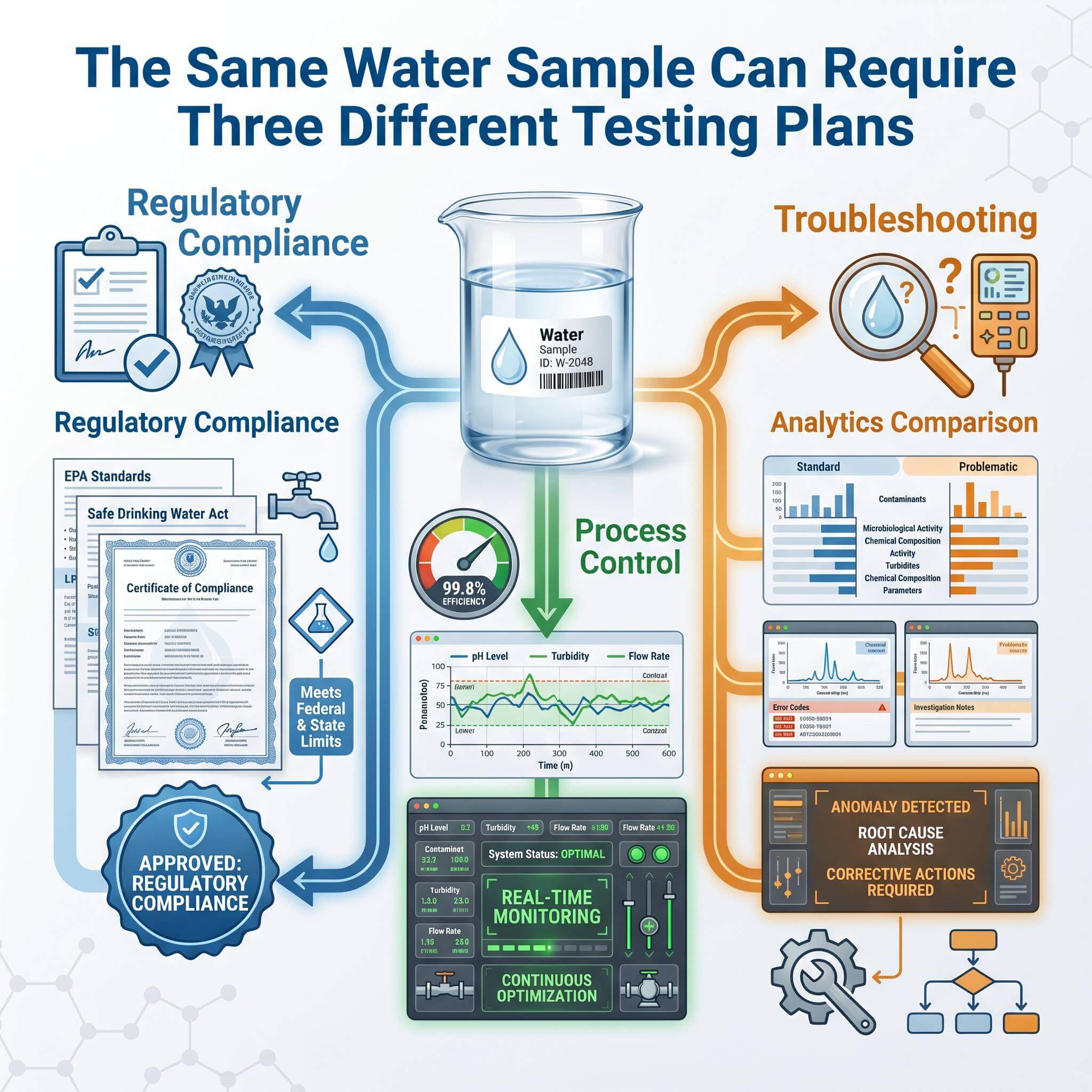
The key question is not “Which instrument is the most advanced?”, but “Which instrument best supports the laboratory’s real workflow?”
Engineering-based selection matrix:
Decision Factor | Priority | Selection Guidance |
Testing frequency | ★★★★★ | High frequency → dedicated photometer |
Method standardization | ★★★★★ | Standard methods → dedicated photometer |
Operator skill level | ★★★★☆ | Frequent rotation → low operator dependency |
Compliance & reporting | ★★★★★ | Traceability and audit-readiness |
R&D vs routine | ★★★★★ | R&D → high-end; routine → dedicated |
For most routine compliance and process-control testing, the optimal choice is:
ü Dedicated water photometers
ü Production-grade multi-parameter analyzers
ü Systems designed for high throughput and low error risk
Rather than over-investing in instruments, laboratories should invest in:
l Standardized operating procedures
l Sampling and pretreatment quality control
l Robust QC systems
l Structured operator training
If more than 80% of a laboratory’s workload follows standardized methods with fixed wavelengths, an application-optimized photometer water quality analyzer will usually deliver higher data reliability at lower total cost than a general-purpose spectrophotometer.
7. Engineering Perspective: The Hidden Benefits of Simplicity
A simplified instrument strategy aligned with real workflows delivers measurable benefits:
Benefit Area | Engineering Value |
Lower total cost | Reduced purchase, maintenance, training, and downtime |
Fewer errors | Method-locked design and direct readout |
Better consistency | Improved comparability across operators and shifts |
Faster training | New staff operational in 1–2 hours |
Lower compliance risk | Traceable, audit-friendly data |
In real industrial and municipal wastewater environments, process reliability matters more than theoretical optical limits.
Conclusion
In routine water analysis, the primary risks to data quality are not optical limitations but workflow inconsistency, operator dependency, maintenance burden, and long-term data reliability. Over-specified instruments amplify these risks and hidden cost while increasing total cost of ownership.
Routine photometric accuracy is not governed by optical complexity, but by:
l Sample collection and preservation quality
l Pretreatment and digestion control
l Reaction consistency
l Calibration and QC discipline
l System design that minimizes operator dependency
In laboratory engineering practice, the most effective instrument is not the most advanced, but the one that integrates seamlessly into analytical workflows, minimizes human error, and consistently delivers stable, compliant data. Application-optimized instruments for standardized methods, fixed wavelengths, and high-frequency testing consistently deliver better long-term value.
A multi-parameter photometer water quality analyzer designed for standardized methods, method-locked wavelengths, built-in reaction control, and low operator dependency is typically the most efficient and lowest-risk choice for routine testing environments.
Example: iWannaMP Multi-Parameter Photometer Water Quality Analyzer