+852 46135220

Dissolved oxygen is one of the most important operating parameters in aerobic wastewater treatment. In both moving bed biofilm reactors and activated sludge basins, microorganisms depend on oxygen to oxidize biodegradable organic matter and, when nitrification is required, convert ammonia into nitrate.
This often makes the instrument-selection process appear straightforward: Choose a dissolved oxygen meter, place the probe in the biological basin, and monitor the result.
In practice, the more important question is not only which DO meter should be used, but also: Where should dissolved oxygen actually be measured?
A DO value is always associated with a particular location, depth and moment. If the measurement point is poorly selected, the instrument may be accurate while the result is still unrepresentative of the biological process.
In an activated sludge basin, a consistent point near the downstream end or outlet is often useful for routine DO trending. However, the inlet, middle, outlet, and different depths should first be profiled to confirm that the selected point represents the basin. In an MBBR, the probe should be placed in a representative, well-mixed bulk-liquid zone, away from direct diffuser plumes, basin walls, dead zones, and carrier-retention screens. If separate basins or aeration zones are controlled independently, each zone will normally require its own representative online DO signal. A portable DO meter is suitable for profiling and verification, while online sensors are required for continuous monitoring and automatic aeration control.
Why Dissolved Oxygen Location Matters
Dissolved oxygen is not always evenly distributed throughout an aeration basin. The DO concentration at any point is influenced by several factors:
l Oxygen transfer from the aeration system
l Oxygen consumption by microorganisms
l Organic and ammonia loading
l Wastewater flow direction
l Basin depth and geometry
l Mixing intensity
l Location of diffusers or mechanical aerators
l Return sludge and internal recycle flows
l Time of day and changes in influent loading
Even in a basin that appears well mixed, oxygen is continuously being added and consumed. Near an air diffuser, the local DO reading may be relatively high. Further away, microorganisms may consume oxygen faster than it is replenished. Near the beginning of a plug-flow basin, incoming wastewater may create a higher oxygen demand than at the outlet. In deeper or poorly mixed zones, DO may also differ from the value measured near the surface.
Guidance used for activated sludge troubleshooting therefore recommends examining DO at different depths and locations when evaluating the overall oxidative condition of a basin. It also emphasizes that measurements taken at different times are necessary to identify daily and weekly peaks and valleys in oxygen availability.
What Is a Representative DO Measurement Point?
A representative DO measurement point is a location where the reading reflects the oxygen condition relevant to the biological process or aeration-control objective. It should not be selected only because it is easy to reach. The point should have normal mixed-liquor circulation, sufficient sensor immersion, limited direct bubble interference, and safe access for cleaning and verification. A representative location for routine trending may not be sufficient for troubleshooting. Routine monitoring requires consistency, while troubleshooting requires measurements across multiple locations, depths, and operating conditions.
The first principle is therefore: A DO reading describes the conditions around the probe. It does not automatically represent the whole biological reactor.
MBBR and Activated Sludge Basins Are Not Identical Measurement Environments
MBBR and activated sludge processes both use aerobic biological treatment, but their biomass is organized differently.
Activated sludge
In a conventional activated sludge basin, microorganisms are mainly suspended in the mixed liquor as biological flocs. Aeration provides oxygen and normally contributes to mixing. The DO sensor measures the oxygen concentration in the surrounding mixed liquor. That bulk-liquid value is used as an indicator of whether sufficient oxygen is available to support the biological reactions taking place throughout the basin.
MBBR
A moving bed biofilm reactor contains plastic carriers with a large surface area for attached biological growth. The carriers remain submerged and move through a mixed aerobic or anoxic reactor zone. Unlike an IFAS system, a conventional MBBR does not normally depend on return activated sludge to retain its biomass.
This creates an important distinction: The DO concentration measured in the bulk water is not necessarily the oxygen concentration experienced throughout the biofilm.
Oxygen must move from the bulk liquid into the biofilm. As microorganisms consume oxygen, a concentration gradient can develop between the outer and deeper layers of the biofilm. At sufficiently low bulk-liquid DO, oxygen transfer into the biofilm can become a limiting factor for nitrification and other aerobic reactions.
A DO probe cannot directly measure oxygen inside every biofilm carrier. It measures the bulk-liquid condition around the sensor. For that reason, an MBBR measurement should be interpreted together with:
n Ammonia removal
n COD or BOD reduction
n Reactor loading
n Carrier movement
n Aeration performance
n Effluent treatment results
A normal-looking bulk DO reading does not by itself prove that every carrier and every section of the reactor is receiving the same effective oxygen supply.
Where Should DO Be Measured in an Activated Sludge Basin?
There is no single universal location suitable for every activated sludge plant. However, the measurement strategy can be divided into two different purposes:
1.Routine reference monitoring
2.Basin profiling and troubleshooting
These purposes should not be confused.
1. Routine Reference Monitoring Near the Basin Outlet
For routine process monitoring, the downstream end of the aeration basin is often a useful reference location. The Ohio Environmental Protection Agency’s activated sludge troubleshooting guidance recommends beginning near the discharge from the aeration tank into the clarifier. It advises using the same reference location consistently so that measurements collected on different days remain comparable. For larger installations with multiple aeration tanks, monitoring the outlet of each tank can provide useful information about conditions in the individual process trains.
An outlet location is useful because it can help operators evaluate whether aerobic treatment has been completed before the mixed liquor enters the clarification stage. It may also reveal whether the system retains an excessive DO residual at the end of the basin, which could indicate that more aeration is being supplied than the current loading requires.
However, an outlet reading should not be treated as the only possible measurement.
In many systems, especially plug-flow or staged configurations, the upstream section may experience a much higher oxygen demand than the downstream section. An acceptable outlet DO value could therefore exist at the same time as low-oxygen conditions closer to the inlet.
2. Profile the Inlet, Middle and Outlet During Initial Assessment
Before selecting a permanent monitoring point, it is good practice to develop a DO profile of the basin. A basic longitudinal profile can include:
l Near the aeration basin inlet
l One or more points in the middle
l Near the outlet to the clarifier
These measurements help determine whether oxygen is evenly distributed or whether a clear gradient exists along the flow path.
Near the inlet
The inlet may receive the highest concentration of biodegradable organic matter and ammonia. Biological oxygen demand can therefore be high in this section. A low reading near the inlet does not always mean that the entire aeration system is failing. It may indicate that the local oxygen demand is greater than the air supply in that part of the basin.
In the middle
A central measurement helps show how DO changes after part of the incoming load has been treated. It may also reveal poor air distribution, failed diffusers, inadequate mixing or uneven loading between aeration zones.
Near the outlet
The outlet is useful for evaluating the residual DO remaining after the biological reactions have progressed through the basin. It is also often a practical location for routine trend monitoring and feedback control, provided that the location represents the process objective.
3. Measure at More Than One Depth When Necessary
DO can also vary vertically. A surface reading is not always representative of conditions deeper in the mixed liquor. Surface agitation, wind and contact with the atmosphere can affect oxygen concentration near the top of the basin. Conversely, insufficient mixing or poor diffuser performance may allow low-oxygen zones to form deeper in the tank.
As an initial practical reference, some activated sludge guidance recommends positioning a portable probe approximately 1–2 feet below the water surface when monitoring near the discharge point. Permanent-sensor installation instructions may also specify minimum distances from the wall and minimum immersion depths to improve measurement representativeness.
For a deeper basin or a suspected mixing problem, measurements may be compared at:
n Upper mixed-liquor depth
n Mid-depth
n Lower accessible depth
The exact depths should depend on basin design, sensor cable length, safety requirements and the accessibility of the measurement point.
4. Do Not Place the Sensor Directly Above an Air Diffuser
A sensor installed directly in a strong bubble plume may report a local condition rather than the average DO of the surrounding mixed liquor. Bubbles may also interfere with some sensor installations, depending on the measurement technology, mounting orientation and flow across the sensing surface.
Permanent DO-sensor installation guidance commonly recommends:
ü Selecting a sample location representative of the process
ü Avoiding direct installation over aerators or diffusers
ü Keeping the sensor away from the basin wall
ü Providing sufficient immersion
ü Installing near the aeration basin outfall when that point supports the control objective
The most convenient railing position is therefore not automatically the best process position.
Where Should DO Be Measured in an MBBR?
An MBBR requires several additional considerations because the reactor contains moving carriers. The sensor location must represent the bulk liquid while also avoiding interference from:
l Carrier accumulation
l Retaining screens
l Strong bubble streams
l Local dead zones
l Basin walls
l Inlet turbulence
l Mechanical contact with moving media
1. Start With a Representative Mixed Zone
The first objective is to find a location where the carriers are moving normally and the bulk liquid is adequately mixed. A measurement taken in a corner where carriers rarely circulate may not represent the reactor. Similarly, a reading taken in the strongest aeration plume may overstate the oxygen available in other regions.
The preferred point is generally within the active mixed zone, but not directly over an air diffuser and not so close to the surface that atmospheric contact influences the reading. In practice, the location should satisfy three conditions:
u The water around the sensor represents the main reactor volume.
u The sensor remains continuously submerged.
u The mounting system protects the probe and cable from uncontrolled contact with moving carriers or internal equipment.
2. Compare Upstream and Downstream Conditions
A single-stage MBBR may be designed as a well-mixed reactor, but the incoming load, aeration layout and hydraulic pattern can still create local differences. During commissioning or troubleshooting, compare DO at:
n The influent side of the aerobic MBBR
n The central carrier-mixing zone
n The downstream side before the retaining screen or outlet
This comparison can help answer several questions:
l Is oxygen being consumed rapidly near the inlet?
l Is aeration distributed evenly?
l Are carriers moving throughout the full reactor volume?
l Does the downstream end retain excessive DO?
l Are low readings caused by high biological demand or poor mixing?
Once these conditions are understood, a permanent measurement point can be selected more confidently.
3. Avoid Measuring Directly Against the Carrier Retention Screen
Carrier-retention screens can influence local hydraulics. Carriers may accumulate temporarily near the screen, especially when flow, aeration or mixing conditions change. A sensor installed too close to this area may experience:
n Irregular flow
n Carrier impact
n Increased fouling
n Local oxygen conditions that differ from the central reactor
n Difficult maintenance access
A point near the downstream end may still be useful for process monitoring, but the sensor should not be placed where the retaining screen or accumulated carriers distort the measurement. The exact separation distance should be determined from the reactor design and the sensor manufacturer’s mounting requirements.
4. Multi-Stage MBBRs May Need More Than One Measurement Point
Some MBBR systems contain several biological stages arranged in series. These stages may have different functions, such as:
n High-rate carbon removal
n Additional organic polishing
n Nitrification
n Final aerobic treatment
Because the biological load and treatment objective can change between stages, one DO reading in the final reactor may not describe oxygen conditions in the earlier reactors. Where stages have separate aeration zones or separate control valves, each operationally independent aerobic stage should be evaluated separately. This does not always mean that every stage must immediately receive a permanent online sensor. A portable DO meter can first be used to survey the system and identify whether meaningful differences exist.
However, when separate stages require independent automatic aeration control, each control zone normally needs its own representative process signal.
What About a Plant With One MBBR and Two Activated Sludge Basins?
Consider a wastewater plant with:
l One MBBR
l Two activated sludge basins
l Separate aeration equipment for each basin
The initial request may simply be: “We need a DO meter to control oxygen in the MBBR and the two biological basins.”
Before selecting an instrument, several questions must be clarified.
Are the three basins hydraulically connected or independently operated?
If they operate as independent treatment zones, their oxygen demands may be different.
Does each basin have its own blower or control valve?
Independent aeration equipment makes separate process measurements more valuable.
Is the customer asking for periodic checking or automatic control?
This determines whether a portable instrument or online sensors are required.
Do the basins carry the same biological load?
An MBBR and an activated sludge basin cannot be assumed to have identical oxygen demand simply because both are aerobic.
Is the treatment target carbon removal, nitrification or both?
The required oxygen conditions should be linked to actual process performance, particularly ammonia conversion when nitrification is important.
A Practical Initial Measurement Plan
For this type of plant, an initial portable-meter survey could include:
MBBR
l One upstream point
l One central mixed-zone point
l One downstream point
Additional depth measurements where practical
Activated Sludge Basin 1
l Inlet section
l Middle section
l Outlet section
Activated Sludge Basin 2
l Inlet section
l Middle section
l Outlet section
Measurements should be repeated:
l At similar locations
l At documented depths
l At different times of day
l Under different plant-loading conditions
l Before and after major aeration adjustments
This produces a DO profile rather than nine unrelated numbers.
After the survey, the plant may find that:
ü One stable monitoring point is sufficient in each small, completely mixed basin.
ü One basin has a significant inlet-to-outlet gradient.
ü The MBBR requires a protected sensor in a central mixed zone.
ü Separate online sensors are needed for independent control.
ü A portable meter is still useful for checking the permanent sensors and investigating abnormal areas.
Portable DO Meter or Online DO Sensor?
The correct instrument depends on what the measurement must achieve.
Portable DO Meter vs Online DO Sensor
Requirement | Portable DO Meter | Online DO Sensor |
Measure several basins with one instrument | Yes | Normally no |
Create inlet-to-outlet or depth profiles | Yes | Limited |
Continuous 24-hour monitoring | No | Yes |
Detect short-term load changes | Limited | Yes |
Automatic blower or valve control | No | Yes |
Verify a permanent sensor | Yes | Not its primary purpose |
Operator rounds and troubleshooting | Yes | Supports but does not replace profiling |
PLC or SCADA integration | Usually limited | Yes, when the controller supports it |
Requires fixed installation | No | Yes |
Requires routine in-place cleaning | No, but the probe still requires maintenance | Yes |
A portable DO meter answers the question, “What is the DO at this location now?”
An online DO system answers the question, “How is DO changing continuously, and should the aeration system respond?”
Why Measurement Time Matters as Much as Measurement Location
Wastewater loading is rarely constant. DO may change because of:
u Morning or evening flow peaks
u Production cycles in an industrial facility
u Batch discharges
u Changes in ammonia concentration
u Return-sludge operation
u Blower cycles
u Temperature changes
u Cleaning activities
u Weekend or seasonal conditions
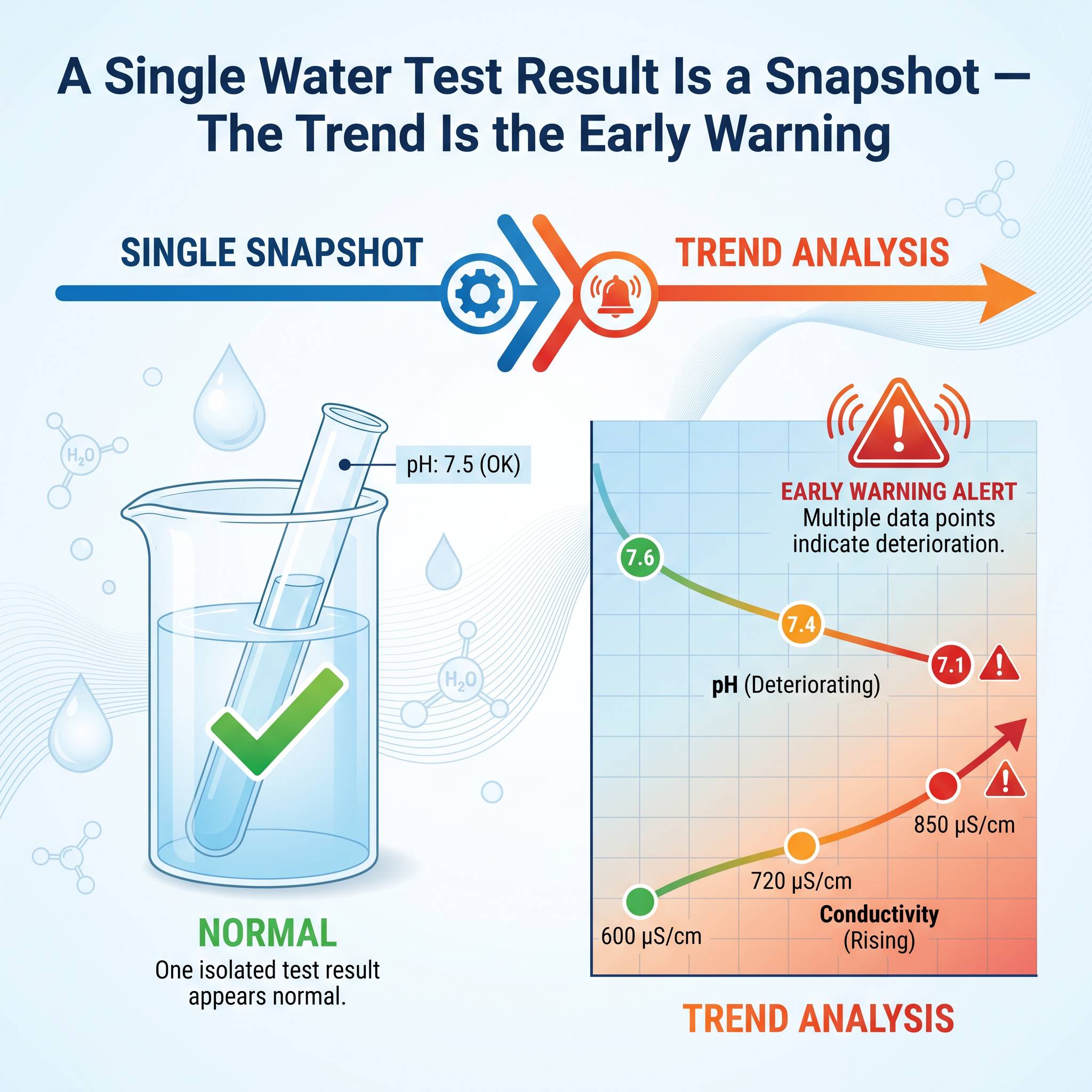
A measurement taken once at 10:00 a.m. may not represent the lowest DO value experienced during the day. Activated sludge troubleshooting guidance specifically recommends monitoring at different times and on different days. Data logging provides a much more complete picture than relying on one isolated measurement.
The plant should therefore document not only the DO value, but also:
n Date and time
n Measurement location
n Measurement depth
n Basin water level
n Number of blowers operating
n Air-valve position
n Wastewater flow
n Ammonia or COD loading, where available
n Recent process changes
Without this context, a DO trend may be difficult to interpret.
Common DO Measurement Mistakes
Mistake 1: Measuring Only Where Access Is Easiest
A walkway or railing may offer convenient access, but the closest location may be near a wall, surface layer, diffuser or dead zone. Convenience is important for safety and maintenance, but the selected point must still be representative.
Mistake 2: Changing the Measurement Location Every Day
A DO result becomes less useful when operators measure at different locations and depths without recording the changes. For routine trending, use a consistent reference point. For profiling, deliberately change the location—but clearly label every measurement.
Mistake 3: Holding the Probe Directly in the Bubble Stream
The reading may reflect local aeration intensity rather than the oxygen condition in the mixed liquor. Move away from the direct diffuser plume and allow the reading to stabilize.
Mistake 4: Assuming the Highest DO Reading Is the Most Accurate
The highest value is not necessarily the best representation of the biological process. It may simply come from a highly aerated local zone.
Mistake 5: Using One Outlet Reading to Diagnose the Entire Basin
An outlet reading is valuable for routine reference monitoring, but it may not reveal low oxygen near the inlet or at another depth. When performance declines, profile the whole basin.
Mistake 6: Treating a Target DO Value as Universal
A commonly cited operating value may be a useful starting point, but it should not replace plant-specific evidence. The appropriate target depends on:
l Organic loading
l Ammonia loading
l Temperature
l Biomass characteristics
l Process configuration
l Effluent requirements
l Aeration efficiency
l Actual treatment performance
The correct target is the lowest stable oxygen condition that continues to meet the plant’s biological treatment objectives with an appropriate operating margin—not simply the highest value the aeration system can maintain.
Mistake 7: Ignoring Sensor Fouling and Maintenance
Wastewater sensors are exposed to biological growth, solids, grease and other deposits. A poorly maintained sensor may drift slowly while still displaying believable numbers. Permanent sensors should therefore be installed where they can be safely:
n Removed
n Inspected
n Cleaned
n Verified
n Calibrated when required
A representative point that cannot be maintained will not remain reliable for long.
Conclusion
The correct location for measuring dissolved oxygen in an MBBR or activated sludge basin cannot be determined from the DO meter specification alone. It depends on:
n Reactor type
n Flow pattern
n Aeration layout
n Biological loading
n Measurement purpose
n Control strategy
n Basin geometry
n Sensor accessibility
For routine activated sludge monitoring, begin with a consistent downstream or outlet reference point, but verify it through inlet-to-outlet and depth profiling. For an MBBR, select a representative mixed zone away from direct bubble plumes, walls, dead zones, and carrier-retention screens. Where basins or aeration zones are operated independently, each zone should be assessed separately and may require its own online DO sensor for continuous control.
A portable DO meter is useful for surveying multiple locations and checking process conditions. Online sensors are more appropriate when continuous trends, alarms or automatic aeration control are required.
The most important principle is simple: Do not select the measurement point because it is the easiest place to put the probe. Select it because the reading can support a real operating decision.