+852 46135220

A laboratory receives a water sample from the final outlet of a wastewater treatment plant. At first glance, the task seems straightforward: test the sample and report the results. But before selecting the parameters, methods, or instruments, one question must be answered:
What decision will be made from the data?
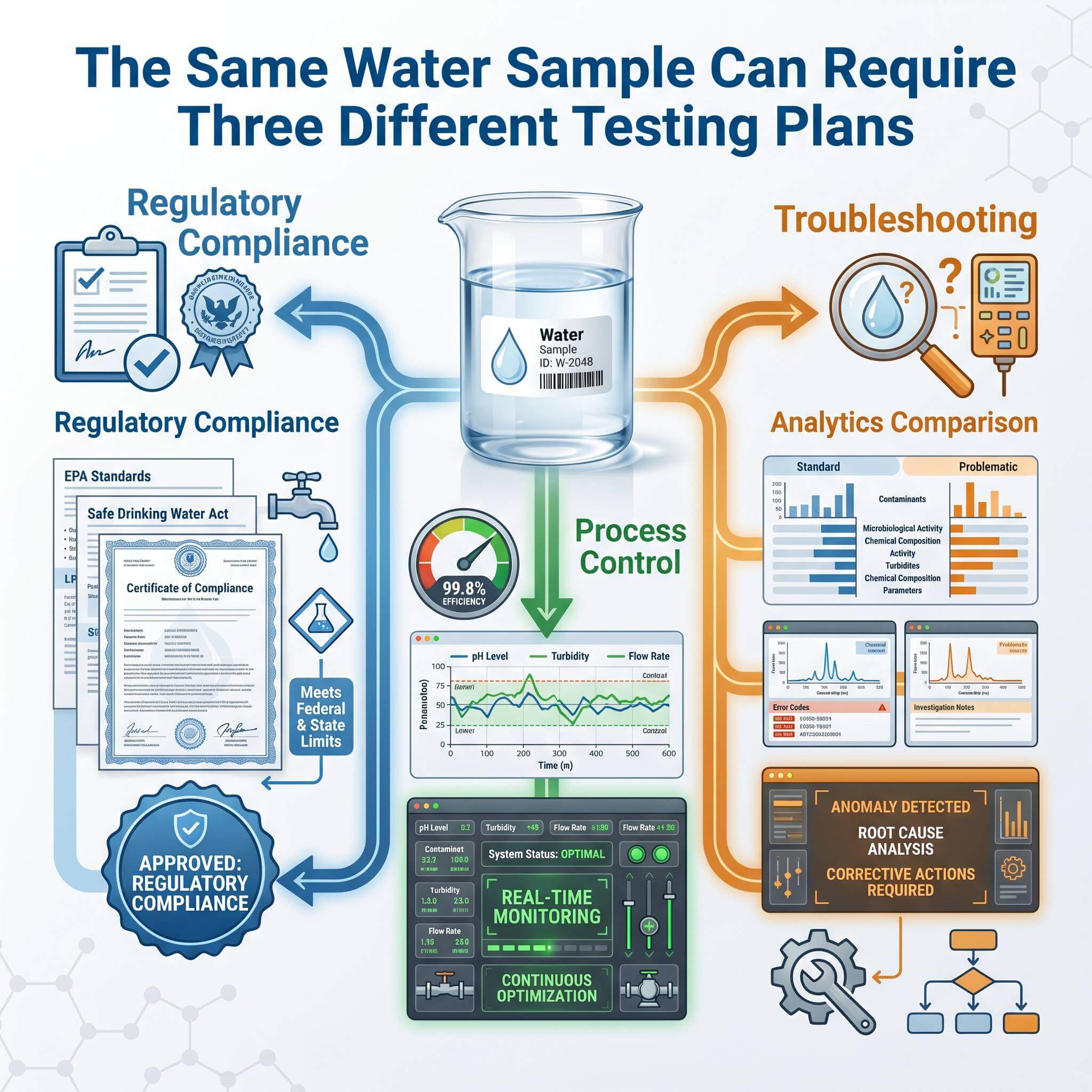
The same water sample can require different testing plans because the purpose of testing determines what should be measured, how often it should be measured, where the sample should be collected, and how the result will be interpreted. A compliance testing plan asks whether the water meets a legal or contractual limit. A process-control testing plan asks whether the treatment system is operating normally and whether an adjustment is needed. A troubleshooting testing plan asks what caused an unexpected result or process failure. The sample source may be the same, but the decision behind the measurement is different.
The water has not changed. The purpose of the testing has. This distinction is important because a testing plan is not simply a list of parameters. It is a combination of:
l Monitoring objectives
l Parameter selection
l Sampling location
l Sampling frequency
l Analytical method
l Detection range
l Required accuracy
l Data interpretation
l Action thresholds
A result can be analytically correct but still provide little operational value if the testing plan was designed for the wrong purpose.
“The Same Sample” Does Not Always Mean the Same Bottle
Before comparing the three testing plans, one technical point should be clarified. When we say that the same water sample may require different testing plans, we normally mean water collected from the same source, location, and sampling event. It does not necessarily mean that every analysis should be performed using water from one physical bottle.
Some parameters have different sampling and preservation requirements. For example:
n Dissolved oxygen may need to be measured immediately or directly on site.
n Microbiological samples usually require sterile containers.
n Metal analysis may require acid-preserved bottles.
n Nutrient samples may need cooling or specific preservation procedures.
n Volatile compounds require containers with minimal headspace.
n pH and temperature can change during transport and storage.
Therefore, a proper sampling event may produce several sample containers, even though they all represent the same water source. The testing objective should influence both the analytical plan and the sampling plan.
Testing Plan 1: Regulatory Compliance Water Testing
The purpose of regulatory testing is to determine whether the water meets a defined standard, discharge permit, contractual specification, or legal requirement. In this plan, the laboratory does not choose parameters simply because they are interesting or easy to measure. The required parameters are normally defined by regulations, permits, industrial standards, customer agreements, or monitoring programs.
For a wastewater treatment plant outlet, a compliance plan might include:
l Chemical oxygen demand
l Biochemical oxygen demand
l Total suspended solids
l Ammonia nitrogen
l Total nitrogen
l Total phosphorus
l pH
l Oil and grease
l Selected heavy metals
l Microbiological indicators
The exact list depends on the discharge category, local regulations, industrial sector, receiving water body, and permit conditions.
What matters most in compliance testing?
Compliance testing places particular emphasis on:
n Approved analytical methods
n Proper sampling procedures
n Traceable calibration
n Quality-control records
n Suitable detection limits
n Chain of custody
n Sample preservation
n Data integrity
n Documented reporting
The result may be used by environmental authorities, customers, auditors, or legal teams. For this reason, method conformity and documentation can be as important as the numerical result itself. A rapid operational method may provide a useful indication, but it may not automatically replace the officially recognized reference method used for compliance reporting.
The frequency is usually predefined
Compliance monitoring may be required:
l Daily
l Weekly
l Monthly
l Quarterly
l During specific discharge periods
l At a frequency linked to production volume or discharge capacity
The sampling time may also be specified. A single grab sample, a time-based composite sample, and a flow-proportional composite sample can produce different information.
For compliance testing, the question is usually: Does the discharged water meet the required limit under the specified monitoring conditions? The testing plan must therefore be built around the regulation, not only around the treatment process. In simple terms, compliance testing prioritizes standardized methods, traceability, documentation, and legally defensible results.
Testing Plan 2: Process Control Water Testing
Now consider the same treatment plant outlet sample from an operational perspective. The plant operator may not be asking whether the sample is legally compliant. The immediate question may be: Is the treatment process stable, and does anything need to be adjusted? This changes the testing plan. Process-control monitoring usually focuses on parameters that respond quickly to changes in treatment conditions and can support timely operational decisions.
Typical parameters may include:
l pH
l Dissolved oxygen
l Conductivity
l Turbidity
l Chemical oxygen demand
l Ammonia
l Nitrate
l Orthophosphate
l Temperature
l Oxidation-reduction potential
l Sludge-related indicators
Some of these parameters may also appear in the compliance plan, but they are used differently.
The same parameter can serve a different purpose
Consider COD. In compliance monitoring, COD may be measured to verify whether the final effluent is below a permitted discharge limit. In process control, COD may be measured at several locations:
n Plant influent
n After primary treatment
n Before the biological stage
n After biological treatment
n Final effluent
The operator is not only interested in the final value. The operator may also calculate removal efficiency, compare loading between treatment stages, or identify a sudden increase in influent organic matter.
Similarly, ammonia may be a regulated discharge parameter, but operationally it can also indicate whether nitrification is functioning properly. A rising ammonia concentration in the final effluent may suggest:
u Insufficient dissolved oxygen
u Low sludge age
u Toxic shock to nitrifying bacteria
u Excessive hydraulic loading
u Unfavorable temperature
u Abnormal pH or alkalinity
u Equipment failure
The parameter is the same, but the operational interpretation is broader.
Process-control testing must be timely
For routine operation, a result received several days later may have limited value. Operators often need to know whether they should:
n Increase aeration
n Adjust chemical dosing
n Modify recirculation
n Reduce loading
n Inspect a treatment unit
n Divert abnormal influent
n Repeat the measurement
n Collect additional samples
This is why process-control plans often favor methods that are:
ü Fast
ü Repeatable
ü Easy to perform
ü Suitable for frequent testing
ü Available near the treatment process
ü Capable of covering the expected concentration range
Portable meters, bench photometers, multiparameter analyzers, digestion instruments, and online sensors can all support process monitoring, depending on the parameter and application. The purpose is not to measure every possible substance. It is to obtain enough reliable information to keep the process under control. In simple terms, process-control testing prioritizes speed, repeatability, trend detection, and timely operational action.
Testing Plan 3: Troubleshooting and Root-Cause Investigation Water Testing
The third plan begins when something unusual happens. Perhaps:
u Final effluent COD suddenly increases.
u Ammonia rises even though dissolved oxygen appears normal.
u Conductivity changes sharply.
u Turbidity increases after filtration.
u The effluent develops an unexpected color or odor.
u Results differ significantly between two laboratories.
u A customer reports a problem that routine results did not predict.
At this point, repeating the normal routine panel may not be enough. The objective is no longer simply to confirm compliance or track daily operation. The objective is to identify the cause of the abnormal result.
Troubleshooting requires hypothesis-based testing
A diagnostic testing plan should begin with possible explanations. For example, if final-effluent COD increases, possible causes might include:
u Higher influent organic loading
u Incomplete biological treatment
u Toxic inhibition
u Solids carryover
u Industrial chemical discharge
u Sampling contamination
u Chloride interference in the COD method
u Digestion or reagent problems
u Incorrect dilution
u Instrument calibration error
Each hypothesis suggests a different set of measurements. The investigation might therefore include:
l COD at multiple treatment stages
l Dissolved COD and total COD
l Total suspended solids
l Turbidity
l Chloride
l pH
l Conductivity
l Dissolved oxygen
l Ammonia and nitrate
l Microscopic examination of activated sludge
l Oxygen uptake or respiration indicators
l Repeat analysis using fresh reagents
l Comparison with a reference method
l Analysis of a duplicate or spiked sample
The troubleshooting plan may contain more parameters than routine monitoring, but the additional parameters should be selected for a reason. Adding twenty unrelated tests does not automatically make the investigation more effective. That's why “more parameters” doesn’t mean better water quality data.
Sampling locations become more important
A single outlet sample can show that a problem exists, but it may not show where the problem began. Troubleshooting often requires samples from several points:
n Raw influent
n Equalization tank
n Primary treatment outlet
n Biological reactor
n Secondary clarifier
n Filtration outlet
n Final discharge point
n Suspected industrial source
The pattern across these locations can be more informative than one isolated result. For example, if COD is already high after biological treatment but remains stable through the final stage, the problem may be associated with the biological process. If COD rises only after a specific chemical-treatment step, the cause may be linked to chemical addition, contamination, or sampling.
A diagnostic plan therefore follows the process, not just the final result. In simple terms, troubleshooting testing prioritizes identifying where the problem started and which technical factor caused it.
Comparing the Three Testing Plans
The following comparison shows how one sampling event may support different decisions. Although the three plans may include some of the same parameters, they do not use those parameters in the same way. Compliance testing compares results with formal limits, process-control testing compares results with operational trends, and troubleshooting compares results across locations, methods, or possible causes.
Testing purpose | Main question | Typical parameter strategy | Testing frequency | Main priority |
Regulatory compliance | Does the water meet the required standard? | Parameters defined by permits, regulations, or contracts | Fixed or legally defined | Method conformity and defensible results |
Process control | Is the treatment process stable, and should anything be adjusted? | Fast indicator parameters linked to operational actions | Frequent, sometimes continuous | Timely and actionable information |
Troubleshooting | What caused the abnormal result? | Targeted parameters selected according to possible causes | Temporary and investigation-driven | Root-cause identification |
The difference is not simply the number of parameters. The real difference is the relationship between the data and the decision.
Can One Water Testing Plan Replace Another?
Not usually. A compliance testing plan cannot fully replace process-control monitoring because regulatory sampling may be too infrequent to detect early operational changes.
A process-control result cannot automatically replace a compliance result because the method, calibration, documentation, sampling procedure, or laboratory accreditation may not meet official reporting requirements. A routine process-control panel also cannot replace troubleshooting because routine indicators may show that a problem exists without identifying its cause.
In practice, the three plans should support one another:
l Compliance testing confirms whether formal requirements are met.
l Process-control testing helps prevent treatment failure before limits are exceeded.
l Troubleshooting testing explains abnormal results and supports corrective action.
A well-managed water or wastewater facility may therefore use all three plans at different times.
Why Routine Testing Panels Are Often Misused
Many laboratories and water-treatment facilities use a fixed testing panel as routine water quality analysis parameters for every situation. This approach is convenient, but it can create several problems.
Too much testing
A broad parameter list may increase:
u Reagent consumption
u Analyst workload
u Sample-handling complexity
u Instrument maintenance
u Quality-control requirements
u Reporting time
u Overall cost
Some results may never be used to make a decision.
Too little testing
A narrow routine panel may confirm that something is wrong without explaining why. For example, measuring only final-effluent COD may reveal deterioration, but it cannot determine whether the cause is high influent loading, biological failure, solids carryover, or analytical interference.
Testing the right parameter at the wrong frequency
A useful parameter may still have limited value if it is measured too infrequently. Monthly ammonia testing may satisfy a reporting requirement, but it may not be enough to control a rapidly changing biological process.
Using a compliance method as the only operational tool
Reference methods are essential for many official applications. However, some may require more time, preparation, or laboratory resources than are practical for frequent process adjustments. Facilities may therefore need both:
l A formal method for reportable compliance results
l A rapid, validated operational method for routine control
The two methods should be compared, understood, and used for their intended purposes.
How to Build the Right Testing Plan
Before selecting parameters or purchasing an instrument, the following questions should be answered.
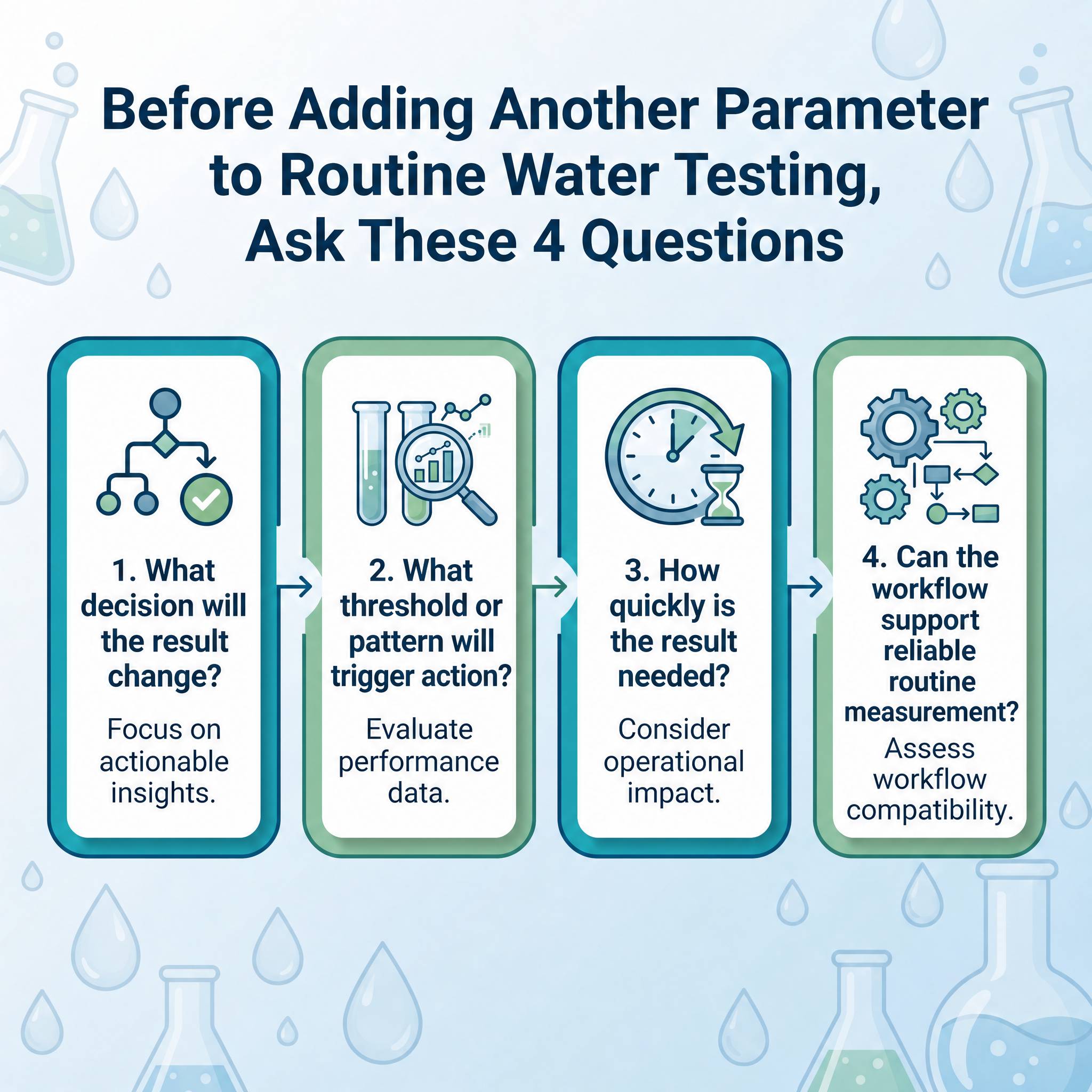
1. What decision will the result support?
Will the result be used to:
l Release water for discharge?
l Adjust aeration?
l Change chemical dosing?
l Confirm treatment efficiency?
l Investigate a complaint?
l Identify a pollution source?
l Demonstrate regulatory compliance?
A parameter without a defined decision role may add data without adding value.
2. How quickly is the result needed?
Some decisions can wait for a central laboratory result. Others must be made within minutes or hours. Required response time affects the choice between:
l On-site measurement
l Portable instrumentation
l Bench laboratory testing
l Online monitoring
l External reference laboratories
3. What concentration range is expected?
An instrument or method should match the actual sample range. A method designed for trace concentrations may not be suitable for concentrated wastewater without dilution. A high-range method may not provide enough sensitivity for final drinking-water verification. Expected concentration, detection limit, dilution requirements, and possible interferences should be considered together.
4. Where should the sample be collected?
The final outlet is not always the most useful location. A good plan may require measurements before and after critical treatment stages to identify where conditions change.
5. How often can the result change?
Stable groundwater and rapidly changing industrial wastewater may require very different monitoring frequencies. Frequency should reflect:
l Process variability
l Risk
l Regulatory requirements
l Operational response time
l Historical trends
6. What action level will be used?
A laboratory result becomes more useful when it is connected to a predefined response. For example:
n Normal operating range
n Internal warning level
n Corrective-action level
n Regulatory limit
n Emergency shutdown level
Without action levels, results may be collected and reported without influencing the process.
Testing Plans Should Change as Conditions Change
A testing program should not remain fixed simply because it has always been used. Changes in the following areas may justify a review:
l Raw-water source
l Production process
l Wastewater composition
l Treatment technology
l Discharge permit
l Customer requirement
l Seasonal temperature
l Chemical use
l Historical trend
l Instrument capability
l Identified operational risk
A parameter may move from occasional investigation into routine monitoring when it repeatedly provides useful warnings. But before adding another parameter to routine water testing, ask these 4 questions. Conversely, a parameter may be removed from frequent testing if years of data show little variation and no clear operational action. Routine does not mean permanent. It means regularly useful under current conditions.
The Instrument Should Follow the Testing Plan
It is tempting to begin with the instrument:
l Which analyzer measures the most parameters?
l Which spectrophotometer has the widest wavelength range?
l Which portable meter has the longest parameter list?
l Which online sensor produces continuous data?
But instrument selection should come after the testing objective has been defined. A suitable instrument is one that can provide the required:
n Parameters
n Measurement range
n Accuracy
n Detection limit
n Speed
n Repeatability
n Sample throughput
n Data management
n Method compatibility
n Maintenance level
A laboratory performing regulatory analysis may prioritize traceability, approved methods, and comprehensive quality-control functions. A treatment operator may prioritize rapid measurements, simple workflows, rugged construction, and low operating cost. A troubleshooting team may need flexible methods, multiple ranges, spectral capability, or the ability to test unusual samples. No single instrument configuration is automatically best for all three plans.
For example, a bench photometer or multiparameter water quality analyzer may be appropriate for frequent COD, ammonia, nitrate, or phosphate testing. A digestion instrument may be required for parameters such as COD, total phosphorus, or total nitrogen. Electrochemical meters may be more appropriate for pH, conductivity, dissolved oxygen, or oxidation-reduction potential.
Conclusion
The same water source can tell different stories depending on the question being asked.
For a regulator, the sample may answer: Is the discharge compliant?
For an operator, it may answer: Is the treatment process stable?
For an investigator, it may answer: What caused the abnormal condition?
These questions require different combinations of parameters, methods, frequencies, sampling points, and instruments.
Effective water testing does not begin by asking how many parameters can be measured. It begins by asking: What decision must this result help us make?
Once that question is clear, the testing plan becomes easier to design—and the data becomes far more useful.