+852 46135220

Quick technical summary
In routine water quality laboratories, uncontrolled multi-parameter analyzers often underperform because they combine incompatible analytical workflows within a single platform. When photometric methods, digestion-based colorimetric tests, turbidity measurements, and electrode methods coexist without strict workflow control, operator variability and procedural inconsistency increase significantly.
For routine testing environments characterized by high throughput, repetitive tasks, and multiple operators, system control and workflow standardization are more critical than the total number of measurable parameters.
Well-designed routine water testing systems therefore prioritize controlled parameter sets, compatible analytical methods, and standardized workflows rather than maximum parameter coverage.
In modern water quality testing laboratories, multi-parameter water quality analyzers are often seen as a natural upgrade path—more parameters promise broader coverage, fewer instruments, and higher efficiency.
However, in routine water quality testing, many laboratories experience the opposite outcome:
u Unstable data
u Increased operational burden
u Reduced confidence in results
The issue is not multi-parameter testing itself, but whether the design of these platforms truly matches their intended application scenarios.
This article examines why uncontrolled multi-parameter platforms frequently perform poorly in routine water testing and offers a more rational perspective for laboratory instrument selection.
Routine Water Testing Is a Stability Problem, Not a Capability Problem
Across industrial process control, municipal wastewater monitoring, and quality control laboratories, routine testing environments share several common characteristics.:
l High throughput: dozens to hundreds of samples per day
l Repetitive tasks: repeated measurement of the same parameters
l Limited training time: operators may be rotating staff or beginners
l Emphasis on repeatability and comparability: rather than analytical novelty
In this context, the definition of “performance” is not how many parameters an instrument can measure, but rather:
ü Consistency: how reliably the instrument performs over time
ü Operability: whether different operators can follow the same workflow every day
ü Comparability: whether results remain comparable across time and personnel
In routine laboratory engineering, performance is often defined as operational stability under real working conditions rather than analytical capability under ideal laboratory settings.
Routine water testing systems must therefore be evaluated using three practical criteria: repeatability, workflow stability, and operator independence. Instruments that perform well in research environments may not necessarily deliver reliable results in routine laboratories where multiple operators, high sample throughput, and simplified procedures are common..
What Is an “Uncontrolled” Multi-Parameter Platform?
“Uncontrolled” does not mean the instrument itself is malfunctioning. Instead, it refers to a design that lacks application-specific constraints. In the context of laboratory instrument design, an uncontrolled multi-parameter platform refers to a system that integrates many analytical methods but lacks workflow constraints that ensure consistent operation across parameters.
Such platforms typically exhibit the following characteristics:
u Extensive parameter menus: dozens or even hundreds of test items
u Multiple analytical principles combined in one instrument: photometry, electrode methods, turbidity measurement, etc.
u Inconsistent sample preparation requirements: some parameters require digestion, others distillation, others direct measurement
u Different calibration logics: various parameters rely on different curve management methods
u Unclear application boundaries: limited guidance on when a parameter is reliable or suitable
From a specification sheet, such systems appear powerful. From an operational perspective, they introduce hidden complexity.
The Core Problem: One Platform, Multiple Incompatible Workflows
Multi-parameter platforms often integrate parameters that require completely different operational workflows:
l Direct photometric methods: Like ammonia nitrogen, nitrate (color development followed by measurement)
l Digestion-based colorimetric methods: Like COD, total phosphorus, total nitrogen (requiring high-temperature digestion)
l Turbidimetric methods: Like sulfate (turbidity measurement)
l Electrode methods: Like pH, dissolved oxygen, ion-selective electrodes
These methods differ significantly in their sensitivity to:
l Sample matrix effects (The degree of interference)
l Operational technique (pipetting order, mixing procedures)
l Time and temperature control (color development time, digestion conditions)
l Reagent handling (freshness, preparation standards)
From an engineering perspective, these analytical methods differ not only chemically but also operationally. Each method imposes different requirements on sample preparation, reaction timing, temperature control, reagent handling, and operator technique. When these requirements coexist in a single platform without clear workflow separation, laboratories effectively operate multiple analytical systems inside one interface, increasing the probability of procedural deviation.
Engineering reality: A comparison test conducted by a environmental monitoring laboratory showed that when COD (digestion-based) and ammonia nitrogen (direct colorimetric) were analyzed on the same multi-parameter platform, the relative standard deviation (RSD) between operators reached 8.2% for COD, while ammonia nitrogen results showed only 2.3% RSD. The root cause was not the instrument itself, but the difficulty of maintaining consistent workflows.
Why Underperformance Is Especially Visible in Routine Laboratories
In research or advanced analytical laboratories, complexity can often be absorbed due to:
u Highly trained analytical chemists
u Detailed standard operating procedures (SOPs) for each parameter
u Frequent method validation and performance verification
Routine laboratories typically lack these resources. As a result, uncontrolled platforms often lead to the following outcomes:
1. Results Become Operator-Dependent
Different operators may unknowingly follow different workflows, particularly when switching between parameters.
For example: One operator may strictly apply 2-hour digestion for COD, while another may shorten digestion time for total phosphorus, simply because the platform does not clearly enforce different protocols.
2. Error Rates Increase
Most errors are not dramatic instrument failures, but rather small accumulated deviations, such as:
l Incorrect color development time (30 seconds difference)
l Incorrect wavelength selection (confusing high/low ranges)
l Improper blank handling (missing or incorrect blanks)
l Incorrect reagent addition sequence
Individually, these deviations seem minor. Combined, they can render the data unreliable.
3. Data Comparability Is Lost
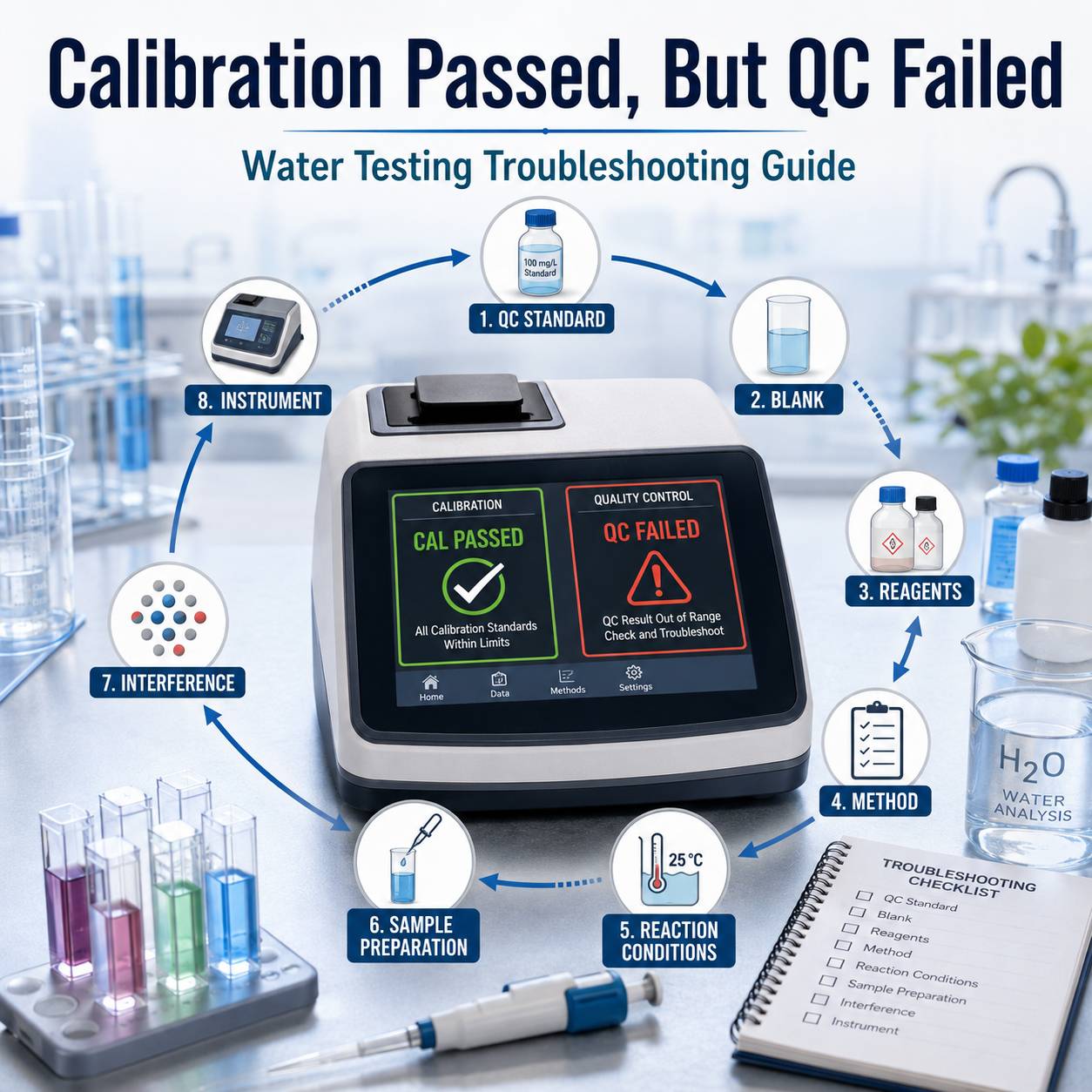
Results may appear internally “acceptable” (passing QC checks) but lose comparability across conditions:
l Between shifts (morning vs evening)
l Between operators (experienced vs new staff)
l Between time periods (this month vs last month)
For process trend analysis and long-term compliance reporting, this loss of comparability can be critical.
More Parameters ≠ More Useful Data
One of the most common misconceptions in water testing is that measuring more parameters automatically improves understanding of water quality.
Engineering reality shows otherwise:
u Each additional parameter introduces operational cost (reagents, consumables, QC)
u Each additional parameter adds training burden (procedures, troubleshooting)
u Each additional parameter introduces another potential failure point (method incompatibility, unrecognized interference)
Without strong system control, increasing the number of parameters often reduces overall data quality rather than improving it.
Another frequently overlooked factor is data management complexity. As the number of measurable parameters increases, laboratories must maintain additional calibration curves, reagent inventories, quality control standards, and maintenance schedules. Without strong system control, this complexity can degrade laboratory efficiency and ultimately reduce the reliability of reported data.
Supporting data: A large wastewater treatment plant tracked laboratory performance after switching from dedicated instruments for COD, ammonia nitrogen, and total phosphorus to a single platform covering 50 parameters.
Results showed:
l QC pass rate decreased from 97% to 82%
l Rework rate increased threefold
The issue was not poor instrument performance but operational complexity exceeding routine staff capacity.
Capability vs Control
It is essential to distinguish between two concepts:
Dimension | Definition | Value in Routine Testing |
Capability | What the instrument can measure under ideal conditions | Necessary, but not sufficient |
Control | How reliably the system produces usable data in real environments | Decisive factor |
Typical characteristics of controlled systems include:
ü Clearly defined parameter ranges rather than “measure everything”
ü Standardized workflows across parameters
ü Limited method variability within the same platform
ü Instrument design aligned with routine, repetitive, high-throughput testing
Routine water testing benefits more from controlled systems than from maximum capability. For routine laboratories, the most reliable systems are not those with the highest analytical capability, but those with the highest operational control.
Not All Multi-Parameter Systems Are the Same
This article does not reject all multi-parameter analyzers. The key difference lies in design philosophy.
Design Philosophy | Objective | Typical Characteristics | Performance in Routine Testing |
Parameter quantity first | Maximize measurable items | Mixed methods, diverse workflows, vague application boundaries | Often underperforms |
Controlled parameter set first | Optimize repeatability for specific parameters | Carefully selected compatible methods, standardized workflows, application-optimized design | Consistently strong |
Selection Principles for Routine Water Testing Platforms
Key Question | Evaluation Focus | Risk Indicator |
Are parameters method-compatible? | Do they rely on similar analytical principles? | Mixed principles → operational confusion |
Are sample pretreatment requirements consistent? | Digestion, distillation, or direct measurement? | Inconsistent requirements → missed steps |
Can daily workflows remain consistent? | Are interfaces and procedures uniform? | Workflow jumps → cognitive burden |
Is the system optimized for routine repetition or occasional flexibility? | Designed for high-throughput multi-operator labs? | Flexibility focus → stability sacrificed |
Before selecting a multi-parameter system, laboratories should answer these engineering-oriented questions. If the answers are unclear, underperformance becomes highly likely—not due to chemical methods, but due to system design.
Conclusion: Simplicity Is Often an Engineering Achievement
In routine water testing, simplicity is not a limitation but is an engineering achievement. Uncontrolled multi-parameter platforms often underperform not because they are inherently bad, but because they attempt to do too many things without sufficient operational structure. For laboratories focused on routine, repetitive, defensible data, controlled system design matters far more than the number of measurable parameters.
A truly well-designed multi-parameter photometer water quality analyzer for routine testing does not compete on how many parameters it can measure, but on how well it optimizes repeatability, usability, and reliability within a controlled parameter set.
Ultimately, the real questions are:
ü Can different operators obtain consistent results every day?
ü Can today’s data be reliably compared with results from three months ago?
ü Can the laboratory maintain compliant output with minimal training and maintenance cost?
These are the metrics that truly define the value of a routine water quality testing instrument.
Frequently Asked Questions
Why do multi-parameter analyzers sometimes perform poorly in routine laboratories?
Because routine labs rely on standardized workflows and multiple operators. When instruments combine many analytical methods requiring different procedures, workflow variability increases.
Are multi-parameter analyzers always problematic?
No. Systems designed with controlled parameter sets and compatible analytical methods can perform very well in routine environments.
What is often more important than the number of parameters?
Workflow standardization, operator consistency, and method compatibility.
What is recommended well-controlled multi-parameter photometer water quality analyzer for routine laboratories?
Example: iWannaMP Multi-Parameter Photometer Water Quality Analyzer