+852 46135220

When people observe a water sample, their first judgment is often visual.
Is the water clear?
Does it have any color?
Are there any floating materials?
Does it look clean?
In many daily situations, this kind of visual judgment feels natural. Clear water usually gives people a sense of safety, while cloudy, colored, or odorous water immediately raises concern.
But in water quality testing, visual clarity is only a physical observation. It does not confirm chemical safety, biological safety, treatment stability, or application suitability. A clear water sample may still require testing for pH, conductivity, COD, ammonia nitrogen, nitrate, phosphate, chlorine, heavy metals, microorganisms, or other application-specific parameters.
This article explains why clear water should not be treated as clean water, which invisible parameters may still matter, and how laboratories, water treatment plants, industrial
Clear water is not always clean water
Water may look transparent, but it may still contain dissolved pollutants, nutrients, organic matter, ionic contamination, heavy metals, microorganisms, or chemical imbalance that cannot be seen by the naked eye.
This is one of the most important reasons why water quality testing exists. Many water quality problems are invisible. They can only be confirmed through proper measurement, routine analysis, and data interpretation.
1. Clear Water Only Tells You About Appearance
Water clarity mainly tells us whether visible particles, suspended solids, or color-causing substances have reached an obvious level.
If water looks clear, it usually means:
l Suspended particles may be relatively low
l Turbidity may be low
l Visible color may be limited
l Large floating materials are absent
l The sample does not show obvious visual pollution
But this does not mean the water is chemically, biologically, or operationally safe.
Clear water does not automatically confirm that:
u Organic pollution is low
u Ammonia nitrogen is low
u Nitrate or phosphate is low
u pH is balanced
u Dissolved salts are low
u Heavy metals are absent
u Microbial contamination is absent
u Treatment performance is stable
u The water meets application requirements
In other words, visual clarity is only an observation. It is not a complete water quality assessment.
The difference between clear water and clean water is important. Clear water means the water has low visible turbidity, limited color, and no obvious suspended matter. Clean water, however, means the water meets the required physical, chemical, biological, and application-specific standards for its intended use. A water sample can be clear but not clean if invisible contaminants or unstable parameters are present.
2. Many Important Water Quality Parameters Are Invisible
Many water quality parameters cannot be judged by appearance. A water sample may look perfectly clear, but the following problems may still exist.
Invisible Water Quality Concern | Can It Be Seen by Eye? | Common Testing Parameter |
Acidity or alkalinity | No | pH |
Dissolved salts and ions | No | Conductivity / TDS |
Dissolved organic pollution | Usually no | COD / TOC |
Nitrogen pollution | No | Ammonia, nitrate, nitrite |
Nutrient loading | No | Phosphate, nitrate |
Disinfection status | No | Free chlorine / total chlorine |
Metal contamination | No | Heavy metals testing |
Microbial risk | No | Microbiological indicators |
pH imbalance
pH cannot be seen by the eye. Water samples with very different pH values may look exactly the same. A water sample with pH 5.5 and another with pH 8.5 may both appear clear. But their effects on corrosion, biological activity, disinfection efficiency, chemical dosing, or aquatic organisms may be completely different.
This is why pH remains one of the most basic but important parameters in routine water quality testing.
High conductivity or dissolved salts
Conductivity reflects the concentration of dissolved ions in water. These ions are usually invisible. Clear water may still contain high levels of dissolved salts, minerals, acids, alkalis, or industrial contaminants.
For applications such as boiler water, cooling water, pure water, aquaculture, irrigation, and industrial process water, conductivity can reveal changes that visual inspection cannot detect. A water sample may look clean, but if the ionic content is too high, it may still be unsuitable for use.
Organic pollution and COD
Chemical Oxygen Demand, or COD, is commonly used to estimate the amount of oxidizable organic matter in water. Organic pollution does not always cause visible color or turbidity. In many cases, water may look clear but still contain dissolved organic compounds.
Some dissolved organic substances, such as sugars, alcohols, humic substances, surfactants, and certain industrial solvents, may be colorless and transparent. However, they can still consume oxygen during oxidation and may contribute to oxygen depletion or affect downstream treatment processes..
This is especially important in wastewater treatment, industrial discharge, surface water monitoring, and process water control. Visually clear effluent does not automatically mean the organic load is low.
Ammonia nitrogen
Ammonia nitrogen is another parameter that cannot be identified by appearance alone. In wastewater, aquaculture, drinking water sources, and environmental monitoring, ammonia can indicate pollution, biological treatment performance, or nitrogen cycle imbalance.
Water with elevated ammonia nitrogen may still look clear. Without testing, the problem may remain hidden until it affects downstream treatment, aquatic life, odor formation, or compliance results.
Nitrate and phosphate
Nitrate and phosphate are nutrients. They are usually dissolved and invisible. In surface water, aquaculture, agricultural runoff, and environmental monitoring, these parameters can be important indicators of nutrient loading and eutrophication risk.
Clear water may still contain excessive nutrients. The visible effects may only appear later, such as algae growth or ecosystem imbalance.
Heavy metals
Many dissolved metals are invisible at low concentrations. Water may look clean but still contain metals from industrial activity, pipelines, mining areas, corrosion, or natural sources.
Visual inspection cannot confirm whether metals are present or absent. Specific testing methods are required.
Microorganisms
Microbial contamination is one of the clearest examples of how appearance can be misleading. Water may be transparent but still contain bacteria or other microorganisms. In many cases, microbial risks cannot be seen, smelled, or tasted, because most bacteria, viruses, and protozoa do not change the optical properties of water.
Visual clarity cannot confirm microbial safety. Microbiological testing should be selected based on the water use, public health requirements, treatment process, and local regulations. This is especially important for drinking water, treated water, recreational water, food and beverage processing, and healthcare-related applications.
3. How Turbidity Relates to Different Types of Water Pollutants
Turbidity is commonly used to describe how cloudy water is. It is an important physical indicator because it reflects suspended particles in water. In essence, turbidity is caused by the scattering of light by suspended particles in water. However, turbidity also has limitations.
u Low turbidity does not mean all dissolved contaminants are low.
u High turbidity does not identify which pollutants are present.
u Clear water does not prove chemical safety.
u Cloudy water does not fully explain the source of contamination.
Turbidity is useful, but it should be understood as one part of water quality testing, not a replacement for other parameters.
Relationship Between Turbidity and Real Pollutants
Pollutant Type | High Turbidity | Low Turbidity |
Coarse suspended particles | Common | Rare |
Colloidal particles, below 1 μm | Possible | May still exist |
Dissolved salts and ions | No direct relationship | No direct relationship |
Dissolved organic matter, COD | No direct relationship | No direct relationship |
Heavy metals and nutrients | No direct relationship | No direct relationship |
Microorganisms, partly attached to particles | May be related | Not necessarily absent |
This is why routine water quality analysis usually combines physical, chemical, and sometimes biological parameters.
4. Different Applications Define “Clean” Differently
Another important point is that “clean water” does not mean the same thing in every application. Water that looks clean for one use may be unsuitable for another. This is why the word “clean” should always be connected to the intended use of the water. The same clear-looking water sample may be acceptable for one application but unsuitable for another.
Drinking water
For drinking water, clarity is only one basic requirement. Important concerns may include pH, disinfectant residual, microbial indicators, metals, nitrate, and other regulated or risk-related parameters. A clear appearance alone is never enough to confirm potability.
Wastewater treatment
In wastewater treatment, treated effluent may look clear after sedimentation or filtration, but COD, ammonia nitrogen, total nitrogen, phosphorus, or other pollutants may still be above the required level. This is why wastewater treatment plants rely on analytical testing rather than visual judgment alone.
Aquaculture water
In aquaculture, water may look clear while ammonia nitrogen, nitrite, pH, dissolved oxygen, or alkalinity are outside the safe range. Fish and shrimp farming requires water quality control based on actual data, not only visual observation.
Industrial water
For cooling water, boiler water, cleaning water, and process water, clarity does not confirm suitability. Conductivity, hardness, silica, chloride, pH, corrosion-related parameters, and scale-forming ions may be more important than appearance. A clear sample may still cause scaling, corrosion, product defects, or process instability.
Pure water and ultrapure water
Pure water and ultrapure water are usually clear. In this context, appearance provides almost no useful information. The key indicators are often conductivity or resistivity, Total Organic Carbon, or TOC, silica, microbial control, and application-specific purity requirements. For high-purity applications, even very small contamination changes may matter.
5. Why Visual Inspection Still Matters
Although clear water is not always clean water, visual observation should not be ignored.
Appearance can still provide useful preliminary information. Visual inspection may help identify:
l Obvious turbidity
l Abnormal color
l Suspended solids
l Oil film
l Foam
l Algae
l Sediment
l Abnormal odor
l Sudden process changes
These observations are useful as a first screening step.
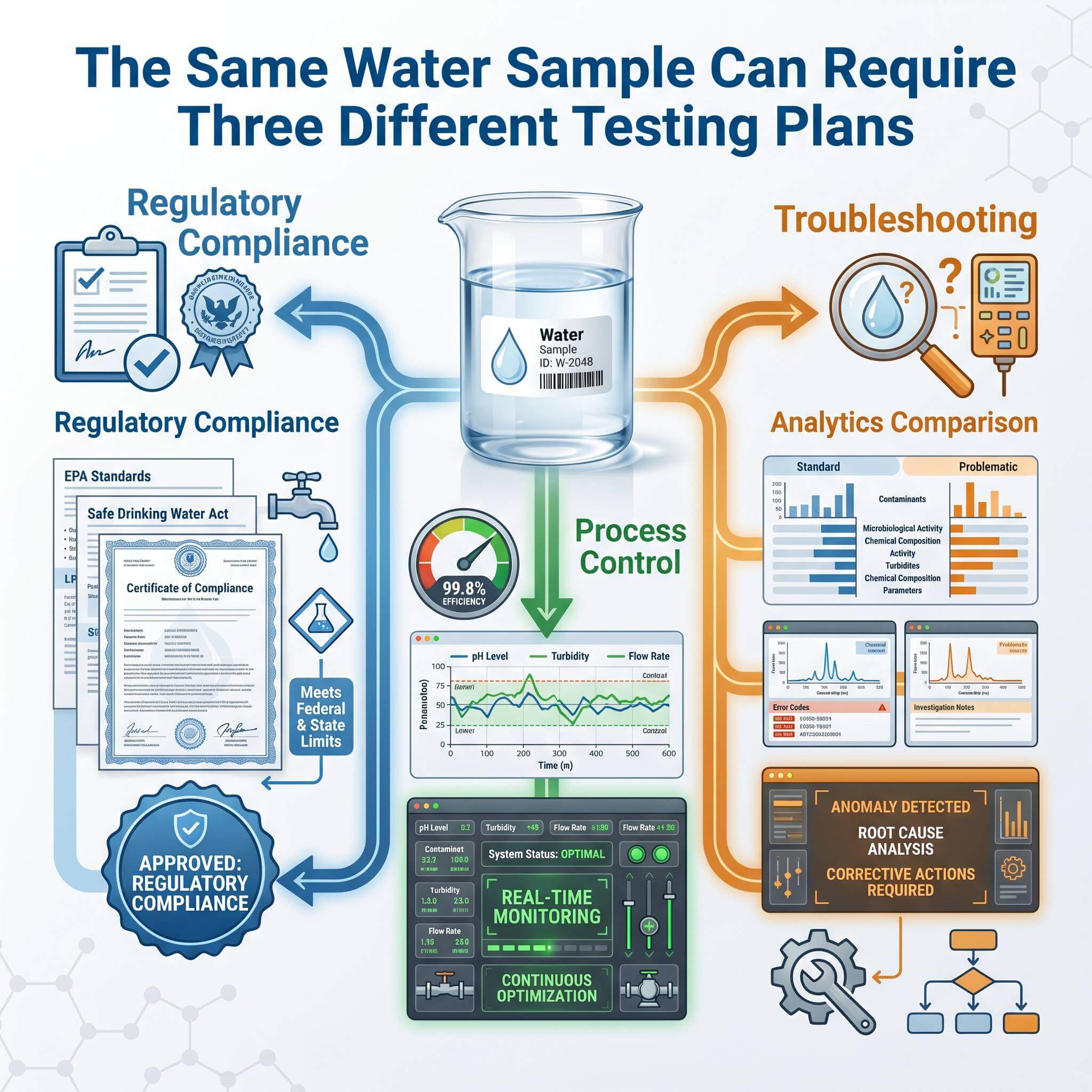
However, visual inspection must never replace measurement. A three-level water quality monitoring strategy is recommended:
n Level 1 — Daily or online monitoring: pH, conductivity, turbidity, and temperature.
n Level 2 — Regular or batch testing: COD, ammonia nitrogen, nitrate, phosphate, hardness, and alkalinity.
n Level 3 — Special or event-driven testing: heavy metals, microorganisms, trace organic pollutants, and specific ions.
6. What Parameters Should Be Tested When Water Looks Clear?
There is no universal testing list for all clear water samples. The right parameters depend on the water source, application, risk, and decision that needs to be made. A proper approach should include:
1.Identifying the water source type and potential risks, such as groundwater, surface water, reclaimed water, or industrial reuse water.
2.Identifying sensitive parameters for downstream treatment or use systems, such as membrane scaling tendency or boiler corrosion control.
3.Determining required compliance items based on regulations or contract requirements.
Typical Recommended Parameter List by Category
l Basic physical and electrochemical parameters, usually essential: pH, conductivity, temperature, turbidity, and dissolved oxygen when needed.
l Organic matter and nutrients, usually recommended: COD or TOC, ammonia nitrogen, nitrate, and phosphate.
l System-specific parameters, selected as needed: free chlorine or total chlorine, hardness, alkalinity, silica, chloride, sulfate, and sulfide.
l Safety and compliance parameters, tested for specific purposes: heavy metals such as As, Pb, Cd, Cr, and Hg; microorganisms such as coliforms and total plate count; and specific organic pollutants such as VOCs and PFAS.
7. The Role of Water Quality Instruments
Water quality instruments help convert invisible water conditions into measurable data. Different instruments are suitable for different tasks.
In practical water quality laboratories, the instrument should be selected according to the parameters, required method, concentration range, sample type, and testing frequency. For example, photometric analyzers are often suitable for routine reagent-based parameters such as COD, ammonia nitrogen, nitrate, phosphate, and chlorine, while electrochemical meters are essential for pH, conductivity, dissolved oxygen, and ORP. A reliable testing program usually depends on combining the right instruments with the right parameters.
Photometer water quality analyzers
Photometers are widely used for routine colorimetric analysis. They are practical for many common water quality parameters, such as COD, ammonia nitrogen, nitrate, nitrite, phosphate, chlorine, and other reagent-based tests. They are very useful when laboratories need routine testing with defined methods, stable operation, and cost-effective analysis.
Spectrophotometers provide greater wavelength flexibility and may be suitable for method development, research, advanced laboratory analysis, or applications requiring broader analytical capability. However, not every routine water quality laboratory needs a full spectrophotometer for daily testing.
pH meters, conductivity meters, dissolved oxygen meters, and ORP meters are essential for many routine applications. These instruments measure parameters that are invisible but very important for water quality control.
Turbidity meters
Turbidity meters measure cloudiness related to suspended particles more objectively than visual judgment. They are important in drinking water, wastewater, surface water, and process monitoring, but they should not be used as the only indicator of water quality.
8. Clear Water Can Create a False Sense of Safety
One of the biggest risks of clear-looking water is a false sense of safety. When water looks clean, people may reduce testing frequency, ignore warning signs, or assume the system is stable.
This may lead to several problems:
u Hidden pollution may be missed
u Treatment performance may be overestimated
u Compliance risk may increase
u Process changes may not be detected early
u Customers may choose insufficient testing programs
u Operators may focus only on visible problems
In water quality management, invisible problems are often more difficult to control because they do not create immediate visual alarms. This is why routine testing should be based on risk, application, and decision-making needs, not only appearance.
9. A Practical Way to Think About Clear Water
When a water sample looks clear, the right question is not:
“Does it look clean?”
Better questions include:
l What is this water used for?
l What risks are expected in this application?
l Which parameters can confirm these risks?
l Is the water source stable or variable?
l Is this result used for routine control, process adjustment, or compliance?
l Are invisible contaminants likely in this system?
l Which parameters must be measured regularly?
l Which parameters only need periodic confirmation?
This way of thinking helps avoid both under-testing and over-testing. The goal is not to test every possible parameter. The goal is to test the parameters that truly help support the right decision.
10. A Decision Framework from Clear Water to Clean Water
From an engineering perspective, moving from “clear water” to “clean water” requires a structured decision process:
1.Define the application and risk level: high, medium, or low.
2.List potential parameters that may exceed limits based on historical data, source water characteristics, and process changes.
3.Determine testing frequency and limits based on standards, equipment tolerance, or process experiments.
4.Perform measurement and record uncertainty.
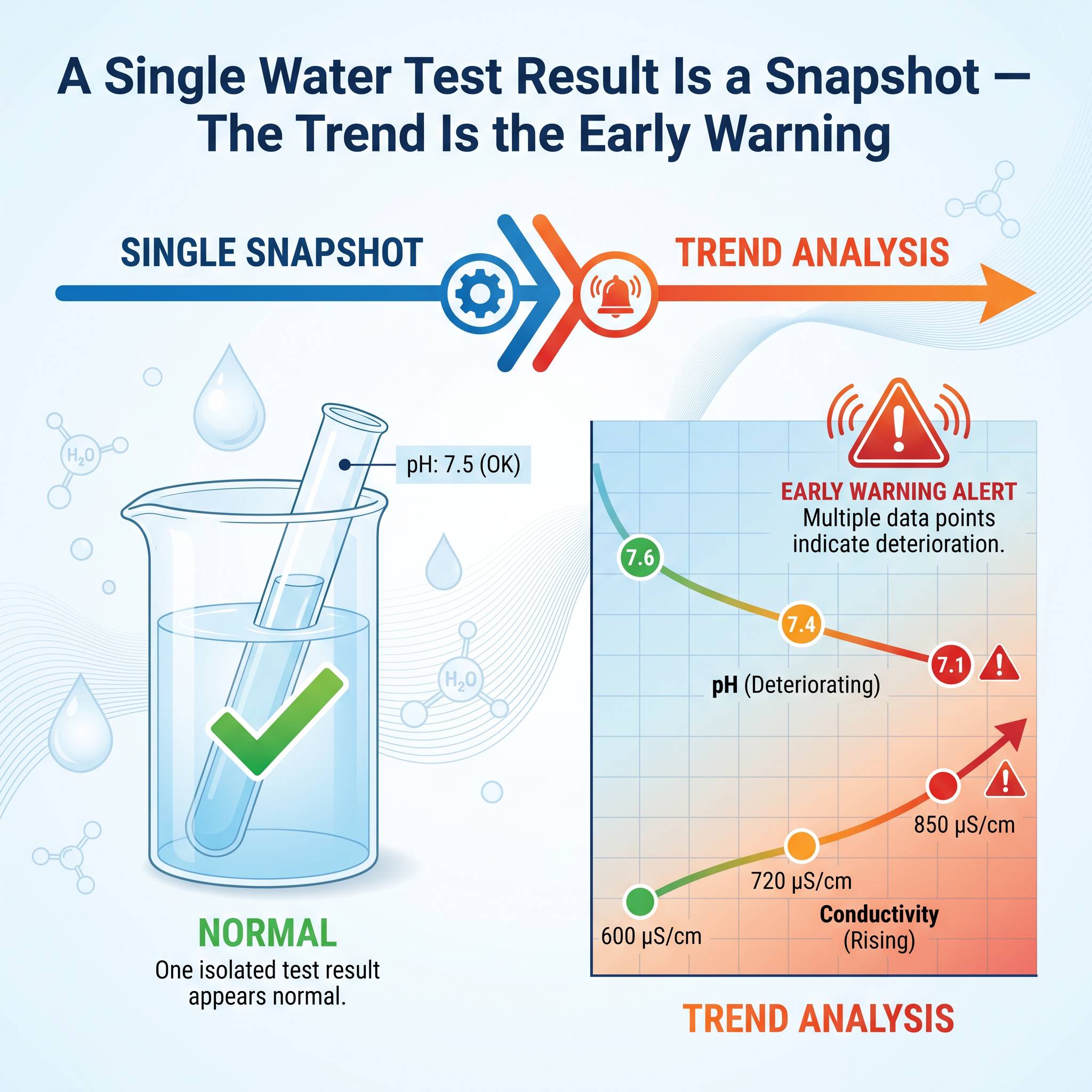
5.Compare trends rather than single-point values, using control charts to evaluate stability.
6.If only visual clarity is available, do not draw any safety conclusion.
Ultimately, clean water in an engineering sense should be concluded only after all necessary indicators of the water sample have been measured through scientific analytical methods.
FAQ: Clear Water and Water Quality Testing
1. Does clear water mean clean water?
No. Clear water only means there are no obvious visible particles, color, or turbidity. It does not confirm that dissolved contaminants, nutrients, heavy metals, microorganisms, or abnormal chemical parameters are absent.
2. Can clear water still contain bacteria?
Yes. Many bacteria, viruses, and other microorganisms do not change the appearance of water. Microbial safety requires appropriate microbiological testing based on the water application and regulatory requirements.
3. What invisible pollutants can exist in clear water?
Clear water may still contain dissolved salts, organic matter, ammonia nitrogen, nitrate, phosphate, heavy metals, chlorine imbalance, abnormal pH, or microbial contamination.
4. Which parameters should be tested if water looks clear?
Common parameters include pH, conductivity, turbidity, temperature, COD, ammonia nitrogen, nitrate, phosphate, chlorine, hardness, alkalinity, dissolved oxygen, and microbiological indicators, depending on the application.
5. Is turbidity enough to judge water quality?
No. Turbidity is useful for measuring cloudiness caused by suspended particles, but it cannot confirm dissolved chemical pollutants, nutrients, metals, or microbial safety.
6. Why is water quality testing necessary if water looks clean?
Water quality testing is necessary because many important risks are invisible. Testing converts hidden physical, chemical, and biological conditions into measurable data for decision-making.
Conclusion
Clear water is not always clean water.
Appearance can provide useful first impressions, but it cannot replace water quality testing. Many important water quality parameters are invisible, including pH imbalance, high conductivity, dissolved organic matter, COD, ammonia nitrogen, nitrate, phosphate, chlorine residual, heavy metals, and microbial indicators.
For laboratories, water treatment plants, industrial users, aquaculture operators, and environmental monitoring teams, clear appearance should be treated as a starting observation, not a final conclusion.
The real value of water quality testing is to convert invisible risks into measurable data. Clear water may look safe. But clean water needs evidence.