+852 46135220

Selecting the right laboratory water testing instruments for industrial facilities is a strategic and technical decision. Unlike online monitoring systems that focus on real-time trends, laboratory analysis serves as the final authority for method validation, data verification, regulatory compliance, and in-depth process diagnostics. Laboratory data form the basis for process adjustments, serve as the benchmark for online analyzers, and act as legally defensible evidence during regulatory audits.
Industrial laboratories face unique challenges: highly variable sample matrices, heavy analytical workloads, strict accuracy and traceability requirements, and constant pressure to balance efficiency with cost. Instrument selection is therefore not a simple comparison of specifications, but the construction of a system aligned with operational needs, technical standards, and long-term sustainability.
This guide presents a structured decision framework from the perspective of practicing engineers and laboratory managers.
1. Define Measurement Objectives and Data Usage
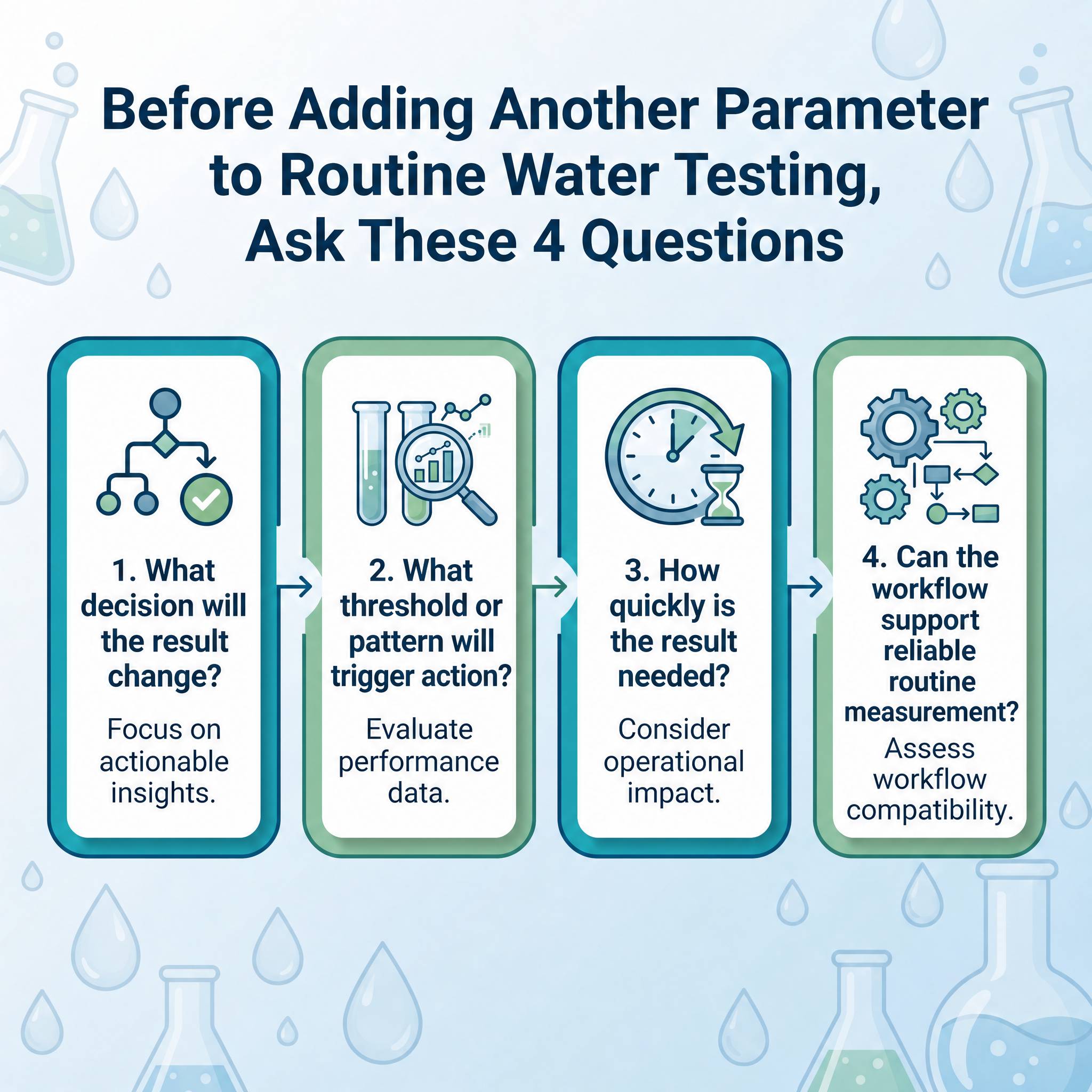
Instrument selection must begin with a clear understanding of why measurements are performed, as this determines technical priorities.
Primary Testing Objectives
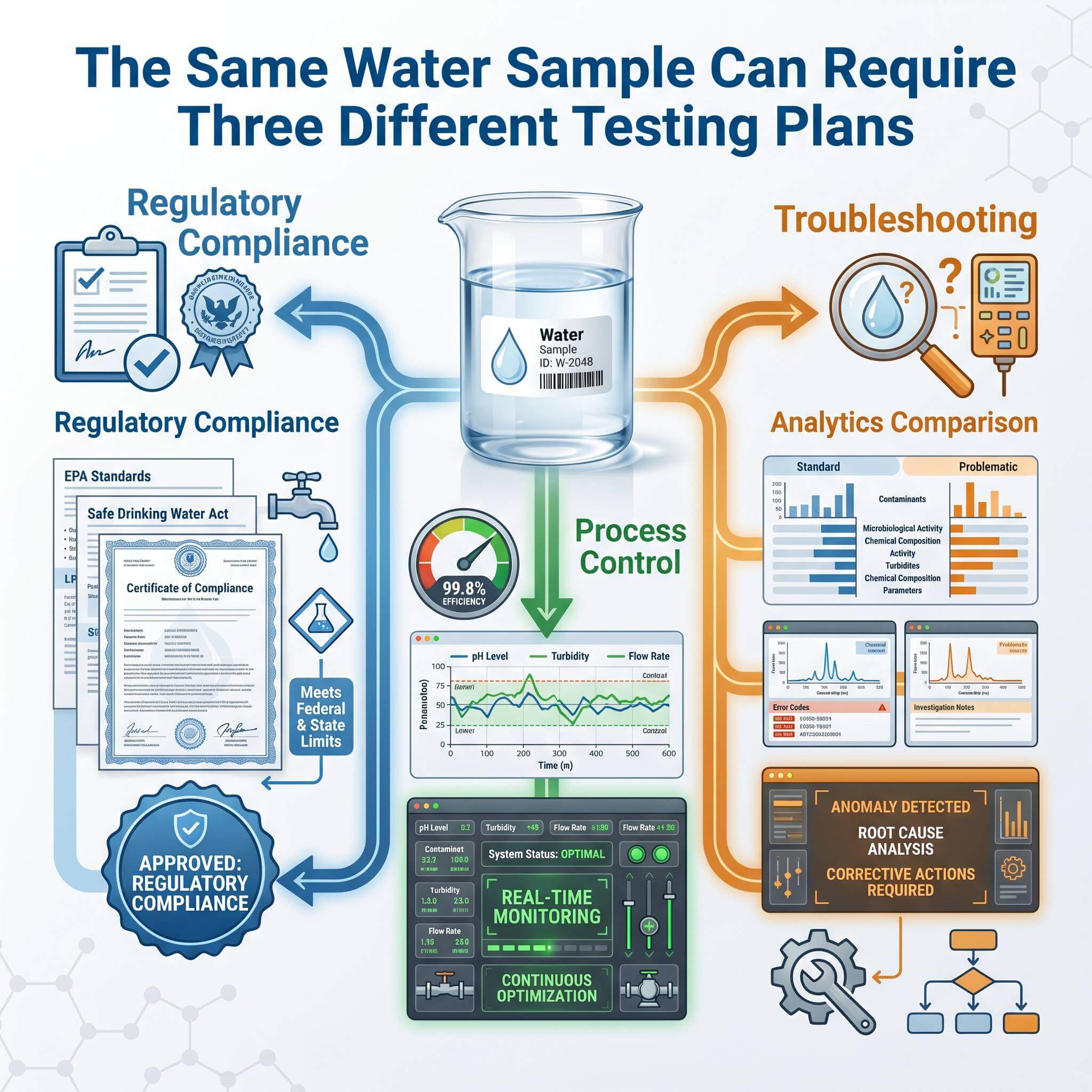
l Routine process monitoring and optimization
Requires high throughput, ease of operation, and strong repeatability to provide rapid feedback, such as pH and turbidity after coagulant dosing.
l Regulatory compliance and official reporting
Instruments must comply with national or international standard methods and support full data traceability (audit trails). This is a non-negotiable baseline.
l Troubleshooting and process diagnostics
Requires accuracy, flexibility, and the ability to measure specific parameters to identify root causes of abnormal conditions.
l R&D and special projects
Demand high sensitivity, extended functionality, or advanced techniques such as ion chromatography or ICP-MS.
Engineering decision rule: Compliance requirements take priority, automation supports high-volume routine testing, and R&D focuses on performance limits.
2. Understand Sample Characteristics and Matrix Challenges
Industrial water samples (raw water, process water, and wastewater) ultimately test instrument performance.
Key Matrix Challenges
l High matrix complexity: High salinity, chlorine, hardness, COD, oil, or suspended solids can affect colorimetric reactions, electrode response, and digestion efficiency.
l Interfering substances: Sulfides, residual chlorine, or heavy metals may poison sensors or distort reactions.
l Wide concentration ranges: From trace levels in ultrapure water to thousands of mg/L in industrial wastewater.
Selection Strategy
ü Mandatory method validation: Test candidate instruments using real samples to assess accuracy, precision, recovery, and interference resistance.
ü Emphasize sample pretreatment: Many errors originate upstream. Homogenizers, centrifuges, distillation units, or SPE systems may be essential.
3. Core Performance Metrics: Accuracy, Precision, and Detection Limits
Data quality is the lifeline of laboratory instruments.
Key Performance Indicators
l Accuracy: Must be verified using certified reference materials (CRMs), especially for compliance reporting.
l Precision: Evaluated by RSD under expected concentration ranges. Long-term stability often matters more than ultra-high resolution.
l LOD and LOQ: Critical for low-level parameters. Ensure they meet regulatory thresholds (typically 1/3–1/10 of limit values).
Engineer’s perspective: Instruments must support internal quality control programs using duplicates, spikes, and blind samples.
4. Analytical Methods and Instrument Principles
Correct method selection ensures both compliance and efficiency.
Common Laboratory Technologies
Spectroscopic Methods:
l Vis spectrophotometers or photometers water quality analyzer: Core tools for COD, ammonia, total phosphorus, and metals. Key factors: dual-beam design, wavelength accuracy, stray light control, cuvette compatibility.
l AAS / ICP-OES: Metal analysis. ICP-OES offers higher throughput and wider linear range; AAS is cost-effective.
Electrochemical Methods”
l pH and conductivity meters: Electrode stability and automatic compensation are critical.
Chromatographic Methods”
l Ion chromatography (IC): Standard for anions and cations. Focus on eluent generation, suppressor performance, and column compatibility.
l GC / LC: Specialized analysis for VOCs, pesticides, and PAHs.
Engineering recommendation: Follow standard-specified methods first. For high-frequency parameters, consider multiparameter analyzers or continuous flow systems to increase throughput.
5. Throughput, Automation, and Efficiency
Laboratory labor costs are high; efficiency is essential.
Productivity Drivers:
ü Sample throughput: Batch digesters, autosamplers, and multi-channel systems increase capacity.
ü Automation: Auto-calibration, dilution, cleaning, and reporting reduce errors and workload.
ü Ease of use: Intuitive software, preset methods, and barcode tracking minimize training and mistakes.
Cost-benefit insight: Automation for high-frequency parameters often pays for itself through labor savings and reduced rework.
6. Data Integration and Regulatory Compliance
Modern laboratories prioritize digital data integrity.
Required Capabilities
l Data export and connectivity: Easy output in electronic formats and compatibility with LIMS.
l Audit trails: Essential for GLP and accreditation requirements.
l User access control: Ensures data integrity and accountability.
Key takeaway: Data management functionality is as important as analytical performance.
7. Total Cost of Ownership and Supplier Evaluation
Purchase price is only the beginning.
TCO Components
ü Initial investment: Instruments, accessories, installation, and training.
ü Operating costs: Reagents, consumables, maintenance contracts, calibration, utilities, and waste disposal.
ü Downtime costs: Delays, missed deadlines, and idle personnel.
Supplier Evaluation Criteria
u Local technical support and response time
u Application expertise for industrial samples
u Structured training programs
8. Recommended Instrument Configurations
Core Compliance Setup
Vis spectrophotometers or photometers water quality analyzer + intelligent digestion instrument + precision pH/conductivity meter.
Efficiency-Focused Setup
Add multiparameter analyzers or continuous flow systems for batch automation.
Specialized Expansion
ICP-OES, IC, GC/MS for metals, ions, or organic contaminants as required.
Conclusion
Selecting laboratory instruments for industrial water analysis is a multidisciplinary engineering task that integrates technical judgment, operational planning, and cost control.
The best instruments are not those with the highest specifications, but those that match sample characteristics, testing volume, staff capabilities, and compliance requirements, while delivering reliable, auditable data at a reasonable lifetime cost.
Engineers and laboratory managers lead this process should through clear requirements, rigorous validation, full TCO assessment, and careful supplier evaluation. The result is a laboratory system that supports stable operations, regulatory confidence, and continuous improvement. Well-selected instruments are not just tools, which are the foundation of credible data and operational trust.