+852 46135220

Online water quality monitoring has become increasingly common in wastewater treatment plants, industrial water systems, drinking water facilities, aquaculture, and environmental monitoring projects. This is understandable. Compared with manual sampling and periodic laboratory testing, online monitoring systems can provide continuous data, real-time alarms, and faster visibility of process changes. For parameters such as pH, conductivity, turbidity, dissolved oxygen, ORP, residual chlorine, and temperature, online monitoring can be extremely valuable for daily operation and process control.
However, one misunderstanding often appears in practical water quality management: If online monitoring is installed, does the laboratory still need to test the water?
The answer is yes.
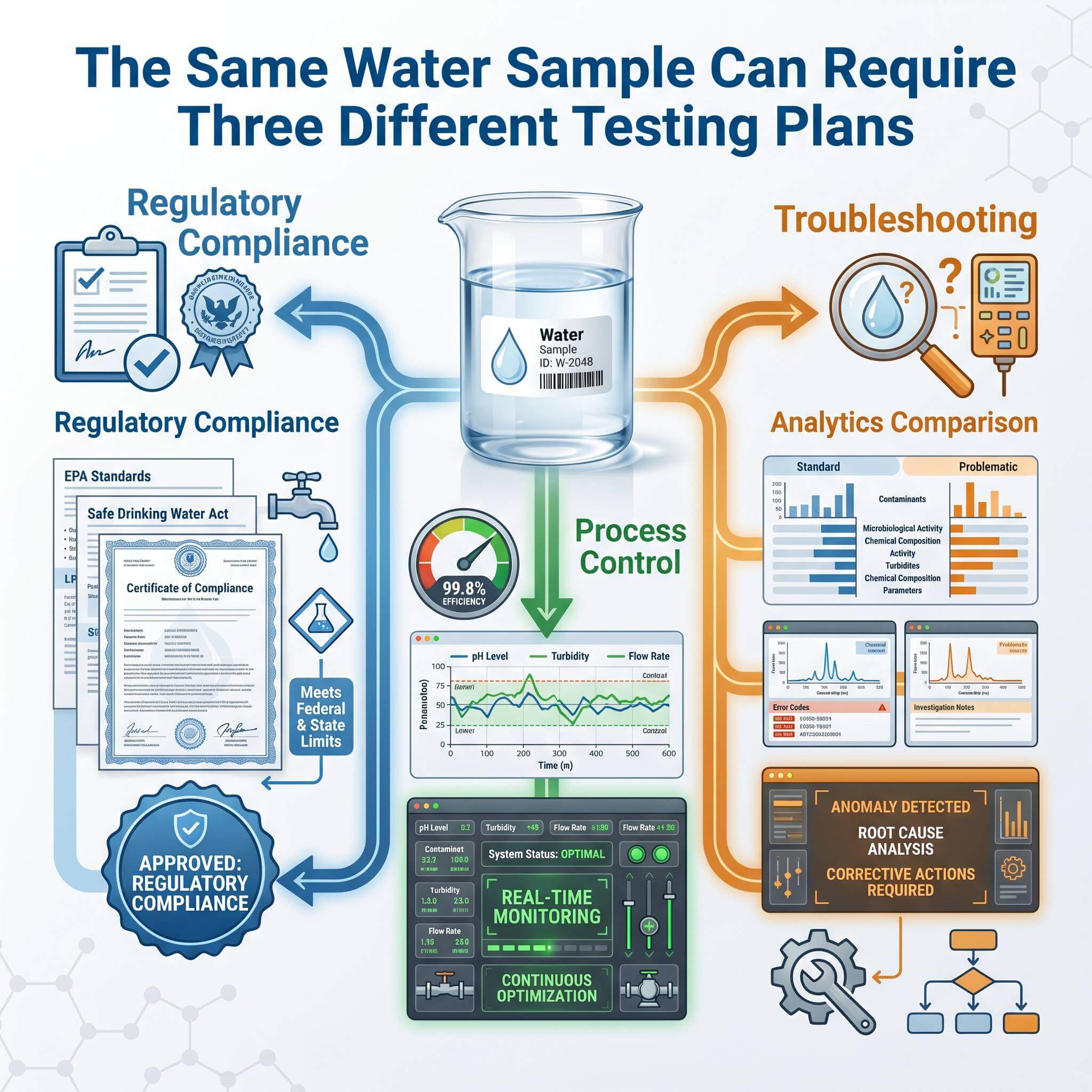
Online water quality monitoring does not replace laboratory testing. Online monitoring is useful for continuous tracking, process control, and early warning, while laboratory testing is still needed for confirmation, regulatory compliance, troubleshooting, and method-based analysis. In most water quality programs, the best approach is not online monitoring or laboratory testing. It is online monitoring plus laboratory testing. Online instruments help detect changes in real time, and laboratory tests help confirm what those changes mean.
1. Online Monitoring Is Best for Trends, Alarms, and Process Control
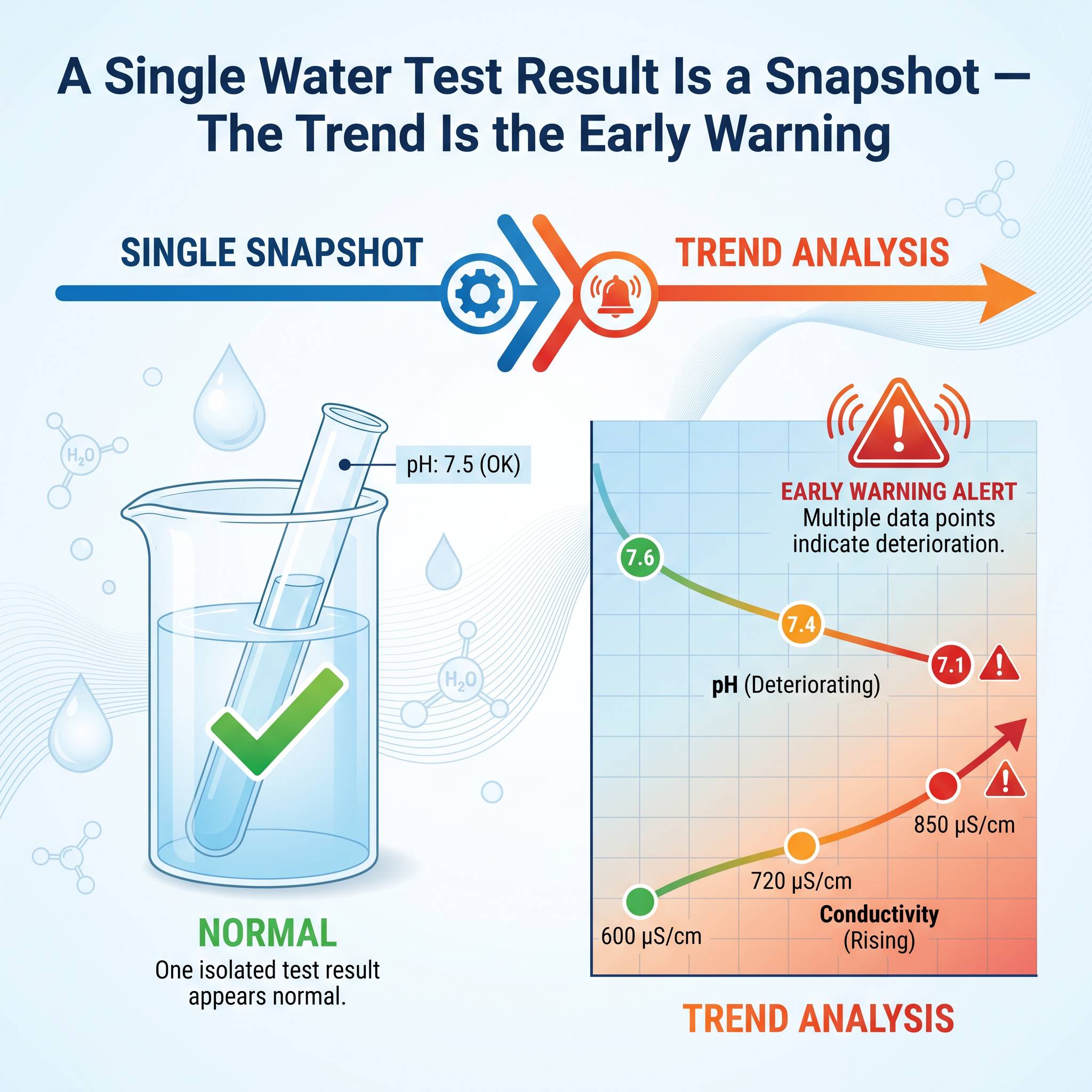
The strongest advantage of online water quality monitoring is continuity. Instead of testing a sample once or twice per day, an online instrument can track parameter changes continuously. This helps operators observe whether the system is stable, whether a sudden change has occurred, and whether a process adjustment is needed. For example, online monitoring can help answer questions such as:
l Is the pH changing quickly?
l Is the conductivity increasing abnormally?
l Is turbidity rising after a filtration process?
l Is dissolved oxygen dropping in an aeration tank?
l Is residual chlorine still within the expected control range?
l Has the treatment process suddenly become unstable?
These are operational questions. In this type of situation, online monitoring is very useful because it provides fast warning signals. It allows operators to react earlier instead of waiting for the next laboratory result. This is especially important in systems where water quality can change quickly, such as:
n Wastewater treatment processes
n Industrial discharge monitoring
n Cooling water systems
n Boiler feedwater systems
n Aquaculture water management
n Drinking water distribution systems
n Surface water monitoring stations
For daily process control, online monitoring can be one of the most effective tools. But seeing that something has changed is not always the same as proving exactly what happened. That is where laboratory testing remains important.
2. Laboratory Testing Is Best for Confirmation, Compliance, and Diagnosis
Laboratory testing is usually slower than online monitoring, but it provides a different type of value. A laboratory test is not only about obtaining a number. It is about testing a sample under controlled conditions, using a defined method, with proper reagents, calibration, sample preparation, quality control, and result verification. This is especially important when the result will be used for:
l Regulatory compliance
l Official reporting
l Discharge limit confirmation
l Root cause investigation
l Product quality decisions
l Process troubleshooting
l Customer or third-party disputes
l Method-based water quality evaluation
For example, if an online turbidity sensor suddenly shows a high reading, the operator may know that something has changed. But the laboratory may still need to confirm whether the cause is suspended solids, sample disturbance, color interference, air bubbles, instrument fouling, or another process issue. Similarly, if an online pH sensor shows a slow drift, it may not mean the water chemistry has actually changed. The issue may come from electrode aging, coating, calibration drift, temperature compensation, or poor sample flow.
Laboratory testing helps confirm whether the online signal reflects the real water condition or an instrument-related issue.
Online Water Quality Monitoring vs Laboratory Testing
Item | Online Water Quality Monitoring | Laboratory Water Testing |
Main purpose | Continuous monitoring, alarms, and process control | Confirmation, compliance, and detailed analysis |
Data type | Trend data and real-time signals | Method-based analytical results |
Best used for | pH, conductivity, turbidity, DO, ORP, residual chlorine, temperature | COD, ammonia nitrogen, total phosphorus, nitrate, nitrite, metals, color, low-level contaminants |
Main advantage | Fast response and continuous visibility | Higher control of method, sample preparation, and quality verification |
Main limitation | May be affected by fouling, drift, bubbles, flow, and matrix changes | Slower than online monitoring and depends on sampling frequency |
Best role in workflow | Detecting changes early | Confirming what the changes mean |
3. A Sensor Signal Is Not Always a Final Test Result
One of the biggest mistakes in water quality management is treating every online reading as a final analytical result. An online sensor is exposed directly to the water environment. This makes it powerful, but also vulnerable. Online instruments may be affected by:
u Sensor fouling
u Air bubbles
u Suspended solids
u Color or turbidity interference
u Temperature fluctuation
u Flow rate instability
u Poor sample circulation
u Chemical coating on electrodes or optical windows
u Calibration drift
u Reagent condition, if the system uses reagents
u Matrix changes in the water sample
In real applications, the online value may be influenced by both the water quality and the condition of the monitoring system itself. This does not mean online monitoring is unreliable. It means online data must be understood correctly.
Online monitoring is excellent for showing patterns and changes. But when the result is close to a limit, when a dispute occurs, or when the data will be used for formal decisions, laboratory confirmation is often necessary.
4. Which Water Quality Parameters Are Suitable for Online Monitoring?
The suitability of online monitoring depends on whether the parameter can be measured directly, continuously, and reliably under actual sample conditions. Not all water quality parameters behave the same way. Some parameters are relatively suitable for online measurement because they can be measured directly or continuously with sensors. Common examples include:
l pH
l Conductivity
l Temperature
l Turbidity
l Dissolved oxygen
l ORP
l Residual chlorine
l Flow-related monitoring indicators
These parameters are often useful for process control because they can change quickly and need frequent observation.
Other parameters are more method-dependent and often require laboratory testing or controlled analytical procedures. Examples include:
n COD
n Ammonia nitrogen
n Total phosphorus
n Total nitrogen
n Nitrate
n Nitrite
n Heavy metals
n Color
n Silica
n Low-level contaminants
n Many regulatory parameters
These tests may require digestion, reagent reaction, color development, filtration, distillation, extraction, or controlled measurement conditions. For these parameters, the result depends not only on the instrument, but also on the complete analytical method. This is why laboratory testing remains essential for many routine water analysis programs.
5. Online Data Tells You “Something Changed” — Laboratory Testing Helps Explain “Why”
A simple way to understand the difference is this: Online monitoring is often good at detecting change. Laboratory testing is often better at confirming meaning.
For example:
l If online conductivity increases, the system may have higher dissolved ions. But laboratory testing may be needed to identify which ions changed.
l If online turbidity increases, there may be suspended particles. But laboratory testing may be needed to determine whether the problem comes from solids, biological growth, coagulant failure, filtration issues, or sample disturbance.
l If online residual chlorine decreases, the system may be losing disinfectant. But further testing may be required to understand whether the cause is organic load, ammonia, microbial activity, dosing failure, or high chlorine demand.
l If online pH shifts, the cause may be chemical addition, process imbalance, temperature effect, electrode drift, or poor maintenance.
Online monitoring provides the signal. Laboratory testing helps interpret the signal. Both are needed if the goal is not only to collect data, but to make correct decisions.
6. Laboratory Testing Is Also Needed to Verify Online Instruments
Online monitoring systems themselves require verification. Even a high-quality online instrument can produce misleading data if it is not properly calibrated, cleaned, maintained, and checked against reliable reference results.
Laboratory testing can help verify whether the online system is still performing correctly. For example, a facility may compare online readings with laboratory results at regular intervals. If the difference is small and stable, the online system may be considered under control. If the difference becomes larger, it may indicate a need for cleaning, recalibration, sensor replacement, reagent replacement, or method review.
This comparison is not a formality. It is part of data quality control. Without laboratory verification, online monitoring may slowly drift away from the true condition of the water without being noticed.
7. The Best Workflow Is Usually Online Monitoring Plus Laboratory Testing
In practical water quality management, the most effective approach is usually not “online or laboratory.” It is “online plus laboratory.”
A well-designed workflow may look like this:
ü Online monitoring provides continuous observation.
ü Laboratory testing provides confirmation and detailed analysis.
ü Field testing provides quick checks and operational flexibility.
ü Quality control procedures make the data reliable.
For example, in a wastewater treatment plant:
n Online pH, DO, ORP, and turbidity can help operators monitor process stability.
n Laboratory COD, ammonia nitrogen, total phosphorus, and suspended solids can confirm treatment performance.
n Portable instruments can be used for quick checks at different sampling points.
n Regular calibration and verification can connect all data sources into one reliable system.
This kind of combined approach is much stronger than relying on only one type of measurement.
8. When Is Laboratory Testing Required for Water Quality Monitoring?
Laboratory testing becomes especially important in the following situations:
When the result is close to a regulatory limit: If a discharge value is near the permitted limit, relying only on one online reading may be risky. Laboratory confirmation can help determine whether the result is truly compliant or whether further action is needed.
When the online reading suddenly changes: A sudden alarm may indicate a real process issue, but it may also come from sensor fouling, bubbles, sample flow problems, or electrical interference. Laboratory testing helps confirm the cause.
When a customer, regulator, or third party questions the result: Formal discussions usually require method-based laboratory data rather than only trend data from an online system.
When the parameter requires chemical reaction or digestion: For parameters such as COD, ammonia nitrogen, total phosphorus, nitrate, and some metals, laboratory methods are often needed to obtain reliable and comparable results.
When troubleshooting a process problem: Online data can show where the abnormal trend started. Laboratory testing can help identify what changed chemically or physically.
Laboratory testing becomes especially important when the result is used for compliance, reporting, dispute resolution, root cause analysis, or process correction. In these cases, the result must be more than a real-time signal. It must be supported by a controlled method and proper quality control.
9. Better Instruments Do Not Automatically Create Better Data
Whether the instrument is online, portable, benchtop, or laboratory-based, data quality depends on more than the device itself. Reliable water testing also depends on:
ü Correct parameter selection
ü Suitable measurement range
ü Proper sampling
ü Correct sample preservation
ü Good calibration practice
ü Regular verification
ü Clean sensors and optical parts
ü Fresh reagents
ü Method consistency
ü Operator understanding
ü Proper interpretation of results
This is why a more advanced monitoring system does not automatically produce better water quality decisions. The instrument must match the application, workflow, sample condition, and decision requirement.
10. How to Decide Which Method Should Be Used
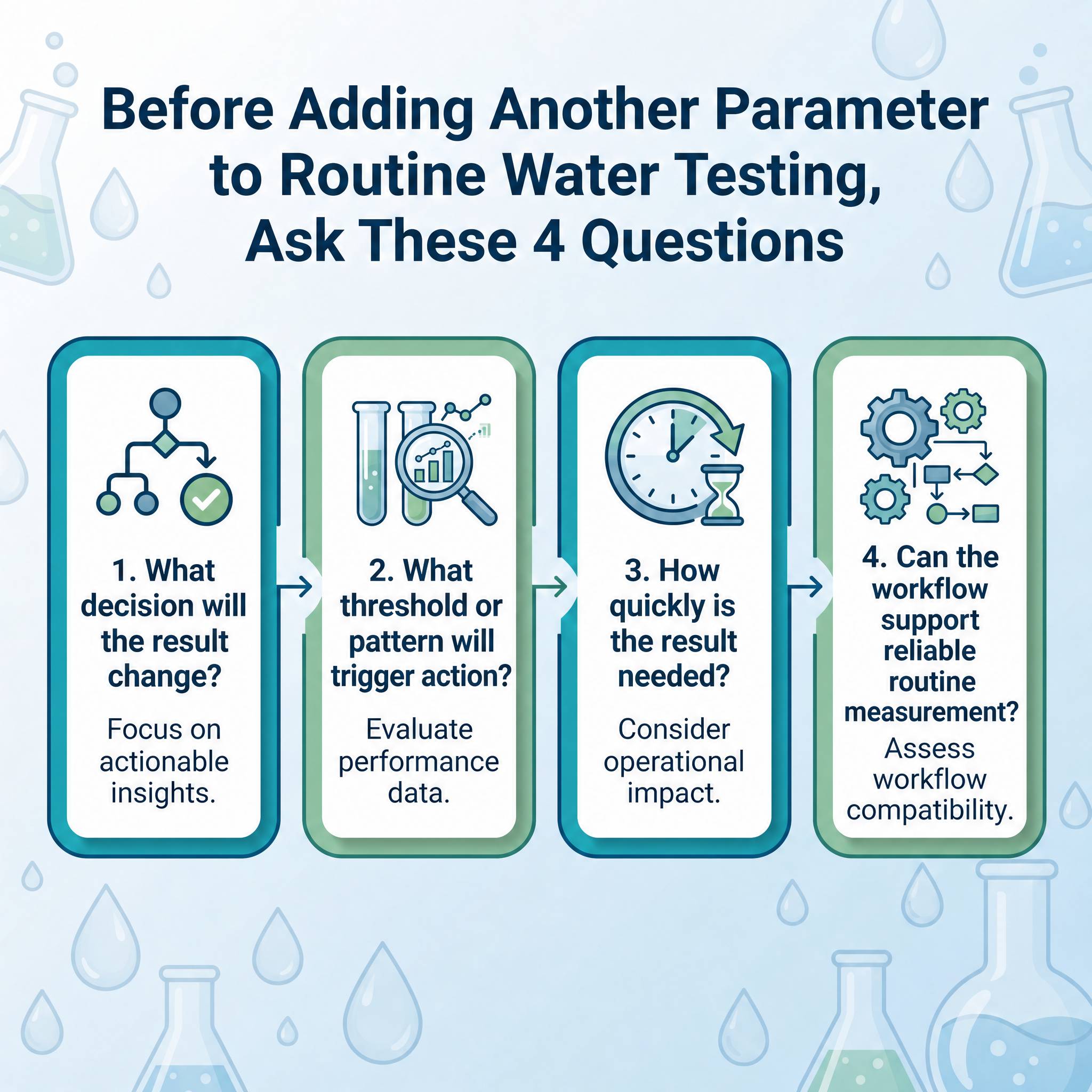
A practical decision framework is to ask four questions:
1. Do we need continuous trend data?
If the answer is yes, online monitoring may be useful.
2. Do we need an official or method-based result?
If the answer is yes, laboratory testing is usually needed.
3. Can the parameter be measured directly and reliably in the process?
If the answer is yes, online monitoring may work well.
4. Does the result require chemical reaction, digestion, or controlled sample preparation?
If the answer is yes, laboratory testing is usually more appropriate. This framework helps avoid both over-reliance on online systems and unnecessary laboratory workload.
Conclusion: Online Monitoring and Laboratory Testing Are Not Competitors
Online water quality monitoring is a powerful tool. It helps facilities see trends, detect changes, and respond faster. But it does not replace laboratory testing. Laboratory testing remains essential for confirmation, compliance, troubleshooting, method-based analysis, and verification of online instruments. In simple terms, online monitoring is best for real-time visibility, while laboratory testing is best for verified results. A reliable water quality testing program should use online monitoring to detect changes and laboratory testing to confirm decisions.
The real goal is not to choose one and reject the other. The real goal is to understand what each method can prove.
Online monitoring helps answer: “What is changing?”
Laboratory testing helps answer: “What does this result really mean?”
When both are used correctly, water quality data becomes more useful, more reliable, and more suitable for real decision-making.