+852 46135220

In water quality testing, one of the most common mistakes is not choosing the wrong instrument. It is choosing the wrong type of test for the question being asked.
Many water laboratories, treatment plants, factories, and field teams use routine water testing every day. They measure pH, conductivity, turbidity, residual chlorine, COD, ammonia nitrogen, phosphate, iron, hardness, and other common parameters. These tests are essential. They help users monitor process stability, check treatment performance, control dosing, identify abnormal trends, and make day-to-day operational decisions.
But routine water testing has a clear boundary. A routine test is designed to answer routine questions. It is not always designed to investigate unknown contamination, confirm trace-level pollutants, explain complex failures, or replace specialized laboratory analysis.
The biggest mistake in water testing is using a routine test to answer a non-routine question. When this happens, the result may look precise. The number may look professional. The instrument may work correctly. But the conclusion can still be wrong. This is why reliable water quality testing is not only about instrument accuracy, reagent quality, or parameter range. It is also about matching the testing method to the testing purpose, the sample matrix, the expected concentration range, and the decision that will be made from the result.
What Is a Routine Water Test?
A routine water test is a test performed regularly to monitor known and expected water quality parameters. It usually has several characteristics:
l The target parameter is already known.
l The water matrix is familiar.
l The expected concentration range is understood.
l The method is suitable for regular monitoring.
l The result supports a repeated operational decision.
l The laboratory or operator has an established procedure.
For example, a wastewater laboratory may routinely test COD, ammonia nitrogen, phosphate, suspended solids, pH, and conductivity. A drinking water operator may routinely monitor pH, turbidity, residual chlorine, conductivity, hardness, and iron. An industrial water system may regularly check pH, conductivity, silica, hardness, alkalinity, and chloride.
These routine tests are extremely valuable because they help answer questions such as:
n Is the treatment process stable?
n Has the water quality changed from yesterday?
n Is the dosing system working?
n Is the discharge close to a control limit?
n Is the process moving in the right direction?
n Does the water meet the internal control target?
For these questions, routine testing is practical, efficient, and often the best choice. But not every water quality question is routine. In simple terms, routine water testing is used to monitor expected water quality conditions on a regular basis. It is best suited for known parameters, familiar sample types, established methods, and repeated operational decisions. Routine water testing does not mean the test is simple or unimportant. It means the testing purpose is already defined and the result is used as part of a regular monitoring program.
What Is a Non-Routine Water Testing Question?
A non-routine question usually appears when something unusual, unknown, or high-risk needs to be investigated. Examples include:
l Why does the water have an unexpected odor?
l Is there an unknown contaminant in this sample?
l Could PFAS, microplastics, pesticides, solvents, or trace metals be present?
l Why did fish die downstream of the discharge point?
l Why do two laboratories report different results for the same sample?
l Why does the water pass routine testing but still cause scaling, corrosion, staining, or biological growth?
l Is a customer complaint related to water chemistry, sampling, storage, or contamination?
l Has a new raw water source introduced new risks?
l Is the treatment process removing a specific regulated contaminant?
l Is the result suitable for legal, regulatory, or third-party dispute resolution?
These questions cannot always be answered by the same routine test panel used for daily monitoring. They often require a different testing strategy, more advanced analytical methods, stricter sample handling, method validation, confirmation testing, or a specialized laboratory.
Routine water testing question | Non-routine water testing question |
Is the pH within the control range? | Why is the pH suddenly unstable? |
Is COD higher than yesterday? | What caused the abnormal COD increase? |
Is residual chlorine present? | Why is disinfection failing despite chlorine residual? |
Is conductivity changing over time? | What new contaminant entered the system? |
Is ammonia nitrogen under control? | Why does the effluent still cause odor or toxicity concern? |
Is the result within the method range? | Is this result legally or scientifically defensible? |
Why This Mistake Happens So Often
This mistake is common because routine water testing instruments have become faster, easier, and more capable. Modern photometers, spectrophotometers, digestion instruments, pH meters, conductivity meters, dissolved oxygen meters, and multi-parameter analyzers can support many routine applications. They are useful tools for laboratories and field users.
However, this also creates a misunderstanding: If an instrument can measure many parameters, users may assume it can answer many water quality questions.
But a parameter list is not the same as an investigation method. For example, a photometer may measure ammonia nitrogen, phosphate, chlorine, iron, nitrate, COD, and many other parameters. This does not mean it can identify unknown contaminants. It does not mean it can confirm PFAS. It does not mean it can explain every odor, color, toxicity, corrosion, or process failure problem.
Routine tests are powerful when the question is clear. They become risky when the question is unclear.
Example 1: “Is This Water Safe?”
This is one of the most common non-routine questions. A user may test pH, conductivity, turbidity, residual chlorine, iron, hardness, and ammonia nitrogen. The results may all look normal.
But can these results prove that the water is safe? Not completely. These parameters provide useful basic information, but they do not cover every possible risk. They do not automatically confirm the absence of heavy metals, pesticides, PFAS, microplastics, volatile organic compounds, pathogens, or other specific contaminants.
A routine water test can say:
l The pH is within the expected range.
l Conductivity has not changed significantly.
l Turbidity is low.
l Residual chlorine is present.
l Iron is below the tested range.
l Ammonia nitrogen is not elevated.
But it cannot say:
n No harmful contaminant exists.
n The water is safe under every regulatory definition.
n No trace-level pollutant is present.
n The water is suitable for every use.
This is why “safe water” is not a single test result. It depends on the application, regulation, contaminant risk, method scope, and decision being made.
Example 2: “The COD Result Is High. What Is the Pollutant?”
COD testing is very useful in routine wastewater analysis. It helps estimate the oxygen demand caused by oxidizable substances in the sample. It is widely used for process control and discharge monitoring.
But COD does not identify the pollutant. A high COD result can indicate increased organic load or oxidizable substances, but it does not directly tell the operator whether the source is:
l Food processing waste
l Chemical discharge
l Cleaning chemicals
l Industrial solvents
l Reducing agents
l Process leakage
l Sample contamination
l Interference from chloride or other substances
l Poor sampling or digestion control
COD is a routine indicator. It is not a full chemical identification method. If the real question is “What caused this abnormal COD increase?”, then COD alone is not enough. The investigation may need trend data, process records, sampling review, chloride control, dilution checks, duplicate testing, TOC comparison, specific chemical tests, or more advanced analysis.
The mistake is not using COD. The mistake is asking COD to answer a question it was not designed to answer.
Example 3: “The Online Monitor Says Normal, But the Laboratory Result Is Different”
Online water quality monitoring is useful for continuous observation. It can detect trends, alarms, and sudden changes. But online monitoring and laboratory testing do not always answer the same question. An online sensor may measure continuously under field conditions. A laboratory test may use collected samples, controlled reagents, digestion, calibration checks, and defined procedures.
Differences can come from:
l Sampling location
l Sample preservation
l Reaction time
l Temperature effects
l Matrix interference
l Sensor fouling
l Calibration differences
l Time delay between sampling and testing
l Different measurement principles
If the question is “Is the system changing over time?”, online monitoring can be very useful.
If the question is “What is the confirmed analytical result for reporting?”, laboratory testing may be necessary.
If the question is “Why do the two results disagree?”, neither result should be accepted blindly. The correct approach is to investigate the method, sample, timing, calibration, and matrix conditions.
Example 4: “Can a Routine Photometer Test Detect Emerging Pollutants?”
Many emerging pollutants, such as PFAS, microplastics, pharmaceutical residues, pesticides, and certain trace organics, require specialized methods. Routine photometric testing is excellent for many common water parameters, especially where colorimetric methods are well established. It is widely used for chlorine, ammonia nitrogen, phosphate, iron, nitrate, COD, and other routine analysis needs. But it is not designed to detect every emerging contaminant.
This distinction matters. A routine photometer can help laboratories monitor many important indicators of water quality. It can support daily treatment decisions. It can improve operational control. It can detect abnormal changes in common parameters. But if the question is specifically about PFAS, microplastics, trace organics, or ultra-low-level contaminants, the laboratory must choose methods designed for those targets. That’s why emerging pollutants still don’t belong in most routine water testing programs.
A routine instrument should not be forced into a role it cannot scientifically support.
The Real Starting Point: What Decision Will the Result Support?
Before choosing a test, the first question should not be: “How many parameters can this instrument measure?”
The better question is: “What decision will this result support?”
This changes the entire testing strategy. For example:
Testing Question | Suitable Testing Approach |
Is the daily treatment process stable? | Routine monitoring parameters |
Is the sample close to a discharge limit? | Validated routine method with QC checks |
Why did the result suddenly change? | Repeat test, sampling review, interference check, process investigation |
Is there an unknown contaminant? | Screening and specialized analysis |
Is PFAS present? | Specific PFAS analytical method |
Is the water suitable for drinking? | Regulatory test panel based on local standards |
Why do field and lab results disagree? | Method comparison and sample handling review |
Is the instrument working correctly? | Calibration verification and control standards |
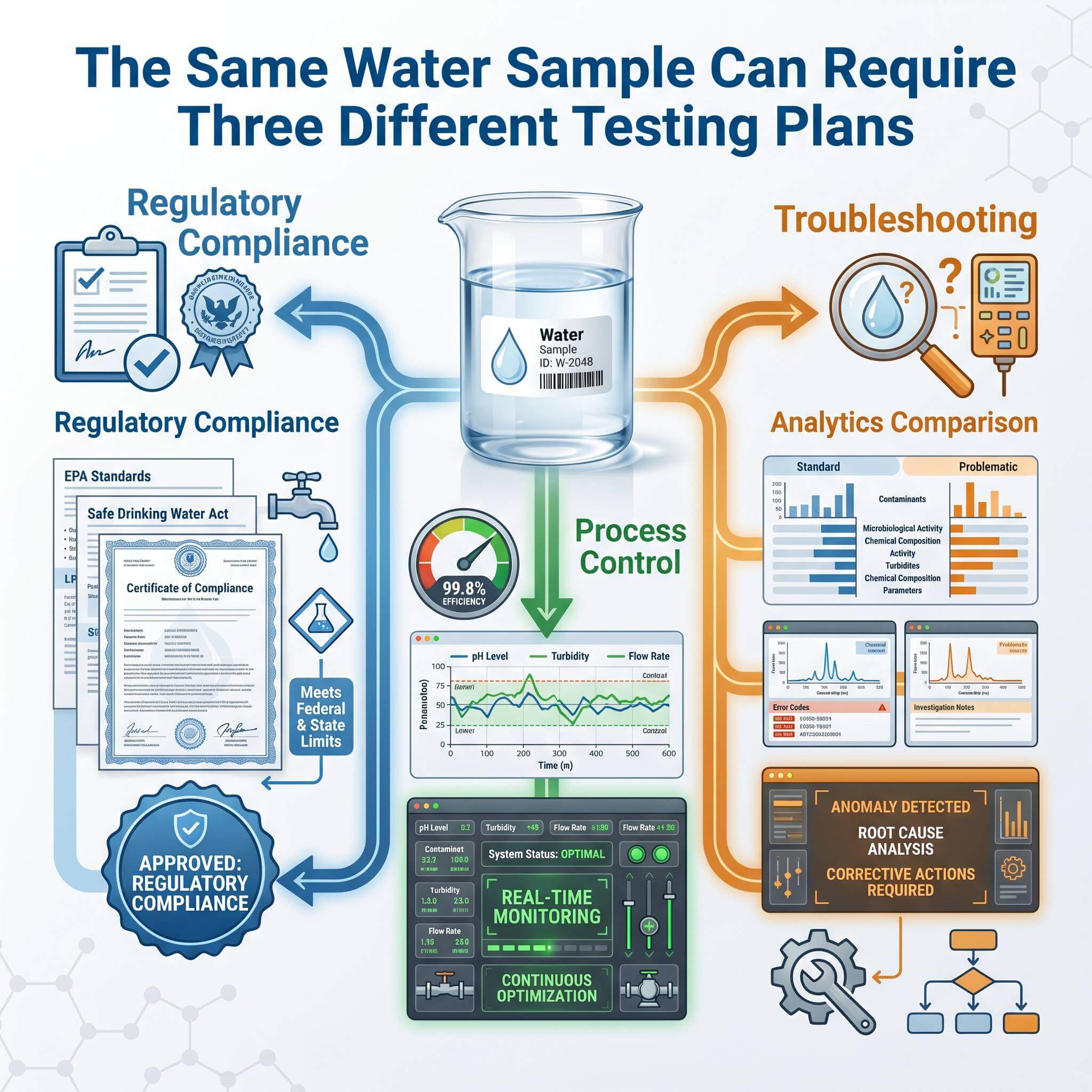
The same water sample can require different tests depending on the decision. This is why parameter selection should always follow the testing purpose.
A Practical Framework: Routine, Investigative, and Confirmatory Testing
A simple way to avoid this mistake is to divide water testing into three levels.
1. Routine Monitoring
Routine monitoring is used for regular control of known parameters. Typical examples include: pH, Conductivity, Turbidity, Dissolved oxygen, Residual chlorine, Hardness, Alkalinity, COD, Ammonia nitrogen, Phosphate, Nitrate, Iron, Manganese, Silica.
These tests are usually suitable for daily operation, process control, trend monitoring, and internal decision-making. Routine testing answers:
l Is the system stable?
l Is the process working?
l Is the value within the expected range?
l Is action needed today?
2. Investigative Testing
Investigative testing is used when something abnormal happens. Examples include: Unexpected odor, Sudden color change, Abnormal COD increase, Customer complaint, Fish kill or toxicity concern, Unstable pH or conductivity, Repeated failure near the limit, Different results from different methods, Suspected interference.
Investigative testing may include routine parameters, but it often requires additional checks:
l Sampling review
l Duplicate testing
l Spiked recovery
l Matrix dilution
l Interference assessment
l Alternative methods
l Process history review
l Comparison with previous data
l Testing upstream and downstream points
Investigative testing answers:
l What changed?
l Is the result real?
l Could the sample or method be affected?
l What is the likely source of the problem?
3. Confirmatory or Specialized Testing
Confirmatory testing is used when the result must support a high-confidence decision. Examples include:
l Regulatory reporting
l Legal dispute
l Third-party verification
l Trace contaminant confirmation
l PFAS analysis
l Heavy metals confirmation
l Pesticide or solvent analysis
l Microbiological safety testing
l Microplastics investigation
This type of testing may require advanced instruments and specialized methods, such as ICP, IC, GC-MS, LC-MS/MS, TOC analyzers, microbiology methods, or dedicated reference laboratory analysis.
Confirmatory testing answers:
l Is the target contaminant present?
l Is the result legally or scientifically defensible?
l Does the sample meet a specific regulatory requirement?
l Can the result be used for official decision-making?
Why “More Parameters” Does Not Always Solve the Problem
When users face an uncertain water quality problem, the natural reaction is often to test more parameters. This can help sometimes.
But testing more parameters without a clear question can also create confusion. A larger parameter list may produce more numbers, but not necessarily better understanding. Some results may be irrelevant. Some may be misinterpreted. Some may create false confidence. Some may distract from the real issue.
For example, if the real concern is trace organic contamination, adding more routine colorimetric parameters may not solve the problem. If the real problem is poor sampling, adding more tests will only produce more questionable data. If the real issue is matrix interference, repeating the same test without checking interference may simply repeat the same error. That’s why more parameters doesn’t always lead to better water quality data.
The goal of water testing is not to generate the longest report. The goal is to generate the right data for the right decision.
How to Know When a Routine Test Is Not Enough
A routine test may not be enough when:
u The contaminant is unknown.
u The water source has changed.
u The result will be used for regulatory or legal purposes.
u The result conflicts with field observations.
u The sample has unusual color, odor, turbidity, or matrix conditions.
u The expected concentration is near the method detection limit.
u The parameter is not directly measured by the method.
u The user needs to identify the source of contamination.
u The result is close to a critical limit.
u A customer complaint cannot be explained by routine parameters.
u Different methods give inconsistent results.
u The consequence of a wrong decision is high.
In these situations, routine testing may still be useful as a first screening step. But it should not be treated as the final answer unless the method is suitable for the decision.
Questions to Ask Before Choosing a Water Test
Before selecting an instrument, method, reagent, or parameter list, laboratories should ask:
1. What question are we trying to answer?
Is this a daily control question, a compliance question, a troubleshooting question, or a contamination investigation?
2. What decision will be made from the result?
Will the result be used to adjust treatment, release water, report compliance, investigate a complaint, or confirm a specific pollutant?
3. Is the target parameter known?
If the target is unknown, routine tests may only provide indirect clues.
4. Is the method suitable for this sample matrix?
Wastewater, drinking water, seawater, industrial water, boiler water, cooling water, and ultrapure water can all behave differently.
5. Is the expected concentration within the method range?
A method that works well at medium concentration may not be suitable for low-level testing.
6. Could interference affect the result?
Color, turbidity, chloride, oxidants, reducing agents, suspended solids, and sample preservation can all influence certain methods.
7. Is confirmation required?
If the decision is high-risk, a screening test may need confirmation by a more specific method.
Conclusion
Routine water testing is not the problem. The problem is expecting routine testing to answer every possible water quality question. A routine test can be accurate, repeatable, and useful — but still insufficient for a non-routine decision.
Before choosing a parameter or instrument, laboratories should define the question clearly:
l Are we monitoring a stable process?
l Are we checking a known parameter?
l Are we investigating an unknown problem?
l Are we confirming a regulated contaminant?
l Are we making a high-risk decision?
When the question is routine, routine testing is one of the most practical and efficient tools available. When the question is non-routine, the testing strategy must change.
The best water laboratories are not the ones that test the most parameters. They are the ones that understand which test answers which question.