+852 46135220

Introduction
Total Nitrogen (TN) is one of the most critical parameters in wastewater analysis and environmental monitoring. It represents the sum of all nitrogen-containing compounds in water and is widely used to evaluate nutrient pollution, treatment efficiency, and regulatory compliance. In municipal and industrial wastewater systems, excessive nitrogen discharge can lead to eutrophication of receiving waters, dissolved oxygen depletion, and severe ecological damage. As a result, TN has become a core control parameter for wastewater treatment plants worldwide.
This article explains the definition of total nitrogen, its measurement principles, and how to correctly interpret TN data in real wastewater treatment applications from an engineer’s perspective.
1. Technical Definition of Total Nitrogen (TN)
Total nitrogen refers to the total concentration of nitrogen present in a water sample in all chemical forms. From an engineering and analytical standpoint, TN typically includes:
l Ammonia nitrogen – NH₃-N / NH₄⁺-N (mainly originating from organic nitrogen degradation and industrial discharges)
l Nitrate nitrogen – NO₃⁻-N (the final product of nitrification)
l Nitrite nitrogen – NO₂⁻-N (an intermediate product of nitrification, usually at low concentrations but highly toxic)
l Organic nitrogen – including proteins, urea, amino acids, etc. (primarily from domestic wastewater and agricultural runoff)
Unlike measuring individual nitrogen species separately, TN analysis provides a comprehensive assessment of overall nitrogen pollution. This is essential for evaluating the overall performance of biological nutrient removal (BNR) processes and the total nitrogen load in effluent, since different nitrogen forms continuously transform into one another through biological and chemical processes.
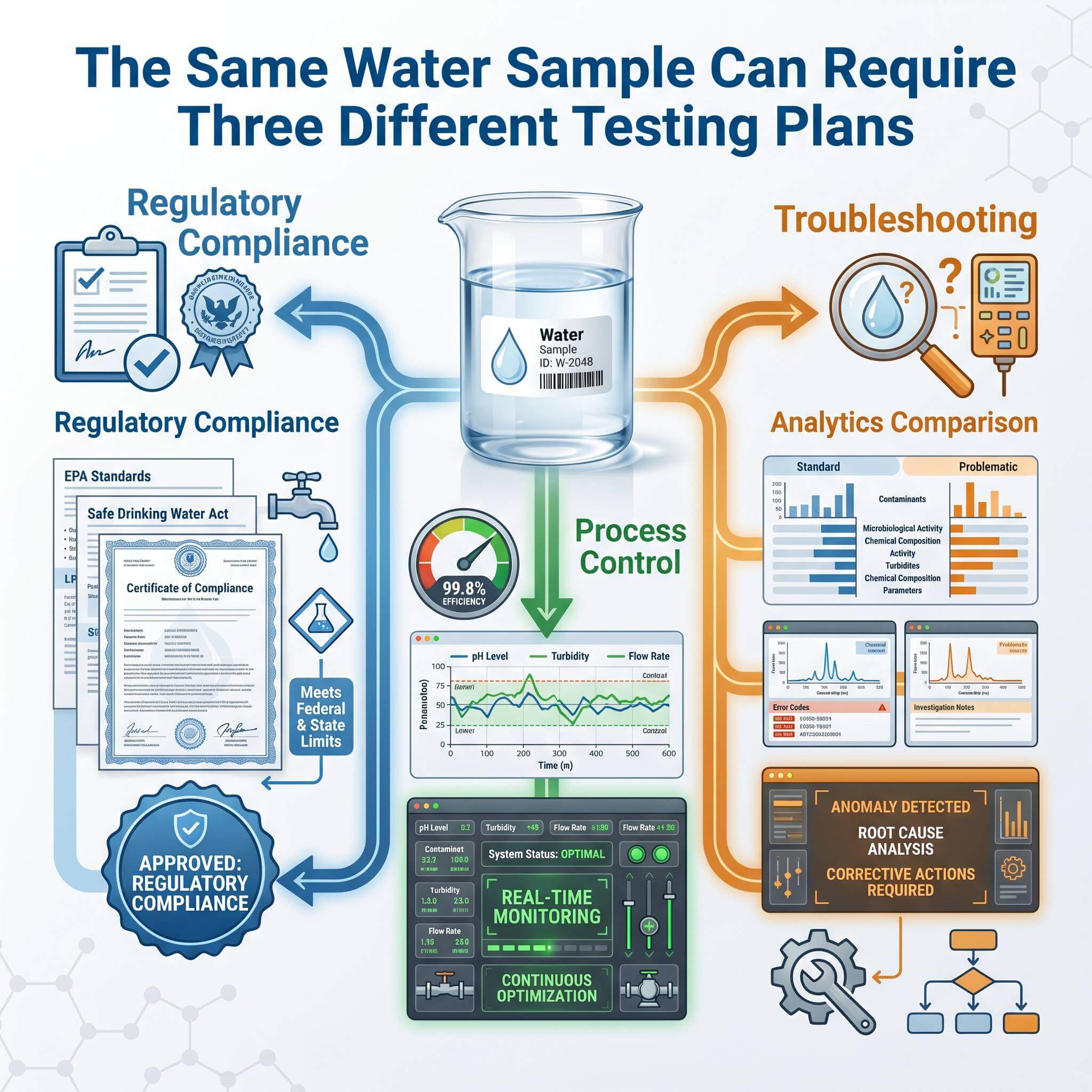
2. Importance of TN in Wastewater Treatment: Process Control and Regulatory Compliance
Total nitrogen is not only an environmental indicator, but also a key operational control parameter. Its main roles include:
Evaluation of nitrogen removal efficiency: Quantifying the overall removal performance of biological denitrification (nitrification–denitrification) or advanced processes such as anammox.
Early warning of eutrophication risk: A key predictor of algal bloom potential in receiving waters which is often evaluated together with total phosphorus (TP).
Process optimization: Monitoring TN and its components at different treatment stages (e.g., anaerobic, anoxic, aerobic tanks) helps optimize internal recycle ratios, external carbon dosing, and aeration intensity.
Ensuring regulatory compliance: Many discharge standards worldwide impose strict TN limits. For example, China’s Discharge Standard of Pollutants for Municipal Wastewater Treatment Plants (GB 18918-2002) specifies a Class 1A limit of TN ≤ 15 mg/L. Under such regulations, TN data are directly used to:
ü Demonstrate compliance with discharge permits
ü Evaluate the effectiveness of plant upgrades and retrofits
ü Support environmental impact assessment (EIA) reports
Because of its regulatory importance, TN analysis must be accurate, reproducible, and fully documented.
3. Measurement Principles and Methods for Total Nitrogen (Based on Alkaline Persulfate Digestion and Spectrophotometric Detection)
Accurate TN determination relies on completely converting all nitrogen species in the sample into a single, measurable form. This section focuses on the alkaline persulfate oxidation–spectrophotometric method, widely used in wastewater analysis.
3.1 Core Measurement Principle
This method consists of two main steps:
Step 1: High-Temperature, High-Pressure Digestion and Oxidation: Under strongly alkaline conditions (pH > 12), potassium persulfate decomposes at 120–124 °C in a sealed digestion system, producing highly reactive sulfate radicals and atomic oxygen. These oxidizing species completely convert all nitrogen forms—organic nitrogen, ammonia, and nitrite—into nitrate nitrogen (NO₃⁻). This step is critical to ensure that the result represents total nitrogen rather than partial nitrogen.
Step 2: Reduction and Colorimetric Determination: After digestion, nitrate is quantitatively reduced to nitrite under acidic conditions using a reducing agent (e.g., a zinc–cadmium reduction column or hydrazine hydrochloride). The resulting nitrite reacts with sulfanilamide to form a diazonium salt, which then couples with N-(1-naphthyl)-ethylenediamine (or similar reagents) to produce a purple-red azo dye. This dye has a maximum absorbance at approximately 540 nm. Measuring the absorbance with a spectrophotometer allows quantitative determination of total nitrogen concentration.
* Engineering focus:
Since the final measurement is based on nitrite, the efficiency and stability of the reduction step are critical. Reduction column activity or reagent effectiveness must be checked regularly. Reaction acidity, temperature, and color development time must be strictly controlled to ensure reproducibility.
3.2 Comparison with Other TN Measurement Methods
l UV digestion–colorimetric methods: Commonly used in online analyzers. UV radiation catalyzes persulfate oxidation, followed by automated color development and photometric detection.
l High-temperature combustion–chemiluminescence: Provides complete oxidation and high accuracy for complex matrices (high salinity, high organic content), but involves expensive instruments and high maintenance requirements. Typically used in laboratories and research applications.
4. Sources, Applications, and Regulatory Context of Total Nitrogen
4.1 Sources of TN in Wastewater
Total nitrogen mainly originates from:
u Domestic wastewater (human waste, detergents)
u Industrial effluents (food processing, chemical and fertilizer industries)
u Agricultural runoff (urea, ammonium salts, organic nitrogen)
u Decomposition of organic matter
The relative proportions of ammonia, nitrate, and organic nitrogen depend on wastewater characteristics and treatment stage.
4.2 Typical Applications and Regulatory Compliance
TN measurement is widely applied in:
ü Municipal and industrial wastewater treatment plants: For process control and compliance monitoring at discharge points. TN data are used to:
u Demonstrate permit compliance
u Evaluate the necessity and effectiveness of plant upgrades
u Support environmental impact assessments
ü Surface water and reservoir monitoring: TN is a core indicator for assessing nutrient status and eutrophication risk.
ü Process optimization and research: Precise TN and nitrogen species data support optimization of BNR processes, including C/N ratio, sludge age, and recycle ratios.
Because TN data are directly linked to regulatory compliance and legal responsibility, accuracy, reproducibility, and complete documentation are essential. Analytical errors may lead to non-compliance risks, incorrect operational decisions, or misjudgment of environmental impacts.
5. Sample Pretreatment and Digestion: The Foundation of Accurate TN Data
For wastewater samples, proper pretreatment and digestion are critical:
l Homogenization: Samples must be thoroughly mixed. For samples containing suspended organic nitrogen (e.g., mixed liquor), homogenization or grinding may be required.
l Interference control: Metal ions, turbidity, and color can interfere with colorimetric detection. Blank corrections and, if necessary, distillation or precipitation pretreatment should be applied.
l Digestion completeness verification: Certified reference materials (CRMs) and matrix spike recovery tests should be used regularly. Acceptable recovery typically ranges from 95% to 105%.
6. Engineering Interpretation and Practical Use of TN Results
6.1 TN Profile Along the Treatment Process
Trend analysis across the entire process is more informative than single-point measurements:
l Influent: High TN load, often dominated by organic nitrogen and ammonia.
l Biological treatment units:
u Anaerobic/anoxic zones: Significant TN reduction is expected due to denitrification. Poor removal may indicate insufficient carbon, inadequate anoxic conditions, or short sludge age.
u End of aerobic zone: TN stabilizes, dominated by nitrate. High ammonia suggests incomplete nitrification.
l Secondary clarifier effluent / final effluent: TN directly reflects overall denitrification performance and compliance risk. High nitrate with low ammonia indicates good nitrification but insufficient denitrification.
6.2 TN-Based Operational Decisions
l Carbon source dosing: Using TN and NO₃⁻-N data together with influent C/N ratio allows precise calculation of external carbon dosing (e.g., acetate, methanol), reducing energy and chemical costs.
l Internal recycle ratio (IRR) optimization: TN trends help evaluate the effectiveness of returning nitrified liquor from aerobic to anoxic zones.
7. Recommended Instrument Configuration and Selection Considerations
Reliable TN analysis depends on the combination of method, instrumentation, and operator competence.
Laboratory Core Configuration
1.Dedicated digestion system: High-temperature, high-pressure digester with accurate temperature control (±0.5 °C), minimal well-to-well variation, pressure protection, and timer functions. Batch capacity (e.g., 25 or 50 positions) should match daily sample volume.
2.Visible spectrophotometer or dedicated water quality analyzer: Since the colorimetric reaction is measured at ~540 nm, the instrument must provide stable light sources, low stray light, and automatic zeroing. Intelligent multi-parameter analyzers with preprogrammed calibration curves and data storage are recommended to reduce human error.
Online Monitoring Considerations
ü Application: Suitable for real-time process control (e.g., carbon dosing) or continuous compliance monitoring at critical discharge points.
ü Key selection criteria: For colorimetric online analyzers, the reliability of oxidation/reduction units, flow path design, anti-clogging capability, maintenance frequency, reagent consumption, and failure rate are decisive factors.
Quality Control Equipment
ü Calibrated balances and pipettes
ü Certified TN standard solutions covering multiple concentration ranges
8. Common Engineering Issues and Troubleshooting
Abnormally Low Results
l Incomplete digestion or reduction: check temperature, time, and reagent activity
l Color development failure: verify reagent freshness and reaction conditions
l Invalid calibration curve: prepare fresh standards
Abnormally High or Unstable Results
l Contamination: clean cuvettes, digestion tubes, and flow paths
l Background interference: correct for sample color or turbidity
l Improper sampling or preservation: samples should be acidified to pH < 2 with sulfuric acid, stored at 4 °C, and analyzed promptly
9. Conclusion
Total nitrogen (TN) is a comprehensive and authoritative indicator for evaluating denitrification performance and environmental impact in wastewater treatment plants. Accurate TN determination using spectrophotometric methods requires a deep understanding of the three critical chemical transformations—oxidation, reduction, and color development.
Beyond meeting regulatory requirements, proper TN measurement and interpretation enable refined process control, energy savings, and stable plant operation. Engineers should view TN analysis not as a simple laboratory number, but as a complete technical system encompassing representative sampling, standardized pretreatment, complete chemical conversion, precise photometric detection, and intelligent process-based data interpretation. Only by doing so can TN data evolve from laboratory results into powerful decision-making tools for process optimization and environmental protection.
Recommended Total nitrogen (TN) Analyzer Configurations for Wastewater Analysis
Based on practical engineering requirements in municipal and industrial wastewater analysis, the following benchtop and portable instrument configurations are commonly adopted: