+852 46135220

In water quality testing, people often ask a seemingly simple question:
What is the best water quality parameter for to measure?
At first glance, this sounds like a technical question about analytical importance, instrument capability, or regulatory relevance. But in practice, the answer is rarely universal.
There is no single “best” water quality parameter in every situation. A parameter is only “best” when it helps laboratory personnel, operators, engineers, or plant managers make the next practical decision with confidence. This is an important distinction.
In real water testing environments, parameters are not measured simply because they are scientifically interesting. They are measured because someone needs to decide what to do next:
l Adjust chemical dosing
l Investigate an abnormal discharge
l Confirm treatment efficiency
l Trigger maintenance
l Escalate a compliance issue
l Continue routine monitoring without intervention
That is why the value of a water parameter cannot be separated from the decision that follows it.
In other words: The usefulness of a parameter depends not only on what it reveals about the water, but also on what decision it enables people to make next.
In practice, this question is relevant across many application scenarios, including wastewater treatment plants, municipal drinking water systems, industrial process water monitoring, aquaculture, and environmental laboratories. In all of these settings, selecting the right water quality parameter is not just an analytical issue. It is a decision-making issue.
A Common Misunderstanding in Water Testing
Many discussions about water analysis assume that parameters have fixed and permanent importance. For example:
l COD is often regarded as a “key” pollution parameter
l Ammonia is often seen as an important wastewater indicator
l Turbidity is widely recognized in drinking water applications
l Conductivity is often used as a general indicator of dissolved ions
l Nitrate and phosphate are important in nutrient monitoring
l Heavy metals are considered highly important for environmental safety
l Emerging pollutants are receiving increasing attention in scientific and regulatory discussions
All of these may be true. But importance alone does not determine routine testing priority.
A parameter may be scientifically meaningful, environmentally relevant, or even regulated, but still not be the most useful parameter for a specific operational decision.
Likewise, a parameter that appears relatively simple or indirect may be the most valuable one in daily practice because it helps people respond quickly and consistently. This is exactly where many selection mistakes begin.
Organizations sometimes choose parameters based on:
u Theoretical completeness
u Broad public concern
u Marketing claims
u Instrument capability
u Or the belief that “more information is always better”
But routine testing does not work that way. The purpose of routine water analysis is not to collect every possible data point. Its purpose is to support timely and repeatable decisions.
That means parameter selection should begin with a more practical question: What decision needs to be made after this result is generated? Only then can it be determined whether a parameter is truly useful in that context.
What Is Parameter Priority in Routine Water Testing?
Parameter priority refers to the process of deciding which water quality parameters should be measured first, how often they should be tested, and which results are most useful for operational control, compliance, or investigation. In routine water analysis, parameter priority is not determined only by scientific importance. It is determined by how strongly a result supports the next monitoring, treatment, or management decision.
The Real Role of a Water Parameter
A water parameter is not just a number. It is part of a decision system. Every measured parameter plays one or more of the following roles:
1. Screening
Some parameters are used to quickly indicate whether something may be wrong. Examples: conductivity for changes in dissolved salts, turbidity for solids or filtration performance, and pH for abnormal chemical conditions. These parameters are valuable because they provide rapid warning, not because they explain everything.
2. Process Control
Some parameters directly support operational adjustment. Examples: residual chlorine for disinfectant dosing, pH for coagulation or neutralization control, and dissolved oxygen in biological treatment systems. These are often the most useful parameters because operators can take immediate action based on the result.
3. Performance Verification
Some parameters confirm whether treatment or process goals are being achieved. Examples: COD removal across treatment stages, ammonia removal efficiency, and turbidity reduction after clarification or filtration. These parameters support performance evaluation and trend monitoring.
4. Compliance Confirmation
Some parameters are measured mainly because they are required by internal standards, discharge permits, or regulations. Examples: BOD, total phosphorus, heavy metals, and microbiological indicators. These may be essential, but their decision value depends on how directly they influence the next action.
5. Investigation
Some parameters become most useful only after an abnormal result, complaint, process upset, or contamination event occurs. Examples: specific heavy metals, toxic organics, advanced nutrient speciation, trace contaminants, and emerging pollutants. These parameters are often very important in the right context, but they may not be suitable for routine high-frequency monitoring. That’s why some water parameters never belong in routine analysis.
Together, these roles show that a water quality parameter should not be judged only by analytical importance, but by its relevance to screening, process control, performance monitoring, compliance, and investigation.
So when someone asks which parameter is “best,” the better question is: Best for which role? And best for which next decision?
Why Decision Context Changes Everything
The same parameter can be highly valuable in one system and much less useful in another.
Let us look at a few examples.
1.COD: Useful When the Next Decision Is About Organic Load or Treatment Burden
COD is often one of the most useful routine wastewater parameters because it provides a rapid indication of organic pollution strength. If the next decision involves whether influent loading is increasing, whether treatment performance is changing, whether a discharge trend needs attention, or whether further investigation is required, then COD may be an excellent parameter.
But COD is not always the best parameter. If the next decision is about biological nitrogen removal, nitrification stability, or disinfection performance, COD alone may not provide the most relevant answer. Its usefulness depends on the action that follows.
2.pH: Simple but Operationally Powerful
Compared with more complex chemical analyses, pH may seem basic. But in many systems, it is one of the most decision-relevant parameters.
Why?
Because the next decision is often immediate: Should acid or alkali dosing be adjusted? Is the coagulation chemistry likely to function properly? Is the process moving outside safe operating conditions? Is the water suitable for the next treatment step? In these situations, pH may be far more useful than a more “advanced” parameter that takes longer to measure and does not directly trigger action.
3.Turbidity: Highly Valuable When the Decision Involves Physical Water Quality or Filtration
Turbidity is especially useful when the decision involves filtration performance, solids breakthrough, clarification efficiency, or disinfection reliability. It is not a complete picture of water quality, but it is highly actionable. This makes it a strong routine parameter in many applications.
4.Ammonia: Critical When the Question Involves Process Biology or Wastewater Contamination
Ammonia is especially valuable when operators need to decide whether nitrification is stable, whether wastewater contamination is present, whether biological treatment is underperforming, or whether nutrient control needs adjustment.
But in a different context, ammonia may not be the first priority. Again, no parameter is inherently the “best” in every monitoring context. It becomes the best when it supports the next important decision.
5.Heavy Metals: Important, but Not Always Routine
Heavy metals may be critical for environmental safety and compliance. But in many routine monitoring systems, they are not tested daily or even weekly.
Why?
Because in many cases, the next operational decision does not come from continuous heavy metal data. These analyses may be slower, more expensive, and less directly connected to day-to-day process control. That does not make them unimportant. It means their strongest role is often in compliance, risk control, or investigation — rather than in daily routine adjustment.
These examples show an important principle in water quality monitoring: a parameter may be highly important without being a high-frequency routine parameter. Some parameters are best suited for daily control, while others are more valuable for periodic verification, regulatory reporting, or targeted investigation.
Water Parameters and the Decisions They Commonly Support
Examples:
l COD: Helps assess organic loading, treatment burden, and discharge trend changes
l Ammonia: Helps evaluate nitrification performance, wastewater contamination, and biological treatment stability
l pH: Supports dosing adjustment, coagulation control, neutralization, and process safety
l Turbidity: Helps verify filtration performance, solids breakthrough, and clarification efficiency
l Conductivity: Supports screening for dissolved salt changes, industrial contamination, or source water shifts
l Residual Chlorine: Helps control disinfection performance and distribution safety
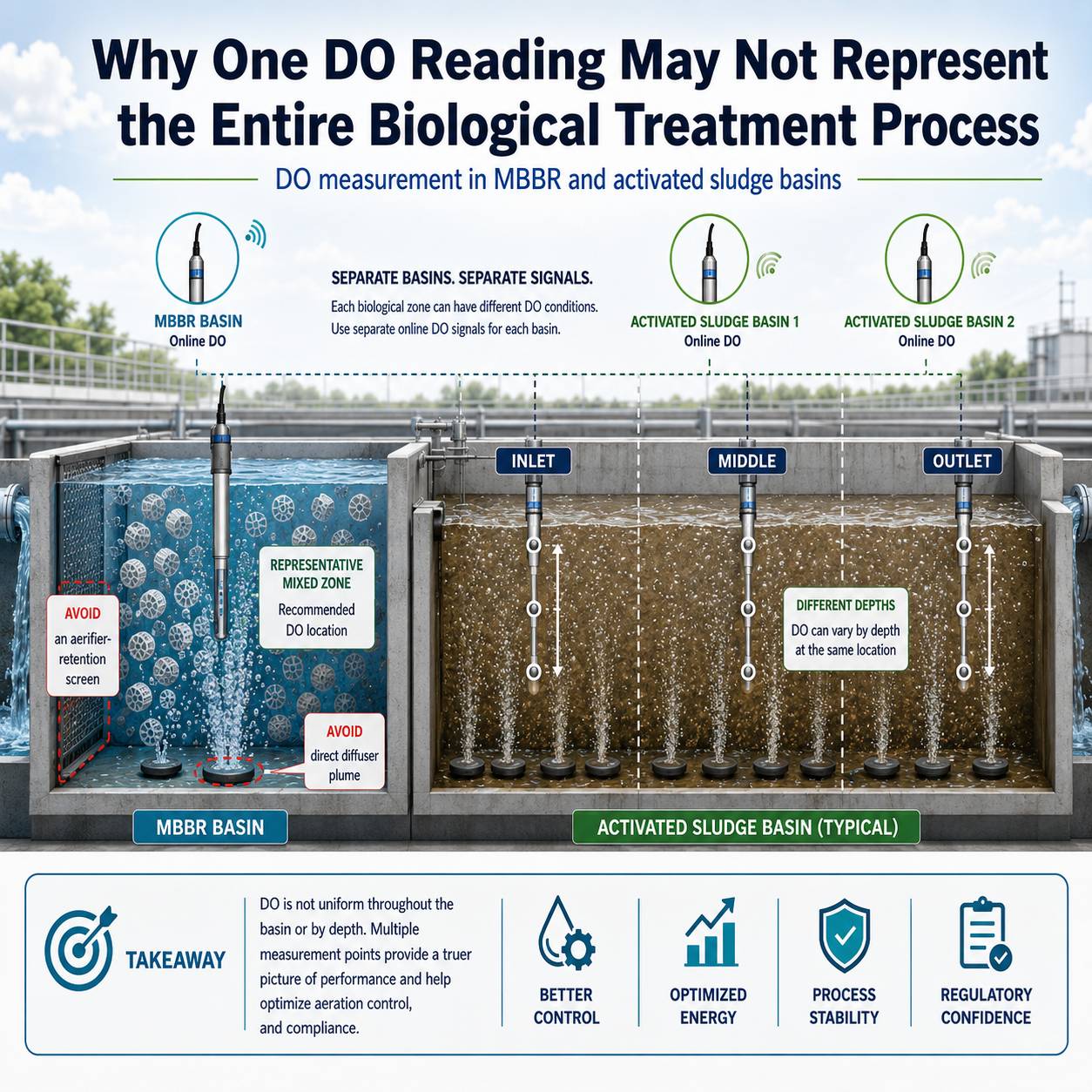
l Dissolved Oxygen: Supports aeration control and biological treatment optimization
l Phosphate / Nitrate: Helps assess nutrient loading, nutrient removal, and eutrophication-related monitoring priorities
The Difference Between Informative and Actionable
One of the biggest mistakes in water testing strategy is confusing informative parameters with actionable parameters. A parameter may provide useful information, yet still have limited practical value in daily operation.
For example, it may:
l Confirm a problem only after the process has already been affected
l Be too slow to support timely intervention
l Require expensive or specialized testing resources
l Fail to clearly indicate what action should follow
l Add detail without improving decision quality
By contrast, actionable parameters help answer questions such as:
u Should we intervene now?
u Should we adjust the process?
u Should we repeat the test?
u Should we escalate the issue?
u Should we investigate further?
u Can we continue operating normally?
This distinction matters because routine testing programs are built around repeatability, comparability, and responsiveness.
A parameter that produces elegant data but does not improve the next decision is often less valuable in routine practice than a simpler parameter that reliably supports action. That is why the “best” parameter is often not the most complex or the most comprehensive one. It is the parameter that improves decision quality at the right time.
Why Different Water Systems Need Different “Best” Parameters
There is no universal ranking of water parameters because different systems operate under different decision structures.
Municipal Drinking Water Systems
Here, the next decision often involves treatment adjustment, filtration performance, disinfectant control, distribution stability, and regulatory compliance. Therefore, parameters such as turbidity, pH, residual chlorine, conductivity, and selected microbiological indicators often have strong operational value.
Wastewater Treatment Plants
Here, the next decision is often about organic loading, biological treatment performance, nutrient removal, discharge control, or process upset detection. As a result, routine priority often centers on COD, ammonia, nitrate, phosphate, pH, dissolved oxygen, and suspended solids, because these parameters are closely linked to operational action.
Industrial Water Systems
In industrial environments, the next decision may relate to scaling risk, corrosion control, process contamination, cooling or boiler performance, or discharge consistency. This means conductivity, pH, hardness, alkalinity, silica, dissolved oxygen, or selected process-specific indicators may be more important than the parameters that dominate environmental monitoring.
Environmental Monitoring Programs
In these systems, decisions may focus more on trend tracking, pollution source identification, ecological impact, watershed changes, or permit compliance. This may require a broader mix of routine indicators and targeted investigative parameters.
The key point is simple:
The best parameter depends on the operational question the system needs to answer next.
Why This Matters for Instrument Selection
This topic is not only about parameter strategy. It also affects instrument selection.
Many buyers begin with questions such as:
l Which analyzer is the most advanced?
l Which instrument can test the most parameters?
l Which method has the broadest capability?
But these are not always the right starting points. If the selected parameters are not aligned with the most important decisions, even a technically capable instrument may deliver poor practical value. For example:
u A multi-parameter platform may look attractive, but only a few of those parameters may be truly actionable in daily operation
u A spectrophotometer may offer broad flexibility, but for fixed routine parameters, a photometer may be more efficient
u A highly sophisticated method may generate more data, but not necessarily better routine decisions
u If fast on-site action matters most, a portable meter may be more useful than a complex benchtop system
That is why parameter priority should often come before instrument selection. The right water testing instrument is not the one with the longest specification sheet. It is the one that supports the most important decisions with sufficient speed, consistency, and practicality.
So, how industrial water laboratories should really choose their instruments? For buyers, distributors, and laboratory managers, this means that instrument selection should begin with decision-critical parameters, not with the longest feature list. A testing system creates more value when it supports the most frequent and most important operational decisions reliably.
A Better Framework for Choosing Routine Parameters
Instead of asking, “Which parameter is best?”, laboratories and operators can ask a more useful set of questions:
1. What decision will this result support?
If there is no clear next decision, the value of routine testing should be questioned.
2. How quickly is the result needed?
A parameter may be important, but if the result arrives too late, its operational value may be limited.
3. Does the result trigger a clear action?
Good routine parameters should support an obvious next step, even if that step is simply further investigation.
4. Is the parameter stable and repeatable enough for trend monitoring?
Routine monitoring depends heavily on consistency.
5. Does it improve decision quality enough to justify the testing burden?
This includes cost, labor, reagent use, training, maintenance, and waste handling.
6. Is it a routine control parameter, a compliance parameter, or an investigative parameter?
These are not the same, and they should not automatically be treated as if they belong to the same testing frequency. This framework helps shift parameter selection away from habit and toward decision-driven logic.
Common Mistakes When Choosing Water Quality Parameters
Include:
u Selecting parameters because they are popular rather than decision-relevant
u Over-prioritizing analytical breadth instead of operational usefulness
u Treating compliance parameters and routine control parameters as if they serve the same purpose
u Choosing instruments before defining parameter priority
u Adding low-actionability parameters to routine programs without a clear response plan
These mistakes often increase testing burden without improving monitoring quality or operational response.
The Strategic Value of Fewer, Better-Chosen Parameters
Many strong routine testing programs do not succeed because they measure everything.
They succeed because they measure the right things for the right decisions. A smaller, carefully selected set of parameters often performs better than a broad but poorly prioritized test menu.
Why?
Because fewer, decision-relevant parameters usually lead to:
ü Faster response
ü Better trend interpretation
ü Higher testing consistency
ü Lower operational burden
ü Clearer escalation logic
ü Stronger integration between laboratory data and operational action
This is also why many real laboratories rely heavily on a core group of parameters. Not because other parameters are unimportant, but because day-to-day control depends on those measurements that can repeatedly guide the next action.
In practice, the strongest routine testing programs are built on decision efficiency, not information volume.
Conclusion
The “best” water parameter is not universal. It is contextual. It depends on what happens after the result is generated.
u If the next step is process adjustment, one parameter may be the best.
u If the next step is compliance verification, another may matter more.
u If the next step is investigation, a completely different parameter may become relevant.
That is why water testing should not begin with the question:
What can we measure?
It should begin with the question:
What decision are we trying to support next?
Once that is clear, parameter priority becomes much more rational. And once parameter priority becomes rational, instrument selection, testing frequency, and monitoring strategy also become much more effective.
In routine water quality testing, the best parameter is the one that improves decision speed, response quality, and monitoring efficiency. This is why parameter selection should always be linked to treatment goals, operational priorities, regulatory needs, and investigation pathways rather than to analytical complexity alone.