+852 46135220

In engineering sites and routine laboratory analysis, water that appears visually clear is often easy to trust. It has no visible particles, no obvious color, and no suspended foam. Intuitively, it may seem suitable for drinking, process production, discharge, irrigation, aquaculture, or industrial reuse.
But in real water quality testing, clear appearance is only a visual observation. It does not confirm that the water is chemically stable, microbiologically safe, properly treated, or suitable for a specific application. Therefore, clear water still needs to be tested.
In practical water quality testing, the first parameters for clear water are usually not the most advanced ones, but the most decision-relevant ones. For most routine applications, pH, conductivity, turbidity, temperature, and application-specific indicators such as residual chlorine, COD, ammonia nitrogen, dissolved oxygen, hardness, alkalinity, nitrate, or phosphate should be prioritized according to the water source and intended use.
For engineers and technical personnel, the more important question is not simply: “Does the water look clear?”
A better question is: “Which parameters should be tested first to confirm that the water quality is truly under control?”
In routine water analysis, parameter selection is just as important as the test result itself. Testing too few parameters may miss important risks. Testing too many parameters without a clear purpose may waste time, increase cost, and create confusing data.
So, when water looks clear, which parameters should come first?
1. Clear Water Does Not Mean Clean Water
Visual appearance is only one part of water quality evaluation. Clear water usually means that there are no obvious suspended solids, color, foam, or floating materials visible to the naked eye. However, many important water quality problems cannot be seen directly.
For example, clear water may still contain:
l Dissolved salts, such as Ca²⁺, Mg²⁺, Cl⁻, and SO₄²⁻
l Nutrient-related factors, such as NH₃-N, NO₃⁻-N, and PO₄³⁻-P
l Refractory dissolved organic matter, often indicated by COD or TOC
l Residual chlorine or disinfection by-products
l Trace heavy metals, such as Pb, Cu, and Cr⁶⁺
l Microbial populations, including bacteria, viruses, and parasitic oocysts
l Process-related impurities, such as silica, oil, iron, and manganese
In applications such as drinking water safety, upgraded wastewater discharge standards, industrial boiler feedwater, circulating cooling water, aquaculture, and electronic-grade ultrapure water, it is not uncommon for a visually clear sample to exceed a key parameter limit and cause serious operational problems or compliance failures.
This is why water quality testing should not start from appearance alone. It should start from the application, the possible risks, and the decision that needs to be made after testing.
2. The First Question: What Is the Water Used For?
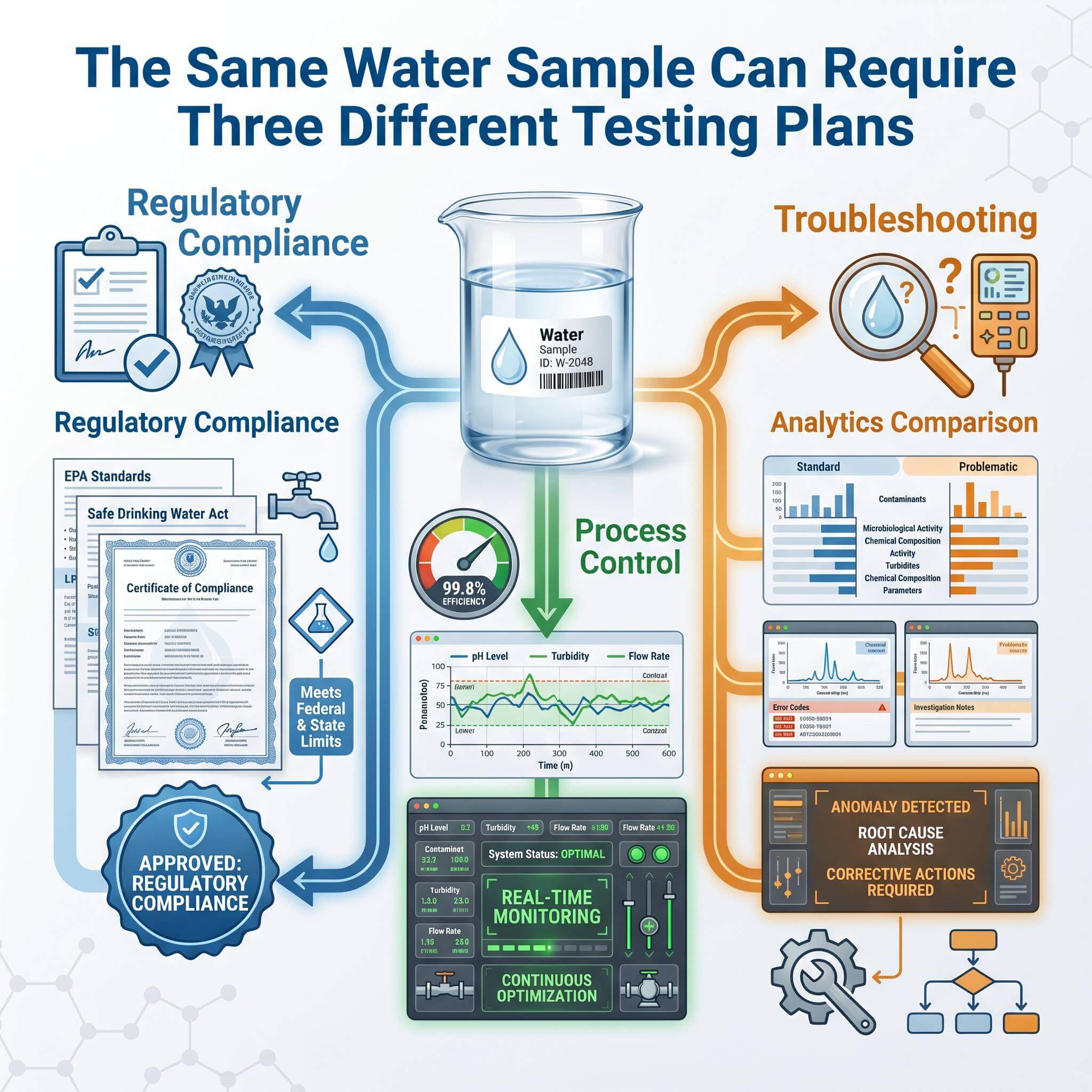
There is no universal “best” parameter for all water testing situations. Parameter priority means selecting the first group of tests according to the water application, the most likely risk, and the decision that the operator needs to make. It is not simply a list of common parameters, but a practical testing logic.
Parameter priority depends on the risk exposure pathway and control requirements of a specific water application. Engineers should first clarify the application:
l Drinking water → hygiene safety and sensory compliance
l Wastewater treatment → biological treatment efficiency and discharge compliance
l Industrial process water → scaling, corrosion, and process contact safety
l Cooling water / boiler water → deposit control, metal protection, and concentration management
l Aquaculture water → survival limits and growth environment for aquatic organisms
l Swimming pool water → disinfection effectiveness and public health protection
l Pure water / ultrapure water → contamination thresholds of ions and organic matter affecting production lines or experiments
This means clear water should not always be tested in the same way. A clear drinking water sample, a clear treated wastewater sample, and a clear cooling water sample may look similar, but their testing priorities are very different.
3. Basic Water Quality Screening Parameters: The First Layer of Routine Testing
For many routine water quality testing applications, several basic parameters are usually tested first because they provide a quick overview of water condition.
In many routine water testing programs, the first screening layer usually includes:
n pH — to check acidity, alkalinity, corrosion risk, biological suitability, and disinfection conditions
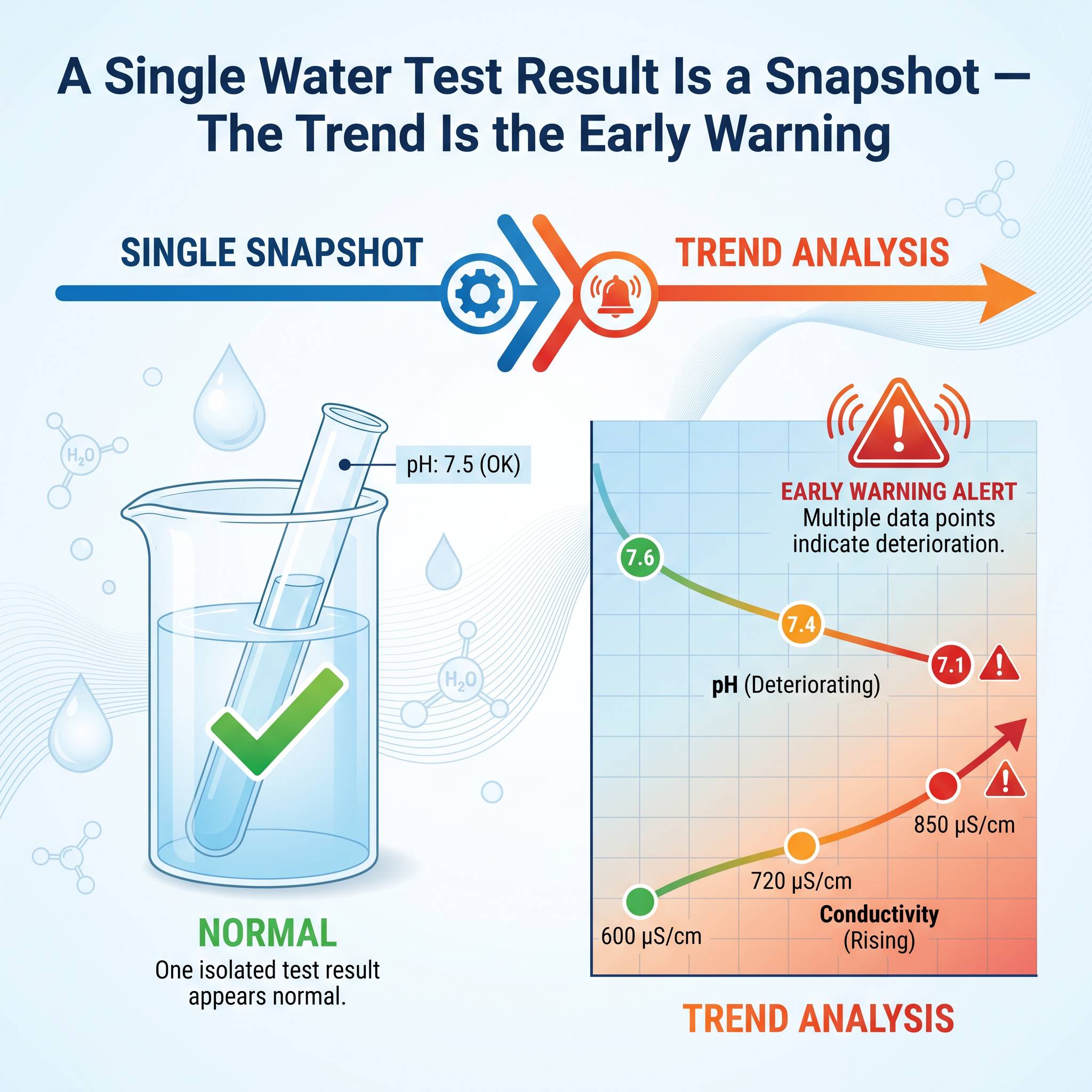
n Conductivity — to screen changes in dissolved ionic content
n Turbidity — to detect suspended or colloidal particles that may not be obvious visually
n Temperature — to support interpretation of pH, DO, conductivity, and biological activity
(1)pH
pH is one of the most common water quality parameters because it affects chemical reactions, disinfection efficiency, biological activity, corrosion, scaling, and treatment performance. Clear water can still be too acidic or too alkaline.
A pH result outside the expected range may indicate:
u Chemical dosing problems
u Process instability
u Contamination
u Corrosion risk
u Poor biological treatment conditions
u Reduced disinfection performance
However, pH should not be interpreted as a simple “good or bad” number. The correct pH range depends on the application. For drinking water, swimming pools, wastewater treatment, aquaculture, and industrial water, the acceptable pH range may be different. That’s why pH is one of the most misunderstood parameters in routine water testing.
(2)Conductivity
Conductivity measures the ability of water to conduct electricity, which is mainly related to dissolved ions. Clear water may still have high conductivity because dissolved salts are not visible.
Conductivity helps identify:
u Changes in dissolved ion concentration
u Possible contamination
u Saltwater intrusion
u Industrial carryover
u Process water changes
u Pure water system instability
In routine testing, conductivity is often used as a quick screening parameter. It cannot tell you exactly which ions are present, but it can show whether the total dissolved ionic content has changed.
(3)Turbidity
Turbidity measures the cloudiness of water caused by suspended particles. Even if water looks clear, low-level turbidity may still be present. This is important in drinking water, filtration systems, surface water, swimming pools, and treated wastewater.
Turbidity may indicate:
u Incomplete filtration
u Suspended solids
u Colloidal particles
u Poor settling
u Changes in treatment process
u Possible microbial protection in particle-rich water
Turbidity is especially important because some particles may not be obvious through visual inspection but can still affect treatment performance or compliance.
(4)Temperature
Temperature is sometimes treated as a basic supporting parameter, but it can strongly affect pH, dissolved oxygen, conductivity, chemical reaction rates, and biological activity.
In aquaculture, wastewater treatment, and industrial water systems, temperature changes can directly affect system performance. Therefore, temperature is not only a recorded value. It is also a related variable that helps explain changes in other parameters and should be collected together with other indicators.
4. Drinking Water: Clear Appearance Alone Is Not Enough to Ensure Safety
Drinking water is one of the most important examples where clear water still needs testing.
Drinking water safety cannot be judged visually. Even if a water sample is colorless and odorless, it may still contain chemical risks, such as nitrate and heavy metals, or biological risks.
For routine drinking water monitoring, the first group of parameters usually includes: pH, Turbidity, Conductivity, Residual chlorine or other disinfectant residual, Ammonia nitrogen, Nitrate, Nitrite, Iron and manganese, Microbiological indicators. These parameters are useful for routine screening, but they do not replace a complete drinking water safety program. Depending on local regulations and water source risk, additional tests such as microbiological analysis, heavy metals, pesticides, volatile organic compounds, or other regulated contaminants may still be required.
Why Residual Chlorine Matters
In many drinking water systems, residual chlorine is used to confirm that disinfection protection remains in the distribution network. Clear water without enough disinfectant residual may still be vulnerable to microbial contamination. Excessive residual chlorine can also affect taste, odor, and user acceptance. Therefore, in drinking water testing, visual clarity cannot replace disinfection monitoring.
Why Nitrate and Ammonia Nitrogen Matter
Nitrate and ammonia nitrogen are invisible in water, but they can indicate pollution sources, treatment problems, or changes in source water. In some systems, ammonia nitrogen can also interfere with chlorination or indicate biological activity. This is why nutrient-related parameters may still be important even when water looks very clear.
5. Wastewater: Treated Water May Look Clear but Still Fail Key Parameters
In wastewater treatment, clear effluent is not always compliant effluent. A treated wastewater sample may look visually acceptable after sedimentation, filtration, or biological treatment but still contain high levels of COD, ammonia nitrogen, phosphate, nitrate, or suspended solids.
For routine wastewater testing, common priority parameters include: COD, BOD, Ammonia nitrogen, Total nitrogen or nitrate, Phosphate or total phosphorus, pH, Suspended solids or turbidity, Color and Residual chlorine.
COD
COD, or chemical oxygen demand, is one of the most widely used indicators of organic pollution in wastewater. Clear wastewater may still contain invisible dissolved organic compounds. A low-turbidity sample does not always mean low COD. This is why COD remains important in industrial wastewater, municipal wastewater, food processing wastewater, textile wastewater, chemical wastewater, and many other applications.
Ammonia Nitrogen
Ammonia nitrogen is especially important in biological treatment systems. Even if effluent looks clear, ammonia nitrogen may remain high if nitrification is incomplete or unstable.
High ammonia nitrogen may indicate:
u Insufficient aeration
u Low nitrifying bacteria activity
u Toxic shock to the biological system
u Low temperature effects
u pH-related inhibition
u Overloading
For wastewater treatment plants, ammonia nitrogen is often interpreted together with COD because they reflect different aspects of treatment performance.
Phosphate and Nitrogen
Phosphate, nitrate, and total nitrogen are important in nutrient control. If clear water is discharged into natural water bodies, it may still carry nutrients that contribute to eutrophication. Therefore, visual appearance alone is not enough to judge environmental impact.
6. Industrial Water: Clear Water May Still Cause Scaling, Corrosion, or Process Problems
In industrial water systems, the purpose of testing is often not only safety or compliance. It is also about scaling and corrosion control, heat transfer efficiency, chemical dosing balance, product quality, equipment protection and process stability. If the chemical composition is not under control, clear water can still cause serious problems.
For industrial water applications, common priority parameters include: pH, Conductivity, Hardness, Alkalinity, Chloride, Iron, Silica, Dissolved oxygen, Turbidity and Residual chemicals.
Cooling Water: In cooling water systems, clear water may still have high hardness, high chloride concentration, or poor pH control. These conditions can increase the risks of scaling, corrosion, biofouling, heat transfer loss and chemical dosing imbalance.
Boiler Water: Boiler water requires stricter control because even small chemistry problems may cause serious equipment damage. Clear boiler make-up water may still contain dissolved ions, silica, dissolved oxygen, or hardness, which can lead to scaling or corrosion. In this case, conductivity, pH, hardness, silica, dissolved oxygen, and alkalinity may be more important than visual clarity.
Electronics, Pharmaceutical, and Food Process Water: In manufacturing, food processing, electronics, pharmaceutical, and chemical production, water quality affects product quality and process consistency. Clear water may not be suitable if it contains ions, organic residues, microbial contamination, or incompatible chemical components. Therefore, the first parameters should be selected based on process risk, not visual appearance.
7. Aquaculture: Clear Water Does Not Always Mean Healthy Water
Aquaculture water may sometimes appear greenish or clear, but fish or shrimp may still suffer mass mortality. The root cause is often an invisible sharp drop in dissolved oxygen, or the accumulation of ammonia nitrogen and nitrite. Therefore, the main concern is not only whether the water looks clean, but whether the water environment can support aquatic life.
Common priority parameters include: Dissolved oxygen, pH, Ammonia nitrogen, Nitrite, Temperature, Salinity or conductivity, Alkalinity, Turbidity and Nitrate.
Dissolved Oxygen: Clear water can still have very low dissolved oxygen. Low dissolved oxygen is one of the most urgent risks in aquaculture because it directly affects the survival of fish and shrimp.
Ammonia Nitrogen and Nitrite: Ammonia nitrogen and nitrite are major toxic risks in aquaculture systems. They are invisible in water, but they can seriously affect aquatic organisms. A pond, tank, or recirculating aquaculture system may look normal visually while ammonia nitrogen or nitrite is already increasing.
This is why these parameters usually need to be prioritized in aquaculture water testing.
8. Swimming Pools and Recreational Water: Clear Water Can Still Be Unsafe
Swimming pool water is another common example. A pool may look blue and clear, but this does not guarantee adequate disinfection or chemical balance.
Important priority parameters include: Free chlorine or other disinfectant residual, Combined chlorine, pH, ORP, Turbidity, Alkalinity, Cyanuric acid and Microbiological indicators.
Free Chlorine and pH Must Be Read Together: Free chlorine confirms the available disinfectant protection, while pH strongly affects chlorine effectiveness and swimmer comfort. A swimming pool may look clear, but if free chlorine is too low or pH is outside the suitable range, disinfection performance may still be poor.
This is why visual clarity should never be the only control point for recreational water.
9. Pure Water and Ultrapure Water: The Cleaner It Looks, the More Sensitive the Testing Must Be
Pure water and ultrapure water almost always look clear, but high-purity water monitoring requires much more sensitive indicators than visual inspection. In fact, the higher the expected purity of the water, the more sensitive the monitoring needs to be.
For pure water and ultrapure water, common priority parameters include: Conductivity or resistivity, TOC, pH, Silica, Microbial count and Particles.
Conductivity and Resistivity: Conductivity and resistivity are key indicators of ionic contamination. Even a very small amount of dissolved ions can affect high-purity water quality. This is why conductivity or resistivity is usually one of the first parameters tested in pure water systems.
pH in Pure Water: pH measurement in pure water can be difficult because low-ionic-strength samples are unstable and easily affected by carbon dioxide absorption, electrode response, and measurement technique. So pH is still useful, but it must be measured and interpreted carefully.
10. The Right First Parameters Depend on the Decision You Need to Make
This is the principle of decision-based water testing: parameters should be selected according to the decision they support, not only according to how many tests an instrument can perform.
A common mistake in routine water quality testing is asking: “How many parameters can this instrument test?”
A better question is: “Which parameters can help me make the next correct decision?”
For example:
u To confirm chlorination safety → free residual chlorine + pH
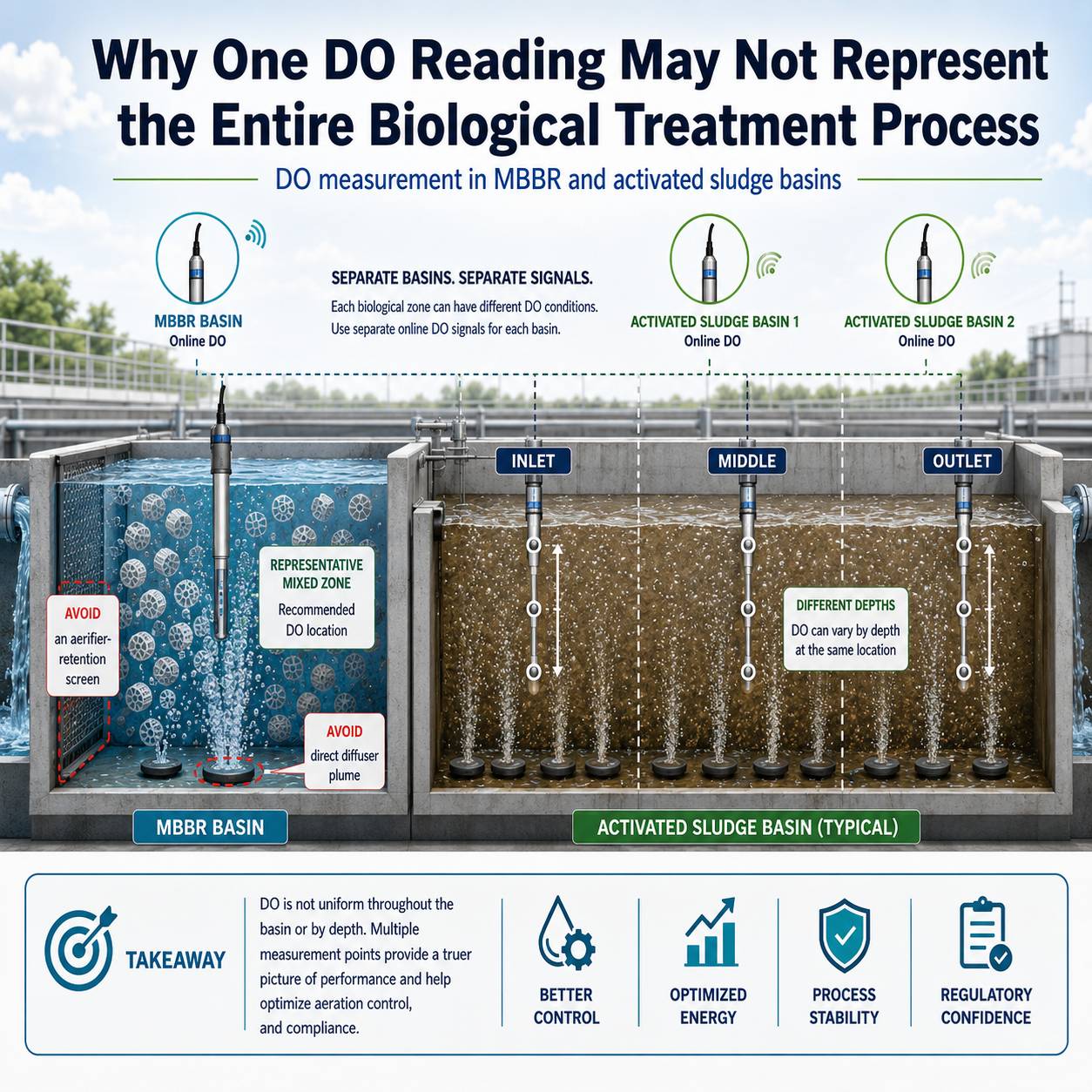
u To check biological treatment efficiency → COD / ammonia nitrogen + DO
u To evaluate cooling water scaling tendency → pH + conductivity + calcium hardness + alkalinity + chloride
u To provide early warning for aquaculture ponds → DO + pH + ammonia nitrogen + nitrite + water temperature
u To protect a pure water system → online resistivity + laboratory or online TOC
11. A Practical Framework for Choosing the First Parameters
When water looks clear but still needs testing, the following framework can help.
Step 1: Identify the Application
First, clarify what the water is used for.
Step 2: Identify the Main Risk
Then identify whether the main risk is microbial, chemical, organic pollution, nutrient pollution, corrosion, scaling, process contamination, poor disinfection, or equipment damage.
Step 3: Select First-Level Screening Parameters
For many applications, first-level screening may include: pH, Conductivity, Turbidity and Temperature. These parameters provide a quick overview of water condition.
Step 4: Add Application-Specific Parameters
Then add parameters according to the application.
Application | First Parameters to Check | Main Purpose |
Drinking water | pH, turbidity, residual chlorine, conductivity, ammonia nitrogen, nitrate | Safety, disinfection control, and source water change |
Wastewater | COD, ammonia nitrogen, phosphate, nitrate, pH, turbidity | Treatment efficiency and discharge compliance |
Cooling water | pH, conductivity, hardness, alkalinity, chloride, iron | Scaling, corrosion, and concentration control |
Aquaculture | Dissolved oxygen, pH, ammonia nitrogen, nitrite, temperature, salinity | Fish or shrimp survival and growth environment |
Swimming pool | Free chlorine, combined chlorine, pH, ORP, turbidity, alkalinity | Disinfection performance and swimmer safety |
Pure water | Conductivity/resistivity, TOC, pH, silica, microbiological indicators | Ionic, organic, and microbial contamination control |
Step 5: Match the Instrument to the Workflow
After the parameter list is clear, then choose the instrument. This order matters. Instrument selection should follow the testing requirement, not the other way around. A laboratory does not need the most advanced instrument in every situation. It needs an instrument that matches its routine parameters, sample type, operator skill level, accuracy requirement, and reporting needs.
12. Why Testing All Parameters Is Not Always the Best Strategy
When water looks clear but the risk is uncertain, some users may think the safest solution is to test as many parameters as possible. But in routine testing, more parameters do not always lead to better water quality data.
Testing too many parameters may create problems:
u Higher reagent cost
u Longer testing time
u More operator workload
u More calibration requirements
u Greater difficulty in data interpretation
u Higher risk of unused or misunderstood results
A focused parameter list is often more practical than a large but poorly managed testing program. The goal is not to test everything. That’s why most water laboratories only test 5-8 parameters in routine water analysis.
The goal is to test the parameters that are truly important for the application and the decision.
13. Why Photometer Water Quality Analyzers Are Useful for Many Routine Parameters
Many routine water quality parameters are measured by colorimetric methods, where reagents react with the target substance and produce a color change. A photometer water quality analyzer measures the color intensity and converts it into a concentration result.
Photometer water quality analyzers are commonly used for parameters such as: COD, Ammonia nitrogen, Phosphate, Nitrate, Nitrite, Residual chlorine, Iron, Manganese, Hardness, Silica and Color.
For routine laboratories, a photometer water quality analyzer can be a practical tool because it supports many common water testing parameters with relatively simple operation. However, a photometer water quality analyzer is not a universal solution for every parameter. Parameters such as pH, conductivity, dissolved oxygen, turbidity, and ORP usually require dedicated electrochemical or optical sensors. This makes photometer water quality analyzer especially useful for laboratories that mainly perform routine colorimetric water tests instead of complex full-spectrum analysis.
This is why parameter priority should come before instrument choice in routine water labs.
Conclusion
Clear water still needs testing because many important water quality problems are invisible. But the solution is not always to test more parameters. A better solution is to test the right parameters first.
Clear water should not be judged only by appearance. The first water quality parameters should be selected according to the application, the main risk, and the decision to be made. In many routine situations, pH, conductivity, turbidity, and temperature form the first screening layer, while parameters such as residual chlorine, COD, ammonia nitrogen, hardness, alkalinity, dissolved oxygen, nitrate, phosphate, TOC, or resistivity should be added according to the specific water use.
In water quality testing, visual appearance is only the beginning. Reliable water quality control depends on matching the right parameters, the right methods, and the right instruments to the actual application.
Clear water may look safe. Testing confirms whether it really is.